Showing posts with label IoT. Show all posts

Monday, August 05, 2019

Arizona State University Embeds Sensors Deep into Student Life


The university wants to deploy IoT inside Sun Devil Stadium and on campus to monitor everything from crowd noise to classroom attendance.

OK, Sun Devils, let's see how loud you can scream. Because a number of sensors installed in Sun Devil Stadium are listening.
“We can identify now the loudest cheering section in the stadium,” said Gordon Wishon, chief information officer with Arizona State University, home to the Sun Devils football team. “The next step in that is — once we’re able to deploy our proximity-based sensing technology — we hope to be able to identify the individuals who are seated in those sections, and then ultimately push out some sort of a reward or discount off of a hotdog, or some sort of a reward.”
The project to measure stadium noise is but one small — and you might say whimsical — pilot project the Tempe, Ariz.-based campus is undertaking as it explores how systems built on a network of interconnected devices can improve not only the game day experience, but everyday life for students on campus.
Cameras installed around Sun Devil Stadium offer not only a safety component, say officials, but they can also offer data indicating how long a restroom or concession line has grown to, and how quickly it's moving.
Wishon also mentions the hundreds of sinks and toilets in the stadium. After a game it often takes several days for custodial staff to check and clean each restroom.
“And so it would sometimes be days before they discovered that sink had been left running,” he said. “So we demonstrated that we could actually instrument the faucet, and could now detect not only when water was left running, but if it had been left running for more than say two or three minutes, we could automatically shut it off.”
These projects are still in the “pilot-demonstration mode,” and have not been fully deployed.
“Our plans are now to begin scaling these groups of concepts and demonstrations more broadly, not just in the stadium facility, but ultimately, our objective here isn’t necessarily focused just on athletics,” said Wishon.
School officials are devising projects that use IoT devices to help the school intervene more directly with students who may be struggling.
One of the first projects will use location-based sensors combined with “virtual Bluetooth” technology to identify when students are attending certain classes.
“From the data that we collect on students and their activities, we know that students who fail to attend ASU 101 — an introductory course for freshman that sort of exposes them to university life and how to study and all those sorts of things — on a regular basis, have a higher probability of failing to persist to their sophomore year,” said Wishon. “So we have a strong interest in knowing which students are attending that class and which are not.”
Class sizes for the 101 course are large, making attendance taking prohibitively difficult.
“And so we needed to find some automated way of taking attendance in those courses,” said Wishon, explaining a pilot program where a cohort of students have agreed to have their connected devices — like a smartphone, laptop or tablet — detected when it enters the classroom, an indication that the student is present.
The university’s IT department is also devising projects to make monitoring the operation of the school’s roughly 2,200 buildings easier and more efficient.
“Some of the newer buildings have building information management systems. Most have nothing,” said Wishon. “Those that do have systems are from a variety of different vendors using a variety of different technologies to deliver building control systems.”
The challenge for the university is how to give officials a single view into each of these different systems in order to better understand energy conservation or water conservation opportunities as well as predicting maintenance needs.
“I think there are enormous cost-savings to be found in the operation of the institution,” Wishon added. “But ultimately, our principal objective is to enhance and improve the student experience and to help deliver greater chances of their success while they’re here at the university.” 

Monday, July 01, 2019

Will Driverless Cars Cause DNA Damage and Cancer?

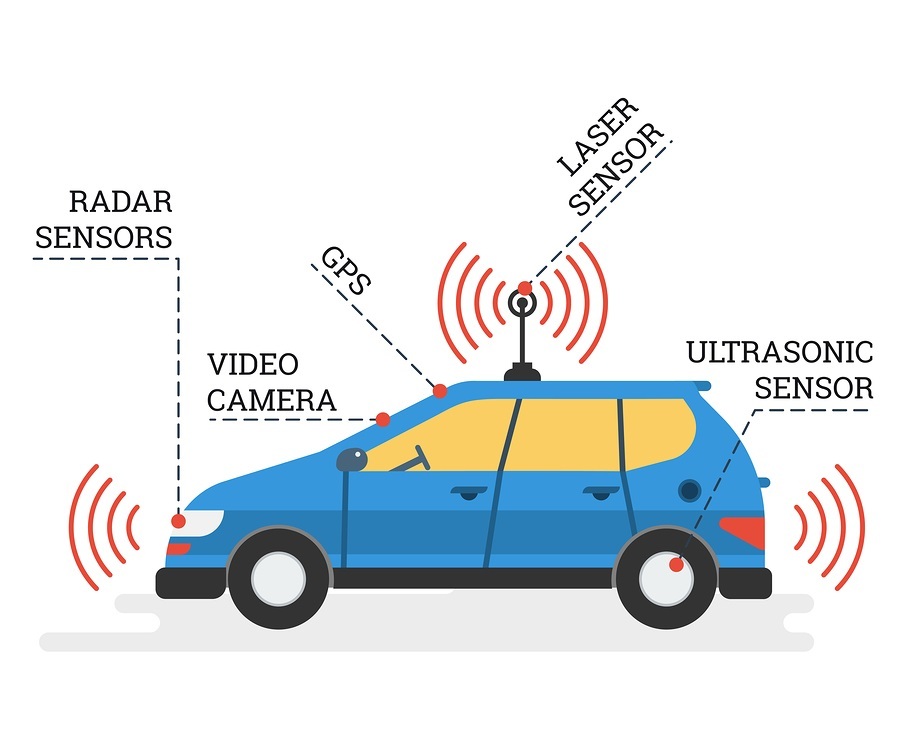
Autonomous Car image with microwave transmissions
by John P. Thomas
Health Impact News
Driverless cars are seen as the next big market potential for the automotive industry.
But before we get too excited about these driverless cars, we need to carefully consider the many levels of health risks involved with this technology, as well as the loss of privacy. Vehicle crashes and fatalities are minor concerns compared to potential human DNA damage and increased risks of cancer.
Now that the fifth generation (5G) of small microwave cell towers is being rolled out by telecom companies, their 5G press releases keep reminding us how their new technology will give us instantaneous internet downloads and will permit us to use driverless cars. [1, 2, 16]
Of course, these press releases never mention the potential health risks.
Driverless cars are already on the road in very small numbers as part of ongoing research and tests. But it is projected that within seven years, we will see a proliferation of driverless cars traveling down our roads.
There will also be very large numbers of cars with Driver Assist Systems (DAS), which supposedly help drivers avoid accidents. [3, 4]

DAS Technology: Computers Take Over – Privacy Gone

DAS equipped cars warn drivers when they start migrating out of their lane or get to close to another vehicle. DAS active cruise control can slow the car or speed it up depending on proximity to other vehicles on the road, and DAS cars can even take total control over the car to handle the sometimes-difficult process of parallel parking. [4]
Both DAS and driverless cars will require on-board computers and multiple on-board microwave radar systems. They will be tied into the 4G and 5G cell tower system through hotspot technology built into the car. The combination of vehicle hotspot antennas and 5G cell towers will allow vehicles to communicate with one another to avoid accidents. [3]
Eventually, this technology will even permit a central traffic control computer to manage traffic flow. These central computers could even be used to slow or speed up vehicles and even stop them if needed. This system will track the activity of every car on the road and even record information about who is driving the vehicles. [3]

From DAS to Driverless Cars – More Microwave Exposure

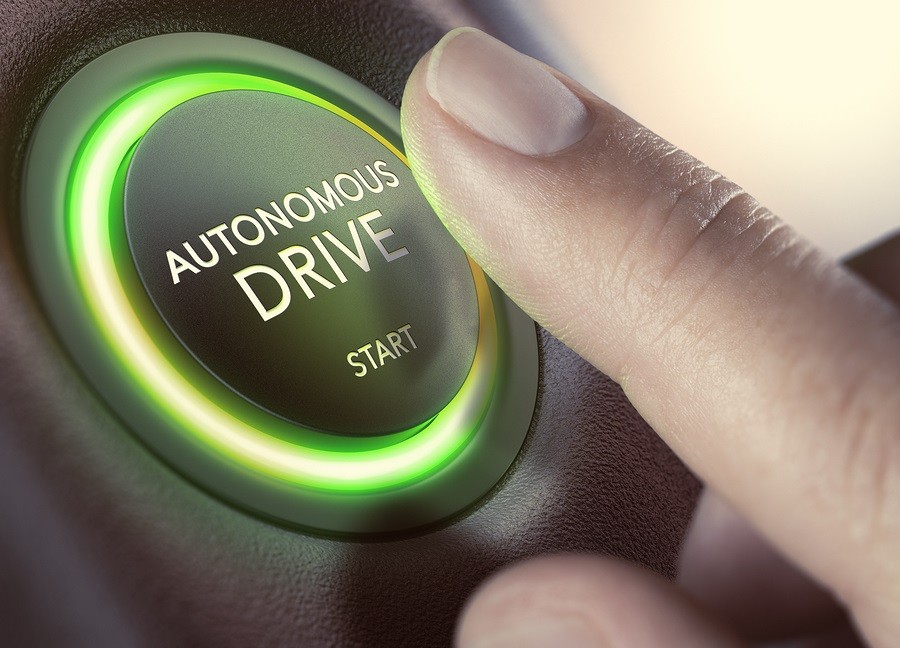
Finger pressing a push button to start a self-driving car.
The main difference between driverless cars and DAS cars lies in the amount of technology that will be used.
Driverless cars will use much more technology. These cars will have visual scanning cameras, laser sensors, and lots of microwave radar systems. Self-driving cars may have up to 10 microwave radar systems using very high frequency radiation, but DAS cars also use microwave radar.
Each radar system will use a different frequency of microwaves in the Gigahertz spectrum and will broadcast that radiation in a specific direction. Multiple radar systems will be located in the front grill of the cars and will project microwave radiation in front of the vehicle.
The forward-facing radar systems will focus on detecting objects at various distances. Other microwave radar systems will focus on activity behind and beside the vehicle. [3]
Self-driving cars will transmit more microwave radar radiation than DAS cars, but both have radiation risks. Both will broadcast microwaves into the environment and microwaves will be reflected back toward vehicles. Microwaves pass through glass and enter vehicles.
Thus, passengers will constantly be irradiated by microwave radiation coming at them from their own vehicle and from other vehicles on the road. [3]
Whenever two cars with microwave radar come toward each other on a two-lane road, both vehicles will directly irradiate the people in the other vehicle.
When two vehicles with radar are following one another at a modest safe distance, the people in both vehicles will experience constant microwave radiation exposure from the forward looking or backward-looking radar beams.
This means that passengers in vehicles will be frequently exposed to microwave radar radiation from all directions unless they happen to be driving on a deserted road.
Even when they might be on an empty road, they will still have constant microwave radiation exposure from the hotspot antennas on their own vehicle in addition to their own on-board microwave Wi-Fi system.
If anyone in the car is using the Wi-Fi on their smart phone, tablet, or laptop, then they will constantly be bombarded by the microwaves coming from these devices.
Of course, let us not forget the constant level of background microwave radiation that enters cars from 3G, 4G, and 5G cell towers, and the microwave radiation from smart meter relay towers and from smart meters attached to homes near the road.

Cars Trap “Microwave Smog”

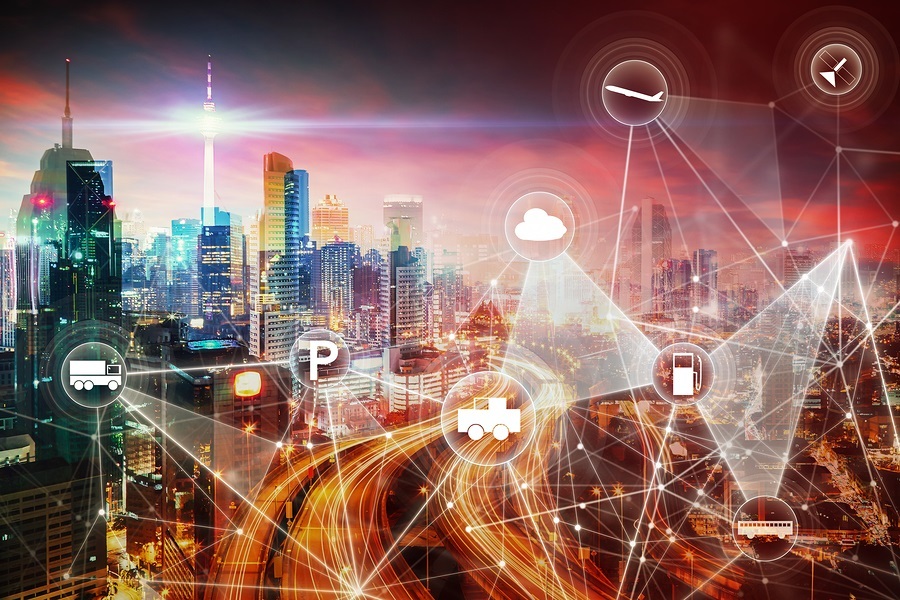
Modern transportation network intelligent vehicle and smart transportation connection concept image
Cars are metal boxes, which encapsulate microwaves. Microwave signals are reflected off surfaces and bounce around inside vehicles. They are easily absorbed by human tissue.
So, even if you aren’t holding a smart phone close to your body, you are still being saturated with microwave radiation as your technology uses Wi-Fi to communicate with the cars hotspot transmitter. [3]
Microwaves that radiate from smart phones and other devices are like second-hand tobacco smoke. It is not only the person who is smoking or using the smart phone that is affected by the smoke or the microwaves, but everyone in the nearby environment is contaminated with the carcinogenic smoke or microwave smog. [3]

Microwave Smog Affects Bicyclists and Pedestrians

The microwave radar systems used in DAS and driverless cars can project microwave radiation for more than 750 feet in front of the vehicle and a similar distance behind the vehicle. They use a combination of short-range, medium-range, and long-range microwave radar systems at very high frequencies.
Each radar system uses different Gigahertz microwave frequencies much higher than current generation cell phones and Wi-Fi.
These frequencies have not been tested to prove they are safe for humans. No safety studies have been done to determine the dangers of constant exposure to multiple microwave frequencies.
This radiation penetrates glass in other vehicles and in nearby homes. It also penetrates the bodies of people in cars and on sidewalks. [3]
Every time a radar equipped vehicle moves along a street, it will irradiate people, animals, plants, and buildings. At a busy traffic intersection, the radiation of the environment will be constant.

Microwave Smog Penetrates Homes, Storefront Businesses, and Offices

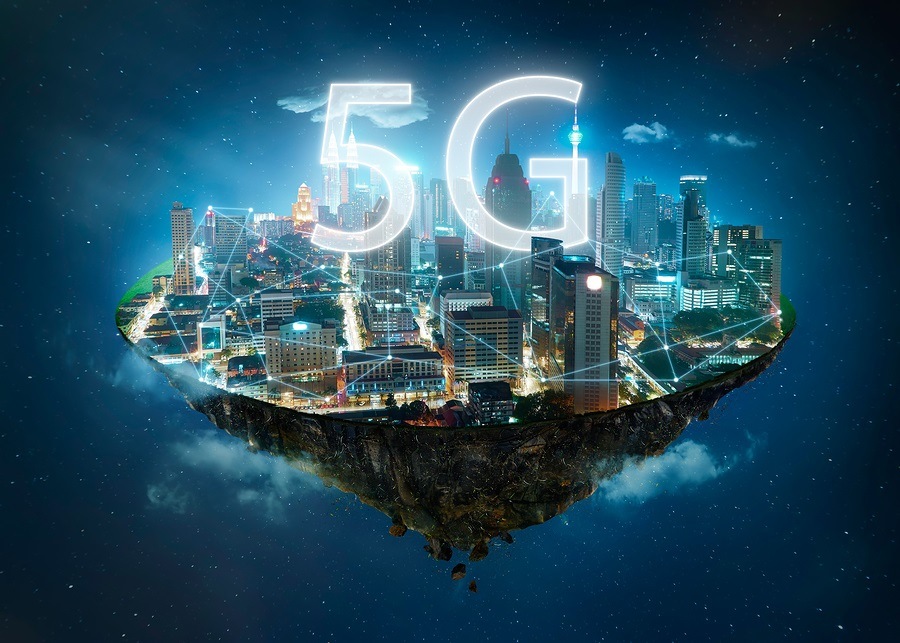
Fantasy island floating in the air with 5G network wireless systems and internet of things , Smart city and communication network concept
When a car equipped with microwave radars systems passes by the average home, apartment building or ground level office or storefront, the buildings and the people in and around them are subject to being irradiated. These microwaves will strike us when we are in our yards and can easily pass through window glass and enter our homes.
As the 5G system continues to be expanded into our cities, these vehicles will have greater freedom to travel in densely populated areas and will expose hundreds if not thousands of people to microwave radiation during every mile of their journey.
The combination of all this microwave technology will damage human DNA and cause many cases of cancer in addition to numerous other forms of severe illness. In my previous article, I presented the long list of illnesses and symptoms of injury that are linked to microwave exposure.

5G Technology is Coming – Linked to Cancer, Heart Disease, Diabetes, Alzheimer’s, and Death

Prototypes of Self Driving Cars Still Use Human Safety Attendants – But Accidents Still Occurring

Researchers are developing computer algorithms for the on-board computers in driverless cars so that they can detect dangerous situations and make correct choices about how to avoid accidents.
While this testing is occurring, human drivers are required to sit behind the wheel and pay attention to the task of driving. They must be ready to take over if the system doesn’t perform properly.
Even with safety attendants sitting behind the wheel, several deaths and numerous accidents have now been attributed to these cars and their semi-passive drivers. [5, 6, 7]
Despite the imperfections in the current auto driving technology, we are told that when 5G gets rolled out, then things should get really safe and the prices for driverless cars will become affordable for many car buyers.
It is estimated that cars equipped with optional driverless packages could be available for purchase in 2025. [8]

New Government Mandate for Vehicle to Vehicle Wireless Communication on the Back Burner

Based on a November 2017 news report [9] it appears that the proposed federal mandate for the Vehicle to Vehicle (V2V) microwave communication system is no longer being pushed forward by the Trump Administration.
This system would have required all car manufacturers to install a microwave communication system called Directed Short Range Communication (DSRC), so that vehicles could use microwaves to send warnings to other vehicles about dangerous situations. This would have been in addition to the microwave systems used by DAS and self-driving cars.
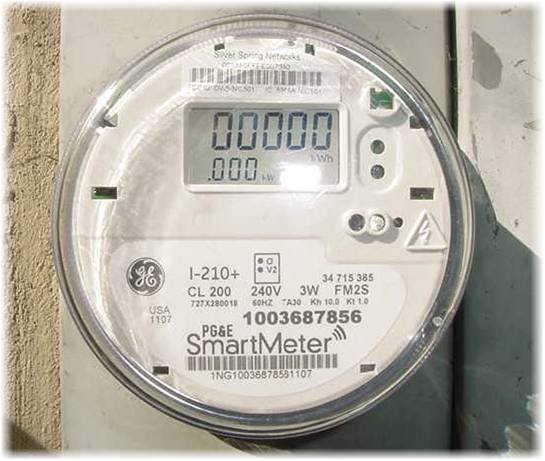
smartmeter
The V2V DSRC system would have produced harmful health effects that would have been equal to or even more dangerous than those produced by utility company smart meters.
The DSRC would have broadcast microwaves in a 360-degree field around light duty vehicles such as cars, trucks, motorcycles, and buses. The microwaves would have radiated in all directions for up to 500 meters – more than 1,500 feet. Each DSRC unit would have sent out bursts of microwave communication 10 times per second.
This means that everyone within 1,500 feet of these vehicles would have been bombarded by intense bursts of high frequency microwaves hundreds of times per second from all the vehicles moving around them. [10, 11, 12]
We should not assume the V2V DSRC system is dead, because it could be easily moved to the front burner again by a future administration in the name of public safety.
The serious health risk of microwave exposure from smart meters was discussed extensively in one of my previous articles.

Smart Meters: Countdown to a National Crisis of Illness and Death

Recommendations When Buying a Car

If you really want to protect your health and the health of your family, then don’t buy a car with a DAS system.
Unfortunately, DAS is becoming standard equipment on many vehicles.
You will even find the US governments proposed V2V DSRC system on certain models from Mercedes-Benz and on Cadillac CTS. [9]
  • If you are buying a car that is already equipped with DAS and/or DSRC, then do everything you can to get these systems disabled.
  • If the model you have selected cannot be purchased without DAS and/or DSRC, and it cannot be disabled, then choose a different model or manufacturer.
  • Otherwise keep your older car that doesn’t have all the microwave technology or shop for a used vehicle that hasn’t been equipped with DAS.

Conclusion: Driverless Cars do NOT Lead to More Freedom and Healthier Lives – They Lead to More Health Risks and Loss of Privacy

Everything associated with DAS cars, driverless cars, and the proposed V2V systems is being promoted in the name of preventing accidents, saving lives, and giving us that level of true freedom that the masters of marketing want us to believe we need.
These vehicles will expose us to a tremendous amount of microwave radiation at frequencies such as 10 Gigahertz, 76-79 Gigahertz, and 140 gigahertz. Safety has not been established for these frequencies or any of the others that saturate our environment today. [3, 14]
Even though microwave radiation is known to be extremely dangerous [3, 13, 14], telecom companies and now car manufacturers are employing the technology as if it is completely harmless. They don’t have to prove safety since the FCC has given the green light to microwave technology based on long outdated research from 1996.
These new sources of microwave radiation will produce extensive harm when combined with all the other sources of background microwave radiation in the environment from Wi-Fi, cell towers, smart meters, cell phones, etc.
Will we be able to enjoy the convenience of driverless cars if we will be suffering from illnesses caused by the microwave radiation they produce?
If the cost of DAS and driverless technology includes more cancer [3, 13], heart disease, and diabetes and dozens of other illnesses [14], then will this technology really benefit us?
If these technologies cause damage to the lenses and retinas of the eyes, cause glaucoma, and can lead to blindness, then do we need it? [3, 15]
Do we need it if the price includes damage to DNA and sperm? [3]
Will we all be safer if this microwave technology leads to infertility, and the death of babies in the womb? [3]
Do we really want our driving habits, including everywhere we travel, recorded with the auto industry and their service providers?
Are DAS equipped cars and driverless cars really worth the potential destruction of our health and loss of privacy?

About the Author

John P. Thomas is a health writer for Health Impact News. He holds a B.A. in Psychology from the University of Michigan, and a Master of Science in Public Health (M.S.P.H.) from the School of Public Health, Department of Health Administration, at the University of North Carolina at Chapel Hill.
References
[1] Verizon to launch 5G residential broadband services in up to 5 markets in 2018, Bob Varettoni. http://www.verizon.com/about/news/verizon-launch-5g-residential-broadband-services-5-markets-2018
[2] AT&T to Introduce 5G Wireless Service in 12 U.S. Cities in 2018, 2/21/2018. http://www.eweek.com/mobile/at-t-to-implement-first-5g-service-in-12-u.s.-cities-by-end-of-2018
[3] Wi-Cancer (home page), Retrieved 3/20/2018. http://www.wi-cancer.info/home.aspx
[4] The Best Driver-Assist Cars, Doug Newcomb and Alex Colon, PCMag.com, 1/18/2017. https://www.pcmag.com/article2/0,2817,2485278,00.asp
[5] Why Ubers Self-Driving Crash Is Confusing for Humans, Aarian Marshall, WIRED, 3/31/2018. https://www.wired.com/story/uber-self-driving-crash-explanation-lidar-sensors/
[6] Tesla’s Autopilot Was Involved in Another Deadly Car Crash, Jack Stewart, WIRED, 3/30/2018. https://www.wired.com/story/tesla-autopilot-self-driving-crash-california/
[7] Mishaps: A grief history of driverless car crashes, Nilesh Christopher, The Economic Times, ET Bureau, 1/13/2017. https://economictimes.indiatimes.com/small-biz/security-tech/technology/driverless-crashes/articleshow/56510821.cms
[8] How 5G will drive the adoption of self-driving cars, Jonathan Camhi, Business Insider, 12/15/2017. http://www.businessinsider.com/how-5g-will-drive-the-adoption-of-self-driving-cars-2017-12
[9] US set to drop proposed vehicle-to-vehicle communications mandate, Zac Estrada, The Verge, 11/1/2017. https://www.theverge.com/2017/11/1/16592704/vehicle-to-vehicle-communications-mandate-trump
[10] Vehicle-to-Vehicle Communication, NHTSA, Retrieved 4/6/2018. https://www.nhtsa.gov/technology-innovation/vehicle-vehicle-communication
[11] DSRC or 5G? #innovationandimpact, YouTube. https://www.youtube.com/watch?v=bw8xrQKoX8Q
[12] 2016 Fall Seminar #8: Dedicated Short Range Communications (DSRC): What, Why, and How? YouTube. https://www.youtube.com/watch?v=aqy7Fk1kOrw
[13] Antenna Sickness, Wi-Cancer.com. http://www.wi-cancer.info/antenna_sickness.aspx
[14] 5G Technology is Coming Linked to Cancer, Heart Disease, Diabetes, Alzheimers, and Death, John P. Thomas, 3/21/2018. http://healthimpactnews.com/2018/5g-technology-is-coming-linked-to-cancer-heart-disease-diabetes-alzheimers-and-death/
[15] Wi-Eyes, Wi-Cancer. http://www.wi-cancer.info/wieyes.aspx
[16] SK Telecom says 5G will be key for autonomous cars development, Juan Pedro Tomás, 3/1/2018. https://www.rcrwireless.com/20180301/5g/sk-telecom-5g-autonomous-cars-tag17

Wireless Technology Consumes Far More Energy Than Wired Connections Such As Fiber


“We have a tsunami of data approaching. Everything which can be is being digitalised. It is a perfect storm. 5G [the fifth generation of mobile technology] is coming, IP [internet protocol] traffic is much higher than estimated, and all cars and machines, robots and artificial intelligence are being digitalised, producing huge amounts of data which is stored in data centres.” Anders Andrae | ‘Tsunami of data’ could consume one fifth of global electricity by 2025 | The Guardian
Our government and the energy industry are revved up about the hoped for energy saving opportunities the IoT and smart grid may provide. ArmedEnergy consumption in production and use of the IoTwith an astronomical amount of data that will be generated by the IoT, industry expects it will be better equipped to 1) reduce peak load on the grid; 2) design new energy saving technologies; and 3) implement energy-saving programs to reduce consumption or shift load to off-peak times. But what these projections fail to include in their analyses is the mega energy footprint of the IoT itself. It is not at all clear that the IoT will ever succeed in offsetting its own fast-growing and unbounded energy consumption. 
According to IEEE Consumer Electronics Magazine Editor Peter Corcoran, energy is one of three main determinants of the “longterm sustainability of the Internet of Things” (the other two being privacy and cyber security). In a recent article characterizing Corcoran as a “longterm IoT skeptic,” author Steven Max Patterson reports:
IoT devices are expected to be low-power devices, but the number of IoT devices that Cisco predicts will be 50 billion by 2020, is an order of magnitude larger than the number of smartphones and tablets in use today. If the energy consumed by these devices and the networks and data centers to which they are connected is considered, energy consumption by IoT will impactfully increase the rate of energy consumption growth.
Wireless Technology Consumes Far More Energy Than Wired Connections Such As Fiber
Wireless technologies consume far more energy than do wired technologies.  According to Kris De Decker Why We Need a Speed Limit to the Internet, a wired connection is the most energy-efficient way to communicate digitally. If connection is made through a cellular network, energy use “soars.”  According to a 2015 publication put out by the Centre for Energy Efficient Telecommunications,
“Our energy calculations show that by 2015, wireless cloud will consume up to 43 TWh, compared to only 9.2 TWh in 2012, an increase of 460%. This is an increase in carbon footprint from 6 megatonnes of CO2 in 2012 to up to 30 megatonnes of CO2 in 2015, the equivalent of adding 4.9 million cars to the roads. Up to 90% of this consumption is attributable to wireless access network technologies, data centres account for only 9%.”
and
“… the final link between telecommunications infrastructure and user device is by far the dominant and most concerning drain on energy in the entire cloud system . . . wireless access networks are clearly the biggest and most inefficient consumer of energy in the cloud environment. [Emphasis added]”
De Decker explains that 3G technologies use about 15 times more energy than wired connections, and 4G technologies consume 23 times more energy. There is no data yet on 5G. If the bulk of our Information Communications Technology (ICT) infrastructure and transmissions were wired, such as Fiber to the Home (FTTH), the energy footprint from our “digital world” would be significantly reduced. And although fiber is safer, faster, more reliable, and far more cyber secure and energy efficient than wireless, Telecom is aggressively pushing for 5g everywhere as it’s far cheaper than to lay fiber. to all homes. Unfortunately, this will greatly grow our energy consumption.
(For more information on wireless consuming more energy than wired, please see https://whatis5g.info/microwave-radiation/#wireless)
Energy Efficiency Measures Offset By Usage
Digital technologies are becoming increasingly more energy efficient, and this trend will hopefully continue. But at the same time that we are making great strides in energy efficiency, more and more people are conducting greater portions of their lives online. Furthermore, not all online activities consume energy equally — there is a hierarchy in energy consumption: The written word is the least energy intensive. Images consume more energy. And, to date, by far the most energy-intensive online activity is watching videos and particularly, high definition videos which 5G is promising. Unfortunately, enticed by tech companies which offer ever more and cheaper options, people are watching far more videos than ever before, and this trend is expected to increase. Of course driverless cars and potentially other IoT applications soon to be unveiled will likely far and away trump energy consumption from videos.
It is a common occurrence in digital technologies that improvements in energy efficiency of a particular device, bring about accompanying changes in usage of the device that often offset the hoped for benefits from energy savings. This is known as the “rebound effect”. For example, a smart phone uses significantly less energy than does a desktop computer. But due to the size of a smart phone, it can be carried around and used 24/7. This increase in use negates, or significantly reduces, energy savings.
We may presume that as more and more “things” in our world take up residence in the Cloud, people’s time online to connect with this data and their “digital selves” will also increase.  Bryon Walsh, Senior Editor at TIME, writes,
“As our lives migrate to the digital cloud — and as more and more wireless devices of all sorts become part of our lives — the electrons will follow. And that shift underscores how challenging it will be to reduce electricity use and carbon emissions even as we become more efficient.”
Global electricity use is indeed rising across the board. But it isn’t just the sending of data or the cooling of data centers that increases electricity use. Entire lifecycles must be taken into account. In other words, manufacturing contributes: The production of all the stuff, such as robots, smart home devices, wearables and augmented reality/virtual reality gadgets will increase electricity use. So will data center hardware and network hardware production — they’re all accelerating ICT electricity use. Patrick Nelson, Network World
Four Ways the IoT Consumes Energy 
1. Data centers: 
In an IoT world, data collected from billions of machines, appliances, “things,” and devices, as well as from sensors and surveillance cameras integrated into our environment, driverless cars, “enhanced humans”, microchipped humans and animals, and virtual and augmented reality, will be stored and responded to in data centers.
The 2014 paper, Data Center Efficiency Assessment, by the National Resources Defense Council (NRDC) reports that the 2 million computer servers in close to 3 million data centers that are used in the US for online activities “gulp enough electricity to power all of NYC’s households for 2 years.” 
A recent study in the Journal for Cleaner Production, states,
“We have found that, if unchecked, ICT GHGE relative contribution could grow from roughly 1–1.6% in 2007 to exceed 14% of the 2016-level worldwide GHGE by 2040, accounting for more than half of the current relative contribution of the whole transportation sector.”  (For more on this study, please see How Smart Phones Are Heating Up the Planet.
In a 2012 paper, How Clean is Your Cloud, Greenpeace offers this comparison: “If the Cloud were a country it would have the fifth largest energy demand in the world.”  What number country would the energy demand of the Cloud equal now with the advent of the IoT? How about 5 or 10 years down the road?
Although plans are underway to build future data centers in places where cleaner energy sources are available, the fact remains that data centers already consume mega amounts of energy, and this is only going to increase with the IoT. Ireland and Denmark are slated for becoming the data base for big tech companies are expecting to carry a heavy energy consumption load. According to a 2017 report, All-Island Generation Capacity Statement 2017-2026, the energy load from data centers in Ireland could account for 20% of Ireland’s peak demand. 
2.Energy consumed from machine-to-machine (m2m) communications:Machine-to-machine communication refers to 1) transmission of data from all Internet connected “things,” 2) remote software updates for personal devices, and 3) back-up of data, digital photos, and videos to the Cloud.
Hazas et al note in Are there limits to growth in data traffic?, that although many m2m communications use very little energy, some, such as driverless cars or wearable medical devices, are highly data intensive and require inordinate amounts of energy, both at the source and in the Cloud.
 Hazas et al explain further that while each machine or “thing” may not consume a lot of energy in a given communication, the sheer volume of transmissions could place m2m communications as a top contender in energy consumption – some predicting that m2m communication will reach around 45% of all Internet traffic by 2022:
“This [machine to machine] communication will occur transparently, without observation or interaction, and potentially without limit. At the time of writing, [2015] the existing 6.4bn connected IoT devices is only slightly less than world population (86%), but market predictions suggest this will reach 21bn [billion] devices by 2020— roughly three times world population estimates.
3. Embodied energy:


(Embodied energy, also known as “emergy,” refers to energy consumed in the production of goods.This includes the mining, manufacturing, transporting, and delivery of a product.)
Digital technology requires far more energy in the manufacturing process than do other products. Kris De Decker explains in The Monster Footprint of Digital Technology, that machines such as cars or refrigerators use far more energy during their “lifetime” than the amount used to manufacture them. According to De Decker, advanced digital technology has turned this relationship “upside down.” As counterintuitive as this may sound, he explains:
“A handful of microchips can have as much embodied energy as a car. And since digital technology has brought about a plethora of new products, and has also infiltrated almost all existing products, this change has vast consequences.”
Our new IoT technology will require billions of sensor nodes, and microchips each of which will require thousands of semiconductors. According to De Decker, the energy needed to produce one semiconductor is “up to 6 orders of magnitude [emphasis added] above those of conventional manufacturing processes.” 
In addition to the billions of Internet connected “things,” FCC Chair Wheeler projects that in a “5G world”, each person will own about 5-6 wireless devices. Add to that the millions of new small cells being deployed to accommodate all the digital “traffic” of the IoT, and it becomes evident that it will take an inordinate amount of energy just to produce the IoT.
4. Obsolescence of digital technologies
Perhaps the largest player in energy consumption of the IoT is that of (planned) obsolescence of all our technologies. Digital technologies generally need to be replaced every 1-3 years as Information and Communication Technologies evolve at an exceedingly fast pace.The fact that our digital devices have such a short lifespan, exacerbates the problem of the excessive amount of energy used in their production. The all too familiar need to “upgrade” will become yet more of a drain on our energy as literally billions of connected devices, machines, and “things“ will recurrently become obsolete and be discarded.
DeDecker maintains that, “Addressing technological obsolescence would be the most powerful approach to lower the ecological footprint of digital technology.”
Will Our Grid Be Able to Absorb the IoT Energy Footprint? 
Our energy grid was built over the course of the last century and is based on a business model that generates and delivers energy from burning fossil fuel. Local renewable energy, such as rooftop solar, is becoming more affordable and therefore increasingly able to replace coal and other polluting sources of energy. Utilities are trying desperately to stay afloat while integrating unprecedented amounts of local renewable energy into our saturated and failing energy grid. In The Grid, The Fraying Wires Between Americans and our Energy Future, Gretchen Bakke explains how challenging it is for our energy industry to integrate decentralized renewables into the grid, while still providing reliable energy delivery and service to customers. Bakke offers the analogy of trying to rebuild an entire airplane fleet while keeping all the airplanes in flight. Faced with the voracious appetite of the wireless industry, our utilities will have an even greater challenge navigating the tenuous, but necessary path forward to a truly sustainable energy future.
Will the Increased Energy Consumption From 5G and the IoT Impact Climate Change?
An even stronger reason that energy consumption of wireless, 5G, and the IoT must be considered, is that our energy grid is still run primarily on fossil fuels – coal, natural gas and petroleum.  So the exorbitant amount of energy that will be needed to support the IoT and its highly energy-intensive footprint will necessarily result in a huge increase in carbon emissions, thereby adversely impacting our climate.  Will the energy footprint of 5G and the IoT be offset by improvements in energy efficiency and innovations businesses may come up with? Not certain at all.
For more on energy consumption and the IoT, please see,Tsunami of data’ could consume one fifth of global electricity by 2025