Monday, February 22, 2016

EMF Exposure Laws for UK due to be Published in 2016

EMF Exposure Laws for UK due to be Published in 2016

LawThe EU Directive 2013/35/EU, which imposes strict health and safety requirements for electromagnetic field (EMF) exposure in the workplace, is due to become integrated into UK law by July, 2016. The new Directive was published in the EU Official Journal in June 2013, and will replace Directive 2004/40/EC. Employers will be responsible for ensuring that workers are protected from the health and safety risks associated with EMF.
Even just a decade ago, EMF would only have come from a few obvious sources (such as machines or computers in the workplace), but today’s employers also have to beware of the proliferation of connected devices. Now employees are surrounded with more wireless transmitters than ever before, with smart phones, wearables and the Internet of Things complicating the matter of EMF exposure. According to the European Agency for Safety and Health at Work (EU-OSHA), the Directive “covers all known direct biophysical effects and other indirect effects caused by electromagnetic fields.” The Agency also pointed out that the Directive currently only addresses short-term effects and does not concern possible long term effects. We expect to hear more details soon, since a practical guide is due by January 1, 2016.
Source: Electronics Weekly | EU-OSHA
http://incompliancemag.com/emf-exposure-eu-directive-2013-35-eu/
Read more: http://incompliancemag.com/emf-exposure-eu-directive-2013-35-eu/#ixzz47dPDmr6N 
Follow us: @incompliancemag on Twitter | incompliancemag on Facebook

ICNIRP 8th International NIR Workshop

8TH International NIR workshop

The International Commission on Non-Ionizing Radiation Protection (ICNIRP) will hold its 8th International NIR Workshop in conjunction with the IRPA14 Congress on the occasion of IRPA’s 50th anniversary at the Cape Town International Convention Centre, Cape Town, South Africa, 9-11 May 2016.

What is that noise? Mysterious shrieking sound puzzles people in Oregon neighborhoood

What is that noise? Mysterious shrieking sound puzzles people in Oregon neighborhoood

FOREST GROVE, Oregon– Does someone need to change their brakes? Or maybe train tracks are nearby?  A mysterious sound is baffling people in a neighborhood in Forest Grove, Oregon.

A resident recorded the sound; you can hear it below. One woman told KATU that the noise has woken her up several times. Another woman said she’s heard the noise for weeks and at all hours.

The perils of LED streetlights


The perils of LED streetlights

By Sandi Maurer of the EMF Safety Network


Screenshot at 100% SR LED

Close up of a PG&E LED streetlight in Santa Rosa California


There is a major push all over the country to install LED streetlights based on assumptions of saving energy and money.  In places where the LEDs have been installed there are so many complaints.  On February 16 Sebastopol will consider whether or not to allow PG&E to install the LED streetlights.  PG&E owns the streetlights and requires cities to opt-in to the changeout.
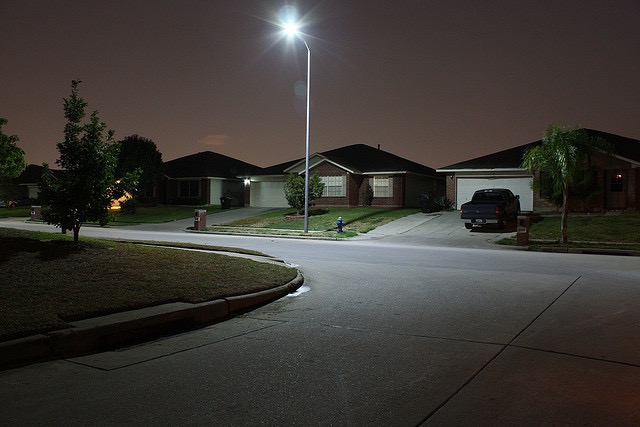
PG&E is currently installing LED streetlights in Santa Rosa, and we took a team to investigate, measure and photograph there.  What we found is, unlike the warm yellow streetlights, the LED’s are very white, with cold blue tones, and painfully bright.
Mary Carvalho who lives in Santa Rosa writes, “Has anyone noticed lately that the night sky is lit up like a full moon every night?”
Paul Marantz, a lighting designer said about the yellow streetlights, “there was a warmth about them that’s missing from the new lights. And because of the way the LEDs are designed, it’s a much more directed light, with more glare.”
When the environment is saturated with blue rich light it causes melatonin reduction which can affect sleep. Harvard Medical Schoolreported blue light has a dark side.  “Light at night is bad for your health, and exposure to blue light emitted by electronics and energy-efficient lightbulbs may be especially so.”

PG&E LED streetlight

PG&E LED streetlight

Bob Parks, executive director of the International Dark-Sky Association states, “Now, people can certainly close their blinds and block-out that rich blue-white light. The problem is that every other species on the planet can’t do that, so you have an impact on everything else. And not just animals — we are talking plants, trees, right down to one-cell organisms.”- Earth Island Journal
The Department of Energy (DOE) and IEEE reported there are serious health risks from LEDs if inexpensive drivers are used.  DOE writes,“Why is flicker bad? For one thing, in addition to being annoying and distracting, it can cause eyestrain, blurred vision, and impairment of performance on sight-related tasks. And in those who are flicker-sensitive, it can cause debilitating headaches and migraines — 10% of the population is estimated to suffer from migraines, and that’s only one of the groups prone to flicker sensitivity.  According to the IEEE recommended practice, flicker has been reported to contribute to autistic behaviors, and can be a trigger for epileptic seizures.… Some of these problems might occur even when the flicker isn’t detectable by the eye.”
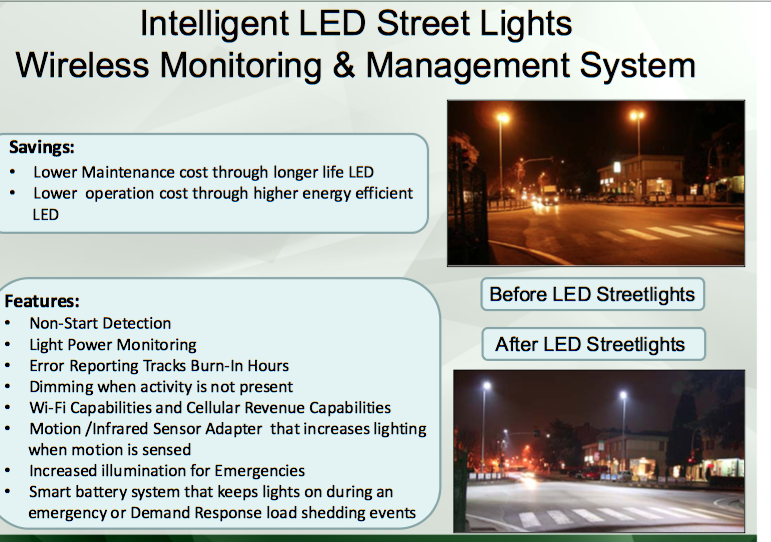
The EMF Safety Network sent a list of questions to PG&E about their LED streetlights. We await their answers.  We can trust PG&E will cut costs and we can’t be certain they will tell the public the truth.  We don’t know whether or not PG&E will be using the streetlights for wireless transmissions, as has been done in Los Angeles and Florida.  The California Public Utilities Commission (CPUC) had a presentationon their website that touted the benefits of “intelligent” wireless streetlights.
Intelligent streetlights
We don’t know if PG&E is installing these, but we do know the rapid increase of microwave technologies deployed on our homes and in our neighborhoods, largely without informed consent, threatens privacy, public health, children, wildlife and nature.
The other risk is whether or not the LED streetlights add unintentional radiation to the power lines, creating “dirty electricity” like PG&E smart meters do.  Samuel Milham, MD and David Stetzer, Electrical Engineer wrote a peer reviewed published paper in 2013.  They wrote, “Dirty electricity, also called electrical pollution, is high-frequency voltage transients riding along the 50 or 60 Hz electricity provided by the electric utilities… has been associated with cancer, diabetes and attention deficit hyperactivity disorder in humans.
Some people claim brighter streetlights will help reduce crime. However, Earth Island Journal reported “Public safety was a big motivator behind the Oakland conversion project, and it may seem intuitive that brighter lights improve safety.  However, some studies suggest that though brighter streets make people feel safer, they have no impact on actual crime levels.”
In 2015, PG&E’s claims of LED cost and energy savings were merely assumptions.  In the CPUC 2015 Uncertain List they stated, “market move to LED technology requires verification.”  As yet PG&E has offered no proof.  In addition the city claimed the streetlight conversion would be free, however PG&E intends to recover streetlight costs through customers rate increases. So we all pay for the LED streetlights.
Why should perfectly good streetlights be scrapped for a risky technology whose benefits are questionable? A study published in late 2010 in the journal Environmental Science and Technology found that LEDs contain lead, arsenic and a dozen other potentially dangerous substances.  While it is possible that the LED’s save energy, it’s not worth the cost to public and environmental health.
In September 2015, the Sebastopol city council had the PG&E streetlight conversion on their consent calendar.  Due to complaints, they took the issue off consent and put it on the regular agenda. At that meeting, Rich Emig, Public Works superintendent, gave a report acknowledging the LED health risks. Public comments included one woman who said when she was a child she had seizures from light flicker. See the Sebastopol City Council’s video which starts at 1:40:00
Considering the city acknowledged the serious pubic health risks, why are they bringing it back to the council, and why have they not notified the public of this issue that will affect each and everyone of us?
More information: 
Residents sue Monterrey over new LED streetlights (2012)
http://www.montereyherald.com/article/ZZ/20120717/news/120718012
Ann Arbor Michigan has been a leader in converting city streetlights to energy-efficient LEDs, but despite a large reduction in energy usage, DTE Energy is proposing rate increases for LED lights, while decreasing rates for conventional high-pressure sodium lights.http://www.mlive.com/news/ann-arbor/index.ssf/2015/02/ann_arbor_responds_to_streetli.html
Darkness is a requisite part of life. 
“Half of your life, half of the lives of all nature, half of all human history has occurred between sunset and sunrise.  We and all of the natural kingdom have evolved in a landscape that segues from a bright blessed day to a dark sacred night.  A dark night is really that–sacred. Every cell in the human body has time-related functions, part of the bigger circadian system.  I’m referring to science, not some woo-woo feel-good incense-laden chanting mysticism.  Healthy life depends on critical functions for which the absence of light is essential.”
1.  All outdoor lighting shall be full cutoff, or fully shielded.
2.  If LED lights are used, they shall have a correlated color temperature (CCT) less than 3000K.
3.  All lights shall minimize glare, sky glow, and light trespass. —–Excerpt and recommendations from www.Nightwise.org
Video of New York news story on LED street lighting and resident reaction. http://pix11.com/2015/04/27/new-bright-leds-that-replaced-street-lamps-angering-local-residents/
The city of Davis received so many complaints about the LED lights they put the project on hold for a year, then spent $350,000 more money on the project. http://sacramento.cbslocal.com/2014/10/21/davis-will-spend-350000-to-replace-led-lights-after-neighbor-complaints/
Grassroots website about LED streetlight complaints http://lightsickness.com/actions-you-can-take/

MEETING THE CHALLENGE OF “UNIVERSAL” COVERAGE, REACH AND RELIABILITY IN THE COMING 5G ERA

MEETING THE CHALLENGE OF “UNIVERSAL” COVERAGE, REACH AND RELIABILITY IN THE COMING 5G ERA


Everyone can foresee a gigantic capacity challenge for wireless networks over the coming decades. The research community is responding well by developing 5G technology in higher bands (eg mmWave) that will unlock huge data rates up to 10 Gb/s or more but its practical application will be limited to dense urban areas.

This inevitably leads to a new coverage challenge being pulled behind this capacity challenge i.e, the coverage of higher speeds and capacity. Nowhere will this challenge be greater than in rural areas where it will be an economic struggle to significantly lift the capacity above the current 4G coverage prediction of 2 Mb/s. Yet in spite of such a glaring need there is scant attention being paid by the 5G research community to improving universal mobile coverage. This White Paper is based on a brain-storming workshop on Rural 5G held at the 5GIC in 2015. The paper reviews a range of possible ways to improve rural coverage without regard to whether this needs new technology or just a more radical way of applying existing technology. This is in the spirit of the 5GIC’s vision of 5G being both a new technology and at the same time being the envelope within which all the technologies (new and existing) work together to deliver “always sufficient” resources to match users’ demands. 

AT&T unveils 5G Roadmap including trials in 2016

5G/Massive MIMO Channel / Industry News

AT&T unveils 5G Roadmap including trials in 2016


February 16, 2016


AT&T* is unveiling its 5G roadmap to bring customers the next-generation of super-fast, flexible wireless connectivity.

Technologies such as millimeter waves, network function virtualization (NFV), and software-defined networking (SDN) will be among the key ingredients for future 5G experiences. AT&T Labs has been working on these technologies for years and has filed dozens of patents connected with them.

We plan to collaborate with Ericsson and Intel to work on 5G solutions in our labs starting in the second quarter of this year, with outdoor tests and trials over the summer. And, we expect field trials of 5G technologies to provide wireless connectivity to fixed locations in Austin before the end of this year. The trials will help guide our 5G standards contributions, and set the stage for widespread commercial and mobile availability once technology standards for 5G are established.

We expect 5G to deliver speeds 10-100 times faster than today’s average 4G LTE connections. Customers will see speeds measured in gigabits per second, not megabits. For reference, at one gigabit per second, you can download a TV show in less than 3 seconds. Customers will also see much lower latency with 5G. Latency, for example, is how long it takes after you press play on a video app for the video to start streaming on your device. We expect 5G latency in the range of 1 to 5 milliseconds.

“New experiences like virtual reality, self-driving cars, robotics, smart cities and more are about to test networks like never before,” said John Donovan, Chief Strategy Officer and Group President, AT&T Technology and Operations. “These technologies will be immersive, pervasive and responsive to customers. 5G will help make them a reality. 5G will reach its full potential because we will build it on a software-centric architecture that can adapt quickly to new demands and give customers more control of their network services. Our approach is simple – deliver a unified experience built with 5G, software-defined networking (SDN), Big Data, security and open source software.”

AT&T’s 5G Roadmap

Data traffic on AT&T’s wireless network grew more than 150,000% from 2007 through 2015, driven largely by video. More than 60% of the data traffic on our total network was video in 2015. 4K video, virtual reality, and IoT will drive the next wave of traffic growth. 5G is ideal for those bandwidth-hungry applications because it will support multiple radio interfaces, enable more spectrum efficiency, and take advantage of SDN and network function virtualization (NFV).

We’re conducting our 5G trials in such a way that we’ll be able to pivot to compliant commercial deployments once 5G technology standards are set. The international standards body, 3GPP, will likely complete the first phase of that process in 2018. Meanwhile, we continue to evolve our 4G network to deliver higher capacity and the best experience for our customers.

5G will be efficient and cost-effective because it will give every customer and device exactly what it needs from the same network – whether it’s 10-year battery life for massive sensor networks or multi-gigabit speeds for large data transfers. AT&T’s global leadership in moving to SDN gives us a head start in supporting exploding growth in mobile video consumption. Combined with our superior spectrum position and broadband build-out commitment to millions of locations throughout the United States, AT&T’s virtualized network will be able to support those next-generation applications quickly and efficiently.

“AT&T’s 5G field trials will play an important role in ensuring rapid and wide-scale adoption of this next generation mobile technology,” said Arun Bansal, Senior Vice President and Head of Business Unit Radio, Ericsson. “5G will impact the entire mobile network – from devices to access and core to cloud – and open up exciting new IoT applications for consumers and industry, so Ericsson is enabling AT&T to move beyond 5G lab tests to gain a greater understanding of 5G’s potential in their own network environments and markets.”

“As early 5G development and trials get underway, industry collaboration is necessary to implement new network architectures and prepare for commercial availability,” said Aicha Evans, corporate vice president and general manager of the Intel Communication and Devices Group. “At Intel, we know that working with partners like AT&T and Ericsson is essential to bringing faster and more efficient wireless networks that will bring new and richer experiences to our lives.”

Unrivaled SDN and NFV Leadership

AT&T has led the industry the last few years in rethinking how companies should design and build their networks. The traditional model relied on complex and cumbersome hardware. But that gear takes too long to deploy and too long to upgrade in the face of the customer demand the industry is experiencing.  
The future is software and our transformation is already underway. Just as consumers replaced their bulky stereos with streaming music apps on their phones, we’re turning routers, firewalls and other network equipment into virtual functions running on commodity hardware – basically servers.

We announced our SDN strategy in 2014 with plans to virtualize 75% of our network by 2020. We exceeded our first major milestone by virtualizing 5.7% in 2015. In 2016, we’re accelerating to 30%.
We already have 14 million wireless customers on our virtualized network, almost certainly the largest implementation in the world. We’ll migrate millions more this year.

Virtualizing the network is fast, efficient, scalable, and lets the hardware ride the cost and performance curve of Moore’s Law. In fact, cost is one of the critical attributes of NFV and SDN. Lowering the cost to deliver a megabyte of data is one of the reasons we were recently able to bring back an Unlimited Data offer. It also provides a sizable cost advantage in the deployment of 5G technology over a traditional network approach.  

Big Data and Open Source Key in AT&T’s Transformation

AT&T is a data-driven enterprise. We’re extracting software from hardware. And we’re extracting data from applications. That’s easy to say but difficult to execute. Our Big Data focus enables new ways to optimize our network, to drive smarter decision-making and to better serve our customers. You can read more here from our senior vice president for Big Data.

We’re building many of our 5G and SDN applications using open source software. We’re also contributing code back to the open source community so other innovators can take advantage of what we’ve learned in this transformation. We shared our latest open source milestones last month. We’ll have more to share in the weeks ahead. In the meantime, AT&T is leading the charge to the next generation of the network with 5G and we’re doing it more efficiently than anyone else.

*AT&T products and services are provided or offered by subsidiaries and affiliates of AT&T Inc. under the AT&T brand and not by AT&T Inc. Additional information about AT&T products and services is available at http://about.att.com. 

http://www.microwavejournal.com/articles/25960


Sunday, February 21, 2016

Smartphones to replace cards at bank machines

Smartphones to replace cards at bank machines

 on 

Here's another use for the smartphone as it invades daily life: in place of your debit card at your bank cash machine.
The "cardless" automatic teller machine (ATM) is gaining ground in the US and around the world, with smartphone technology allowing for speedier and more secure transactions.
Dozens of US banks are installing new ATMs or updating existing ones to allow customers to order cash on a mobile application and then scan a code to get their money without having to insert a bank card.
US banking giants Wells Fargo, Bank of America and Chase are in the process of deploying the new ATMs, as are a number of regional banks and financial groups around the world. Makers of ATMs and financial software groups are ramping up to meet this demand.
"We think our model (using smartphones) reduces a lot of vulnerabilities," said Doug Brown, who leads mobile technology for FIS Global, a major provider of software and technology for ATMs.
Brown said the FIS cardless system is being used at some 2,000 ATMs operated by at least 28 banks in the United States "and we're looking to rapidly expand that."
He said the system should be operational at some 80,000 machines in North America over the coming 18 months. And similar changes are coming in other countries, according to Brown.
- Reducing 'skimming,' fraud -
In addition to speeding the transaction time, the smartphone-based system aims to curb the growing problem of "skimming" in which criminals steal the data on a card, often by inserting devices into the ATM card slot.
By some estimates, skimming cost the global banking industry some $2 billion in 2015 and can lead to other kinds of fraud when card data is stolen.
"Consumers are aware of this, they really understand and welcome this," Brown said.
Another security benefit, Brown said, is that authenticating on the handset reduces the time spent at the ATM to around 10 seconds instead of the typical 30 to 40 seconds
"The performance is kind shocking to some people, they almost jump back at the instantaneous response," Brown said. "But it provides more physical security because they can make the transaction faster."
Bank of America spokeswoman Betty Riess said the group is "currently developing a new cardless ATM solution" based on NFC or near field communication technology to allow customers to authenticate without the use of a card.
"We'll roll out this capability in late February to associates in select ATMs in Silicon Valley, San Francisco, Charlotte, New York and Boston." Riess said. "It will be followed by a broader customer launch mid-year."
Chase said it is planning a similar rollout sometime this year.
"When we first roll this out, customers will be able to request an access code through the Chase mobile app and enter it at the ATM to do their transactions," said Chase spokesman Michael Fusco.
"Later on, they will be able to use their digital mobile wallet to complete the transaction at the ATM."
Wells Fargo is also on board, developing ATMs that will allow customers to use their smartphones to obtain and eight-digit token to authorize a cash withdrawal.
The Wells Fargo system will support Android Pay, "and we'll continue to evaluate additional wallets," said spokesman Kristopher Dahl.
Chicago-based BMO Harris, an affiliate of Bank of Montreal, began using smartphone technology at its 750 ATMs last March.
- 'Headless' ATMs -
Some of the new technologies will require only a software update to the ATM, while others will need new hardware.
ATM manufacturer Diebold is testing a "headless" teller machine, without a screen or keypad, which dispenses cash from interaction on the smartphone.
"What we are saying with this is forget the card reader, forget the PIN pad, we all have these devices in our pockets," said Dave Kuchenski, Diebold's senior business development manager for new technology.
Customers need only verify their identity, which can be done with the device's fingerprint reader, or possibly with an iris scanner on the ATM.
While some existing Diebold ATMs can work with mobile applications, Kuchenski said the new concept, in testing with Citibank and others, could provide "a better user experience."
"We don't have to walk through the same process which we have had since the ATM has existed," he said.
"If we're using a mobile phone, we no longer have the need for a card, we no longer have a need for a receipt printer, we've dematerialized a lot of the devices. Banks like this, because it has fewer moving parts, so it reduces the total cost of ownership."
rl/sg
BANK OF AMERICA
WELLS FARGO & COMPANY
Copyright 2016 Agence France-Presse