Monday, July 02, 2012

Mobile radiation scare in Jaipur

Mobile radiation scare in Jaipur


Rajasthan says levels within permissible limit. Critics claim even ‘safe’ levels are harmful
imagePhoto: Ankur PaliwalSUDHIR KASLIWAL has been living in a Jaipur colony with his family since the 1970s. A jeweller by profession, his life was going smooth until last year when one of his two brothers was diagnosed with brain tumour. He was rushed to Mumbai for treatment. Then his other brother was also detected with brain tumour. “His doctor enquired about our surroundings. When we told him there are three cell phone towers within 20 metres of our house, he cautioned us,” says Kasliwal. Around the same time, his dog fell victim to cancer.
In another colony of Jaipur was Hameeda Patel who succumbed to cervical cancer last month. The 53-year-old used to live with her family in a one-room flat on the first floor. The room is 50 metres away from a building that has a cell phone tower and four antennas. “She was the first cancer patient in our family,” says her son. Since 2010, five persons have died of cancer and five are battling the disease in Patel’s colony that has about 15 cell phone towers.
These are some instances of the health scare that has engulfed Rajasthan’s capital. Although there is no conclusive evidence to prove that electromagnetic radiations (EMR) emitted by antennas on cell phone towers are causing cancer, there could be a link. All the cancer patients in the areas Down To Earth visited were the first in their generation to suffer from the disease and were diagnosed after towers were erected in their vicinity.
The increasing number of cancer cases has people worried. On February 24, two people filed a petition in the Rajasthan High Court. They urged the court to take action against cell phone service providers and the regulatory authorities. On May 31, the court formed a committee to monitor EMR in the city for a month and submit report with suggestions (for more, see "Mobile tower risks: Rajasthan High Court issues notice to telecom operators").
To further address public concerns, the state government organised a workshop on June 2, which was attended by technical and medical experts. “The cancer cases are a mere coincidence. There are multiple causes of cancer like pollution and lifestyle changes,” says Rajesh Pasricha, senior consultant, department of radiotherapy, Bhagwan Mahaveer Cancer Hospital and Research Centre, Jaipur. There is no conclusive evidence to show that EMR is responsible for cancer, he adds.
Officials from the Department of Telecommunications (DoT) say the radiation levels in Jaipur are below the permissible limit. Mahidhar Pant, deputy director general, Telecom Enforcement Resource and Monitoring (TERM) cell, Jaipur, says, “We are required to randomly monitor EMR of 10 per cent of the 5,678 towers in the city annually. We have never found EMR beyond the permissible limit.” But there is no independent verification of the TERM readings, points out Prakash Munshi, an anti-radiation activist in Mumbai.
When less is bad
Even at permissible level, EMR could hurt people. After doctor’s caution, Kasliwal had his house tested for EMR. “The levels were high in the rooms occupied by his brothers, but were within permissible limits,” says Girish Kumar, professor in the electrical engineering department at IIT-Bombay, who measured the radiation.
Precautions taken
 
Although there is no conclusive proof that electromagnetic radiations (EMR) from cell phone towers affect health, many countries have taken precautionary steps. In Italy the permissible EMR is 1 Watt per m2, but in sensitive areas like residential areas, schools and hospitals it is 0.1 Watt per m2. Similar is the case in Switzerland where the countrywide limit is 4.5 Watt per m2 while in sensitive areas it is 0.042 Watt per m2. Nations like Russia, Bulgaria and Poland are playing it safer. They have restricted the limit to 0.1 Watt per m2
 
How can radiation level within the permissible limit be harmful? India follows the norms of International Commission on Non Ionizing Radiation Protection (ICNIRP), Kumar says. It is an independent scientific body that provides guidance on the health hazards of non-ionising radiation exposure.
V K Vijay, director of the Centre for Development of Physics and Education in the University of Rajasthan, sheds more light. “EMR are non-ionising radiations. They have electrical and magnetic field, but no charge. On contact, the field affects the normal dynamics of the human body. But the exact effect is not known,” he says.
According to ICNIRP, the permissible limit for exposure is 4.5 Watt per m2. The reading in Kasliwal’s house was about 0.005 Watt per m2. “Consistent exposure of even 0.001 Watt per m2 is harmful,” says Kumar. Besides cancer, such exposure can damage DNA. “People complain of problems like sleep disorders and hypertension,” he adds. He cites a study conducted in Germany from 1994 to 2004 which found a threefold increase in cancer risk after five years’ exposure to radiations from a cell phone tower at a distance of 400 metres. “At this range, the radiation would be 0.00008 Watt per m2,” says Kumar.
In countries which follow ICNIRP like Russia, Italy and Poland, the permissible limits are 0.1, 1 and 0.1 Watt per m2, respectively (see ‘Precautions taken’). Kumar says the ICNIRP guidelines are intended to protect people from the short-term heating effects and not from biological effects of long-term low-level exposure from towers.
imageJaipur has 5,678 cell phone towers
An expert group commissioned by the Union Ministry of Environment and Forests last year to study the countrywide impact of EMR on birds found the exposure was reducing the number of birds and hurting bees’ egg production. “If birds are getting affected by the radiations, then humans can also be at risk,” says Kumar. Many international studies also show harmful effects of EMR on health. For example, a study conducted between 1996 and 2006 in a Brazil municipality showed that mortality rate due to neoplasia (abnormal cell growth) was higher for people within an area of 500-metre from cell phone base stations.
However WHO, which reviewed 1,000 studies on the health effects of EMR, says there is no convincing scientific evidence to confirm that low radiation from cell phone towers affects health. The International Agency for Research on Cancer classifies EMR as a possible carcinogen because of limited proof. No convincing evidence does not mean no evidence, says Kumar. “We agree that it is a matter of research. But till then should we keep getting ourselves exposed to harmful EMR?” asks Kasliwal.
Last year, an inter-ministerial committee formed by DoT on EMR had recommended reducing the permissible limit by one tenth (0.45 Watt per m2). It is supposed to be implemented by September. But Cellular Operators Association of India says the recommendation has no scientific basis.
Lack of regulation
An official of the state Urban Development and Housing (UDH) department says initially there was no restriction on the number of cell phone towers to ensure best connectivity to people. As a result, discoms set up towers indiscriminately. “Even we do not know of their possible harmful effects,” he says. But for the sake of regulation, the government made model cell phone tower bylaws in 2010. These bylaws with a few modifications were made mandatory in September last year.
Besides TERM, Jaipur Municipal Corporation is also supposed to monitor towers every month, but it hardly does. The country has no official guidelines on the height of tower, distance between towers and distance from houses. “The towers are put based on radio-planning where we take care of all these issues,” says Pant of TERM. G S Sandhu, principal secretary, UDH, says, “We are looking into the matter and would soon release guidelines.”

Hundreds concerned over smart meters


Hundreds concerned over smart meters

Many consumers want to opt out of smart meters

Updated: Friday, 29 Jun 2012, 11:01 PM EDT
Published : Friday, 29 Jun 2012, 11:01 PM EDT
MICHIGAN (WOOD) - Nearly 400 customers are speaking up about smart meters, including some who said they want to be able to opt out of the metering system. 

The "Smart Meter Report" was released Friday by the Michigan Public Service Commission and outlined several concerns by the public including the cost, benefits, safety of the radio transmitter, and customer privacy. 

But the majority of those commenting expressed concerns regarding the actual installation of smart meter technology. 

The new smart meters automatically report usage six times a day to Consumer's Energy and can allow the company to control power to customers. 

According to the report, traditional electromechanical meters are obsolete and are no longer being produced. 

The MPSC says any risks are insignificant. If a consumer wants to opt out, the commission recommends charging a fee, and a reduced rate for those who use the smart meter. 

Consumer's Energy estimates it will cost around $750 million for meter installation, along with other system upgrades and expenses. 

A graph in the commission's report shows 84 percent of the customers who commented expressed concerns about being able to opt out or deny installation. That same graph shows 77 percent expressed concerns regarding health issues and privacy. 
  
To read the entire "Smart Grid Report", click here .

Friday, June 29, 2012

Nuclear Shutdown

Nuclear Shutdown


  • Please forward widely to your political representatives
  • Please circulate widely and repost, but you must give the URL of the original and preserve all the links back to articles on our website. If you find this report useful, please support ISIS by subscribing to our magazineScience in Society, and encourage your friends to do so. Or have a look at the ISIS bookstore for other publications

Now or never


  • “We lost Japan,” said Rie Inomata, who works as an interpreter [1].
  • “I feel guilty and sorry for the children. They did not choose nuclear power plants, they did not choose to be born; but it is them that have to suffer in the future.”
  • “By not protesting against nuclear power I allowed this accident to happen. If we go in the same direction, I don’t see any future.”
  • “If we [are to] make a difference, we must decide now, it is now or never.”

Potential future of Fukushima children written in Chernobyl

The potential future for the Fukushima children victims is written starkly in the government birth and death registries of the heavily contaminated regions in the Chernobyl fallout; dedicated doctors, scientists, and ordinary citizens are bearing witness to the humanitarian disaster still unfolding.

There have been at least close to a million excess deaths, with general mortality rates doubled or tripled [2] (Chernobyl Deaths Top a Million Based on Real Evidence, SiS 55). A diversity of illnesses continue to claim lives including those of children: birth abnormalities, cancers, cardiovascular malfunction, premature aging, defects affecting practically every organ system, often multiple illnesses in the same individual, all associated with exposure to radioactivity in the body either inhaled or ingested in contaminated food. The number of children in Belarus has fallen by more than 27% since 2000, despite increasing birth rates. The horrific health impacts of the nuclear accident are still emerging more than 26 years later because the land is still contaminated, and the genetic/epigenetic legacy is just as long lasting.

Many of the deaths and sicknesses could have been avoided had governments not done their best to suppress the evidence from the start, even to the point of persecuting doctors and scientists - who put their lives and careers at risk in trying to save the children -including cutting off major funding for a simple treatment that would have reduced the children’s radioactive burden [3, 4] (Apple Pectin for Radioprotection, The Pectin Controversy, SiS 55).

Fukushima fallout as big as Chernobyl

Chernobyl was generally recognized as the biggest nuclear accident in history. Within days of the first explosion, Fukushima was reclassified by the International Atomic Energy Agency to the highest grade 7 – with “widespread health and environmental effects” – the same as Chernobyl [5] (Fukushima Nuclear Crisis, SiS 50).

But as in Chernobyl, the government has withheld vital information from people, the international regulators are downplaying the health impacts, and to this day, the total radioactivity released from the stricken Fukushima Dai-ichi nuclear power plant is still unknown [6] (Truth about Fukushima, SiS 55).

The most authoritative estimates based on measurements carried out by the Comprehensive Test Ban Treaty monitoring stations around the globe indicate that the total radioactivity released from the Fukushima accident is at least as great as from Chernobyl; some 15 times the official estimate, and much more global in reach [7] (Fukushima Fallout Rivals Chernobyl, SiS 55). The radioactivity in the waste water discharged into the Pacific Ocean is already the single largest release into the ocean in history.

The Japanese government’s own measurements show widespread contamination, with levels of radioactivity outside the official evacuation zone so high that within a matter of weeks, people would have been exposed to 10-200 times the legal limit dose for a whole year [6]. Evacuation especially of children from those areas is a matter of the utmost urgency. Yet the Japanese government is still refusing to do that.  

Nuclear reactors to restart despite lag in crisis plan

On 16 June 2o12, Japanese premier Noda ordered the restart of two nuclear reactors amid widespread protest, and new crisis plans drafted after the Fukushima disaster are still to be implemented by any local community living near the nuclear power reactors. The Ohi nuclear reactors to be restarted are a case in point.

If a Fukushima-style meltdown were to happen, the only route for escape or sending help is [8] “a winding, cliff-hugging road often closed by snow in winter or clogged by beachgoers in summer.” Radioactivity from the meltdown could contaminate Lake Biwa, the country’s biggest freshwater source serving 14 million people. The reactors sit on Wakasa Bay, a region home to 13 commercial reactors. Some of the crucial measures designed to protect residents in the new crisis plans are not ready, such as a raised seawall in 2013 and an onsite command centre by March 2o16. And filter vents that could reduce radiation leaks to the environment won’t be ready for three more years.

The Fukui provincial government has only started survey in June 2012 for a multibillion dollar project to repair the sole route to the Ohi nuclear plant and to add a new alternative evacuation road.

Governor Yukuko Kada of neighbouring Shiga province accuses the central government of still ignoring the residents, and says it has still refused to provide radiation simulation data she has asked for in order to compile an evacuation map and to study the impact on Lake Biwa, as another Fukushima-class crisis could “instantly make the lake water undrinkable.”
Public opposition to resuming operations remains high because of the Fukushima disaster and a lingering distrust of the nuclear industry as well as the pro-nuclear regulators and governments.

But the public have good reason on their side.

Big nuclear accidents 200 times more often than previous estimates

Scientists at the Max Planck Institute for Chemistry in Mainz have calculated that catastrophic nuclear accidents such as Chernobyl and Fukushima may occur once every 10 to 20 years, based on the operating hours of all civil nuclear reactors and the number of nuclear meltdowns that have occurred [9]. This is more than 200 times as often than estimated in the past. The research team also determined that in the event of such a major accident, half of the long-lived radioactive caesium-137 would be spread over an area extending more than 1 000 km away from the reactor. Western Europe in particular is likely to be contaminated about once in 50 years by more than 40kBq of Cs-137 per square metre, a level upwards that the International Atomic Energy Agency (IAEA) defines as ‘contaminated’.

Their calculations showed that if a single nuclear meltdown were to occur in Western Europe, ~ 28 million people would be affected by contamination of more than 40 kBq per square metre.  In southern Asia, the dense population would put the number of people affected by a major nuclear accident at ~34 million, while in the eastern USA and in East Asia this would be 14 to 21 million.

Fukushima has triggered Germany’s exit from their nuclear power programme. It is to close down all 17 nuclear reactors and replace them with renewable energies, mostly wind and solar, and has invested €200 billion (8 % of the country’s GDP) towards that end [10]. “Germany's exit from the nuclear energy program will reduce the national risk of radioactive contamination.” said Director and lead author of the Max Planck study Jos Lelieveld, an atmosphere chemist [9]. “However, an even stronger reduction would result if Germany’s neighbours were to switch off their reactors. Not only do we need an in-depth and public analysis of the actual risks of nuclear accidents. In light of our findings I believe an internationally coordinated phasing out of nuclear energy should also be considered.”

Some governments have too cosy a relationship with the nuclear industry

The UK government is chief among those countries with nuclear ambitions undaunted by the Fukushima disaster. It is still determined to go ahead with the construction of at least 10 new reactors, despite plenty of counter-evidence available to it, which include evidence that an adequate supply of low carbon energy could be produced without it, to the point of misleading Parliament by omission of the evidence in order to get the decision through [11] (UK’s Nuclear Illusion, SiS 55), and with a huge public subsidy. Why?
The most likely explanation is a too-cosy relationship between the government and the nuclear industry, which applies in other countries like France [12] (The True Costs of French Nuclear Power , SiS 53) with close links to nuclear weaponry. But times have changed, the nuclear option is a dinosaur, both as far as energy supply and defence is concerned, and it is time to end the nuclear illusion once and for all.

WHO cannot be trusted

The World Health Organisation (WHO), which should have been an independent regulator of nuclear safety, has long abandoned this obligation. In 1959, the WHO signed an agreement (WHA 12-40) with IAEA that effectively gave the IAEA responsibility for health issues arising from the civilian use of nuclear power. The terms of the agreement are freely available to the public [13] but they are still not widely known, with the result that most people are unaware that reports and other documents that purport to have major input from the WHO, the agency set up by the UN in 1948 to deal with international health issues, are actually from the IAEA, the body whose mission is to promote the nuclear industry. The WHO has put its name on documents such as the 2003-2005 report of the Chernobyl Forum [14] that it had little to do with; it could not have because it has no department for nuclear health and no experts in the field. Its report on Fukushima, similarly, cannot be trusted [15] (WHO Report on Fukushima a Travesty, SiS 55)
IndependentWHO, an organisation concerned about the dangers of nuclear power in general and the consequences of Chernobyl and Fukushima in particular, demands the revision of agreement WHA 12/40, and has held a vigil outside WHO headquarters in Geneva every working day since April 2007 to draw attention to the crime of non-assistance to the victims of Chernobyl and now Fukushima. (For more, see its web site:http://independentwho.org/en/.)

Thanks to the IndependentWHO, the editors of SiS were invited to the Scientific and Citizen Forum on Radioprotection – From Chernobyl to Fukushima, 11-13 May 2012, Geneva, which the group organized. This led to the series of articles that has been collected into the present report, Death Camp Fukushima Chernobyl.

Special report to be included in Science in Society #55 (available August 2012).Pre-order now or Subscribe. All proceeds from SiS 55 will be donated to children of Fukushima and Chernobyl
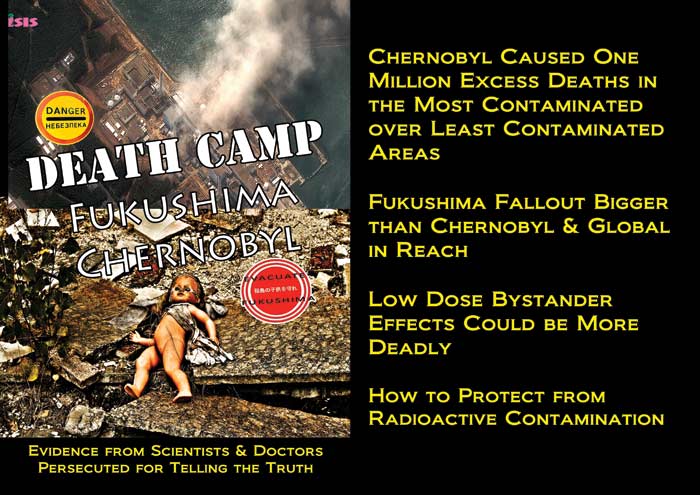
Death Camp Fukushima Chernobyl

Death Camp Fukushima Chernobyl is a concise summary of scientific evidence on:
  • The devastating health consequences of the Chernobyl radioactivity fallout suppressed by governments and pro-nuclear regulatory authorities
  • The real extent of the Fukushima fallout and health hazards faced by victims, both downplayed by the Japanese government and the regulatory authorities
  • New findings on the amplified health impacts of low dose ionizing radiation
  • Simple radioprotection measures.
It also shows why the official picture presented by organisations such as the WHO is highly misleading, and why countries still determined to go nuclear are clinging to obsolete energy and defence policies.

The report makes clear that children living in the highly contaminated areas outside the official evacuation zone around Fukushima Dai-ichi nuclear plants must be evacuated promptly in order to avert a humanitarian disaster on the scale of Chernobyl.  Concerted international effort is needed to provide help for evacuating the children and to continue health monitoring and research on radioprotection. Finally, a global phase out of nuclear power is in order given that a combination of renewable energy options can provide all our energy needs safely, sustainably and at much more affordable costs for all, as we made the case thoroughly in ([16] Green Energies - 100% Renewable by 2050, ISIS Report). 

References

  1. Stories from Fukushima, Message in a Bottle, From the kids of Fukushima to the World, accessed 20 June 2012,http://message.in.a.bottle.over-blog.com/pages/STORIES_FROM_FUKUSHIMA_ENGLISH-6985709.html
  2. Ho MW. Chernobyl deaths top a million. Science in Society 55 (to appear) 2012.
  3. Ho MW. Apple pectin for radioprotection. Science in Society 55 (to appear) 2012.
  4. Greaves S. The pectin controversy. Science in Society 55 (to appear) 2012.
  5. Ho MW. Fukushima nuclear crisis. Science in Society 50m 4-9, 2011.
  6. Ho MW. Truth about Fukushima. Science in Society 55 (to appear) 2012.
  7. Ho MW. Fukushima fallout rivals Chernobyl. Science in Society 55 (to appear) 2012.
  8. “Crisis plans lag even as Japan’s reactors restart”, Mari Yamaguchi, Associated Press, chron.com,  21 June 2012, http://www.chron.com/business/article/Crisis-plans-lag-even-as-Japan-s-reactors-restart-3650896.php#page-1
  9. “Probability of contamination from nuclear accidents is higher than expected” Max-Planck-Gesellschaft, 22 May 2012, http://www.mpg.de/5809418/reactor_accidents
  10. “Germany swaps nuclear for solar and wind power”, Oliver Lazenby, Truthout, 22 June 2012, http://truth-out.org/news/item/9932-germany-swaps-nuclear-for-solar-and-wind-power
  11. Saunders PT. UK’s nuclear illusion. Science in Society 55 (to appear) 2012.
  12. Greaves S . The true costs of French nuclear power. Science in Society 53, 8-11, 2012.
  13. Agreement between the International Atomic Energy Agency and the  World Health Organisation, IAEA/WHO, 1959, http://www.iaea.org/Publications/Documents/Infcircs/Others/inf20.shtml#note_c
  14. Chernobyl’s Legacy: Health Environmental and Socio-Economic Impacts and Recommendations to the Governments of Belarus, the Russian Federation and Ukraine. IAEA Division of Public Information. Vienna, IAEA, 2006, http://www.iaea.org/Publications/Booklets/Chernobyl/chernobyl.pdf
  15. Greaves S. WHO report on Fukushima a travesty. Science in Society 55 (to appear) 2012.
  16. Ho MW, Brett C, Burcher S and Saunders PT. Green Energies, 100 % Renewables by 2050, ISIS/TWN, London/Penang, 2009, http://www.i-sis.org.uk/GreenEnergies.php


Cell Phone Radiation Damages Sperm, Studies Show


EWG Science Review

Cell Phone Radiation Damages Sperm, Studies Show

Phones Carried on Belt or in Pants Pocket May Harm Reproductive Health

Although most scientific and public attention on the issue of the safety of cell phone radiation has focused on evidence suggesting an increased risk of brain tumors (Baan 2011), a little-noticed but growing body of research points to a new concern – sperm damage (La Vignera 2012).
In a comprehensive review of the published scientific literature, the Environmental Working Group found 10 human studies that have identified a startling variety of changes in sperm exposed to cell phone radiation. In the most striking findings, men who carried their phones in a pocket or on the belt were more likely to have lower sperm counts and/or more inactive or less mobile sperm. These findings accord with similar results in laboratory animals.
Collectively, the research indicates that exposure to cell phone radiation may lead to decreases in sperm count, sperm motility and vitality, as well as increases in indicators of sperm damage such as higher levels of reactive oxygen species (chemically reactive molecules containing oxygen), oxidative stress, DNA damage and changes in sperm morphology (see summary below).
Many men who talk on a cell phone using a Bluetooth device or other headset keep the phone in a pants pocket or clipped to a holster. This exposes their reproductive organs to cell phone radiation, and several studies have found lower sperm count and/or poorer sperm quality in men who use their phones this way than in those who do not.
Scientists have yet to identify a mechanism by which cell phone use might cause such effects (Makker 2009). However, the research appears to rule out the possibility that the changes are caused by simple heating, which is considered to be a possible source of some radiofrequency radiation-related health problems (De Iuliis 2009; Volkow 2011).
The findings are particularly significant in light of the fact that infertility affects approximately 15 percent of couples of reproductive age, and nearly half of these cases are linked to male fertility (Sharlip 2002). The number and consistency of the findings raise the possibility that cell phone radiation could be contributing to this significant public health problem and demand further investigation.
Studies linking cell phone exposure to harmful effects on sperm have been done in the United States, Australia, Austria, Hungary, Poland, Turkey and South Africa, using diverse methodologies. In some, scientists compared sperm counts and sperm health in men who wore cell phones on the hip with those who carried them elsewhere on the body or did not use cell phones at all. In others, researchers exposed sperm to cell phone radiation under laboratory conditions. In still others, scientists examined whether there was a correlation between sperm health and the intensity of cell phone use among men undergoing evaluation for infertility.
Among the findings:
  • Men who carried a phone in a hip pocket or on the belt had 11 percent fewer mobile sperm than men who kept a phone elsewhere on the body (Kilgallon 2005).
  • Men who carried a cell phone on the belt and used it intensively during a five-day test period had a 19 percent drop in highly motile sperm from their previous levels (Davoudi 2002).
  • Men who talked on the phone for more than an hour a day had 17 percent fewer highly motile sperm than men who talked less than 15 minutes a day (Fejes 2005).
Laboratory studies on the effects of cell phone radiation on rats, rabbits and other animals have found similar effects on reproductive health (Kesari 2011; Mailankot 2009).
All these studies found statistically significant correlations between cell phone radiation and sperm health, and many found that the adverse changes increased with the amount of radiation exposure. Opinions differ as to the possible mechanism by which cell phone radiation might produce these changes (Falzone 2010).
A number of research papers include unambiguous statements on the potential of cell phone radiation to affect men's reproductive health:
  • “Keeping the cell phone in a trouser pocket in talk mode may negatively affect spermatozoa and impair male fertility” (Agarwal 2009).
  • “Use of cell phones decreases the semen quality in men by decreasing the sperm count, motility, viability and normal morphology. The decrease in sperm parameters was dependent on the duration of daily exposure to cell phones and independent of the initial semen quality” (Agarwal 2008).
  • “These findings have clear implications for the safety of extensive mobile phone use by males of reproductive age, potentially affecting both their fertility and the health and wellbeing of their offspring” (De Iuliis 2009).
  • “Overall, these findings raise a number of related health policy and patient management issues that deserve our immediate attention. Specifically, we recommend that men of reproductive age who engage in high levels of mobile phone use do not keep their phones in receiving mode below waist level” (De Iuliis 2009).
  • “Our results showed that cell phone use negatively affects sperm quality in men… Men with poor sperm quality planning for pregnancy should be advised not to use cell phones extensively” (Gutschi 2011).
  • “The results show that human spermatozoa exposed to RF-EMR have decreased motility, morphometric abnormalities and increased oxidative stress, whereas men using mobile phones have decreased sperm concentration, motility…, normal morphology, and viability. These abnormalities seem to be directly related with the length of mobile phone use” (La Vignera 2012).
Given the backdrop of increasing infertility rates (Swan 2006), the research findings should be a wake-up call to male cell phone users who are trying to have children or may want to in the future.
Even as scientists continue to gather new data on health risks from cell phone radiation, the findings underscore that consumers should practice simple, precautionary safe-cell-phone-use habits, such as keeping the phone away from the body, in order to protect their health and fertility. Men, in particular, should avoid carrying a cell phone on the belt or in a pants pocket when in use.

What About Women's Health?

There are no published studies examining the effect of cell phone radiation on reproductive health in women. Such studies are much more difficult to carry out, since they often require invasive techniques. However, several recent articles suggested that cell phone radiation might be harmful to the developing fetus. For example, a 2009 study in Turkey found that after pregnant rats were exposed to cell phone radiation for 15 minutes twice a day during the entire gestation period, their female pups had fewer ovarian follicles (Gul 2009). A 2012 study by researchers at the Yale University School of Medicine found that mice exposed to cell phone radiation during gestation were hyperactive and had impaired memory (Aldad 2012).
There have been similar findings in two human studies. UCLA researchers reported that cell phone exposure during pregnancy and after birth was associated with behavioral problems in young children (Divan 2008; Divan 2012). This line of research is just beginning, but a recent review article emphasized that cell phone radiation might impact reproduction and development in both men and women (Merhi 2011).
Table: Peer-reviewed studies of the effects of cell phone radiation on male reproduction
ReferenceStudy designFindingType of exposure
Davoudi M, Brossner C, Kuber W. 2002. The influence of electromagnetic waves on sperm motility. Journal für Urologie und Urogynäkologie 19: 19-22.Semen analysis for 13 male volunteers who carried a cell phone on the belt and actively used it for 5 days.Compared to a period of cell phone use on the belt by the same volunteers, cell phone use was associated with decreased sperm motility. The percentage of highly motile sperm (classified as "rapid progressive sperm") dropped from a mean of 32% to a mean of 26% after the exposure.GSM phone; study participants used phones for at least 6 hours/day.
Fejes I, Zavaczki Z, Szollosi J, Koloszar S, Daru J, Kovacs L, et al. 2005. Is there a relationship between cell phone use and semen quality? Arch Androl 51(5): 385-93.Semen analysis for 371 men who attended an infertility clinic in 2002-2004.Low-volume cell phone users (less than 15 minutes a day) had a higher percentage of rapid progressive motile sperm (48.7%) than high-volume (more than one hour a day) cell phone users (40.6%).Pattern of use identified by a questionnaire, including duration of phone possession and frequency of daily use.
Kilgallon SJ, Simmons LW. 2005. Image content influences men's semen quality. Biol Lett 1(3): 253-5.Analysis of sperm samples from 52 healthy men aged 18-35.Men who carried a cell phone in a hip pocket or on the belt had lower sperm motility (49.3% motile sperm) than men who did not use a cell phone near the hip (55.4% motile sperm).Questionnaire responses identified men who carried a cell phone in a hip pocket or on the belt, non-users and those who kept a phone elsewhere.
Erogul O, Oztas E, Yildirim I, Kir T, Aydur E, Komesli G, et al. 2006. Effects of electromagnetic radiation from a cellular phone on human sperm motility: an in vitro study. Arch Med Res 37(7): 840-3.Semen samples collected from 27 men exposed to cell phone radiation under laboratory conditions.Exposed specimens had a decrease in rapid progressive sperm from 13% to 9%; a decrease in slow progressive sperm from 44% to 34% and an increase in immotile sperm from 36% to 51%.Test specimens were exposed for 5 minutes to GSM cell phone radiation at 900 MHz.
Wdowiak A, Wdowiak L, Wiktor H. 2007. Evaluation of the effect of using mobile phones on male fertility. Ann Agric Environ Med 14(1): 169-72.Sperm parameters examined in a group of 304 males enrolled at an infertility clinic in 2004-2006.16.7% of regular cell phone users had normal semen morphology, compared to 55.6% of non-users. In 35% of frequent cell phone users, sperm motility dropped by up to a half; only 9% of non-users had comparable decreases in sperm motility.Based on questionnaire responses, 99 participants were classified as cell phone non-users; 157 had used GSM phones sporadically for 1-2 years; and 48 had used cell phones regularly for more than 2 years.
Agarwal A, Deepinder F, Sharma RK, Ranga G, Li J. 2008. Effect of cell phone usage on semen analysis in men attending infertility clinic: an observational study. Fertil Steril 89(1): 124-8.Sperm parameters examined in 361 men undergoing infertility evaluation in 2004-2005Patients who used cell phones more than 4 hours a day had a 42% lower sperm count and 33% lower sperm motility than non-users. The percentage of sperm with normal morphology in high-level users was half that of non-users. Rates of normal morphology were decreased with greater levels of cell phone use.Based on questionnaire responses, cell phone exposure was classified in four groups: no use; less than 2 hours/day; 2-4 hours/day; and more than 4 hours/day.
Agarwal A, Desai NR, Makker K, Varghese A, Mouradi R, Sabanegh E, et al. 2009. Effects of radiofrequency electromagnetic waves (RF-EMW) from cellular phones on human ejaculated semen: an in vitro pilot study. Fertil Steril 92(4): 1318-25.Semen samples collected from 23 normal healthy donors and 9 infertile patients were exposed to cell phone radiation under laboratory conditions.Semen samples exposed to cell phone radiation showed a significant drop in sperm motility (52% to 49%) and viability (59% to 52%); nearly doubled production of reactive oxygen species levels; and a decrease in total antioxidant capacity, a measure of oxidative stress.Samples exposed for 1 hour to radiation from GSM cell phone in talk mode at 850 MHz frequency.
De Iuliis GN, Newey RJ, King BV, Aitken RJ. 2009. Mobile phone radiation induces reactive oxygen species production and DNA damage in human spermatozoa in vitro. PLoS One 4(7): e6446.Purified human sperm from 22 healthy donors were exposed to cell phone radiation under laboratory conditions.Exposed sperm samples showed lower sperm motility and vitality, production of reactive oxygen species and DNA fragmentation. At SAR of 1.0 W/kg sperm, motility decreased from 86% in unexposed sperm to 68%; vitality decreased from 89% to 65%.Samples were exposed to 1800 MHz radiation at a range of SAR values from 0.4 W/kg to 27.5 W/kg for 16 hours, at a constant temperature of 210C to rule out thermal effects.
Falzone N, Huyser C, Becker P, Leszczynski D, Franken DR. 2011. The effect of pulsed 900-MHz GSM mobile phone radiation on the acrosome reaction, head morphometry and zona binding of human spermatozoa. Int J Androl 34(1): 20-6.Purified human sperm collected from 12 healthy volunteers were exposed to cell phone radiation under laboratory conditions.Cell phone radiation exposure appeared to affect sperm's fertilization potential. Exposed sperm's head area dropped by 50%. Sperm-oocyte interaction was decreased by 28% compared to unexposed controls.Samples were exposed for 1 hour to 900 MHz GSM mobile phone radiation at SAR of 2.0 W/kg.
Gutschi T, Mohamad Al-Ali B, Shamloul R, Pummer K, Trummer H. 2011. Impact of cell phone use on men's semen parameters. Andrologia: 43(5): 312-6.Analysis of semen samples from 2,100 men seen at an infertility clinic in 1993-2007.68% of the sperm from cell phone users had pathological morphology, compared to 58% of sperm from non-users. Abnormal sperm morphology diagnosed in 45% of cell phone users versus 27.7% of non-users.Retrospective study compared 991 cell phone users and 1,119 non-users identified via questionnaire responses.
References
Agarwal A, Deepinder F, Sharma RK, Ranga G, Li J. 2008. Effect of cell phone usage on semen analysis in men attending infertility clinic: an observational study. Fertil Steril 89(1): 124-8.
Agarwal A, Desai NR, Makker K, Varghese A, Mouradi R, Sabanegh E, et al. 2009. Effects of radiofrequency electromagnetic waves (RF-EMW) from cellular phones on human ejaculated semen: an in vitro pilot study. Fertil Steril 92(4): 1318-25.
Aldad TS, Gan G, Gao XB, Taylor HS. 2012. Fetal radiofrequency radiation exposure from 800-1900 mhz-rated cellular telephones affects neurodevelopment and behavior in mice. Sci Rep 2: 312.
Baan R, Grosse Y, Lauby-Secretan B, El Ghissassi F, Bouvard V, Benbrahim-Tallaa L, et al. 2011. Carcinogenicity of Radiofrequency Electromagnetic Fields. Lancet Oncology 12(7): 624-26.
Davoudi M, Brossner C, Kuber W. 2002. The influence of electromagnetic waves on sperm motility [in German, “Der Einfluß elektromagnetischer Wellen auf die Spermienmotilität”]. Journal für Urologie und Urogynäkologie 9(3): 18-22.
De Iuliis GN, Newey RJ, King BV, Aitken RJ. 2009. Mobile phone radiation induces reactive oxygen species production and DNA damage in human spermatozoa in vitro. PLoS One 4(7): e6446.
Divan HA, Kheifets L, Obel C, Olsen J. 2008. Prenatal and postnatal exposure to cell phone use and behavioral problems in children. Epidemiology 19(4): 523-9.
Divan HA, Kheifets L, Obel C, Olsen J. 2012. Cell phone use and behavioural problems in young children. J Epidemiol Community Health 66(6): 524-9.
Erogul O, Oztas E, Yildirim I, Kir T, Aydur E, Komesli G, et al. 2006. Effects of electromagnetic radiation from a cellular phone on human sperm motility: an in vitro study. Arch Med Res 37(7): 840-3.
Falzone N, Huyser C, Franken DR, Leszczynski D. 2010. Mobile phone radiation does not induce pro-apoptosis effects in human spermatozoa. Radiat Res 174(2): 169-76.
Falzone N, Huyser C, Becker P, Leszczynski D, Franken DR. 2011. The effect of pulsed 900-MHz GSM mobile phone radiation on the acrosome reaction, head morphometry and zona binding of human spermatozoa. Int J Androl 34(1): 20-6.
Fejes I, Zavaczki Z, Szollosi J, Koloszar S, Daru J, Kovacs L, et al. 2005. Is there a relationship between cell phone use and semen quality? Arch Androl 51(5): 385-93.
Gul A, Celebi H, Ugras S. 2009. The effects of microwave emitted by cellular phones on ovarian follicles in rats. Arch Gynecol Obstet 280(5): 729-33.
Gutschi T, Mohamad Al-Ali B, Shamloul R, Pummer K, Trummer H. 2011. Impact of cell phone use on men's semen parameters. Andrologia 43(5): 312-6.
Kesari KK, Kumar S, Behari J. 2011. Effects of radiofrequency electromagnetic wave exposure from cellular phones on the reproductive pattern in male wistar rats. Appl Biochem Biotechnol 164(4): 546-59.
Kilgallon SJ, Simmons LW. 2005. Image content influences men's semen quality. Biol Lett 1(3): 253-5.
La Vignera S, Condorelli RA, Vicari E, D'Agata R, Calogero AE. 2012. Effects of the Exposure to Mobile Phones on Male Reproduction: A Review of the Literature. J Androl 33(3): 350-6.
Mailankot M, Kunnath AP, Jayalekshmi H, Koduru B, Valsalan R. 2009. Radio frequency electromagnetic radiation (RF-EMR) from GSM (0.9/1.8GHz) mobile phones induces oxidative stress and reduces sperm motility in rats. Clinics (Sao Paulo) 64(6): 561-5.
Makker K, Varghese A, Desai NR, Mouradi R, Agarwal A. 2009. Cell phones: modern man's nemesis? Reprod Biomed Online 18(1): 148-57.
Merhi ZO. 2011. Challenging cell phone impact on reproduction: a review. J Assist Reprod Genet 29(4): 293-7.
Sharlip ID, Jarow JP, Belker AM, Lipshultz LI, Sigman M, Thomas AJ, et al. 2002. Best practice policies for male infertility. Fertil Steril 77(5): 873-82.
Swan SH. 2006. Does our environment affect our fertility? Some examples to help reframe the question. Semin Reprod Med 24(3): 142-6.
Volkow ND, Tomasi D, Wang GJ, Vaska P, Fowler JS, Telang F, et al. 2011. Effects of cell phone radiofrequency signal exposure on brain glucose metabolism. Journal of the American Medical Association 305(8): 808-13.
Wdowiak A, Wdowiak L, Wiktor H. 2007. Evaluation of the effect of using mobile phones on male fertility. Ann Agric Environ Med 14(1): 169-72.
WHO (World Health Organization). 2011. IARC Classified Radiofrequency Electromagnetic Fields as Possibly Carcinogenic to Humans. Press Release # 208. 31 May 2011. Available: http://www.iarc.fr/en/media-centre/pr/2011/pdfs/pr208_E.pdf
http://www.ewg.org/cellphoneradiation/sperm_damage

Tuesday, June 26, 2012

Experts warn of another disaster awaiting at Fukushima


Experts warn of another disaster awaiting at Fukushima


Australian Broadcasting Corporation
Broadcast: 25/06/2012
Reporter: Mark Willacy
Japanese and US nuclear experts warn that another earthquake hitting Fukushima could spark a disaster worse than Chernobyl.

Transcript

LEIGH SALES, PRESENTER: One more major earthquake in Japan and the nation could face a nuclear disaster 10 times the scale of Chernobyl. That's what experts are telling 7.30.

When Japan was hit last year by a massive earthquake and tsunami, the world feared nuclear catastrophe.

The nation's Fukushima nuclear reactors were inside the disaster zone.

We've not heard much about them for a while, but the danger certainly hasn't passed.

Experts say the situation inside Fukushima reactor number four is precarious, as North Asia correspondent Mark Willacy reports from Fukushima.

MARK WILLACY, REPORTER: It's said fortune favours the brave. And after enduring an earthquake, a tsunami and a series of nuclear meltdowns, the people of Fukushima reckon they're due for some luck.

For 13 months, this track was idle. Horses and people kept away because of the fear of radiation. But today, Fukushima is out for a flutter. 

So is this a sign that Fukushima's luck is turning? Possibly. But few here actually realise that a few kilometres to the east is the spent fuel pool of the Fukushima nuclear plant, containing enough nuclear fuel to spawn a catastrophe to dwarf Chernobyl.

In the gloom of this pool, a 1,331 highly radioactive spent nuclear fuel assemblies each containing dozens of rods.

ROBERT ALVAREZ, INSTITUTE OF POLICY STUDIES: The spent fuel pool number four at Fukushima, based on my sorta calculations, contains roughly 10 times more cesium 137 then released by the Chernobyl accident.

MARK WILLACY: It's also clear from this footage that the pool is littered with debris from last year's disaster.

HIROAKI KOIDE, NUCLEAR ENGINEER (voiceover translation): The nuclear fuel in that pool is 2.5 times what's needed in a reactor core. It contains 5,000 times more cesium than was released by the Hiroshima bomb and the pool is just hanging there. We don't know when it could collapse.

MARK WILLACY: This is where the pool sits, five storeys above the ground next to the reactor. That is how things are supposed to look. This is how the reactor building looks now after a hydrogen explosion blew it apart. The blast tore off the roof and caused a reinforced wall of the fuel pool to bulge by up to 3.5 centimetres. As for the hundreds of tonnes of spent fuel, until this month its only protection from the elements was a white plastic sheet. Some nuclear experts warn Japan is literally playing with fire.

HIROAKI KOIDE (voiceover translation): If there's a crack in the pool and water drains out, the fuel rods will be exposed. It will then be impossible to cool the fuel. So if an accident happens, 10 times more cesium than has already been released by the Fukushima meltdown will go into the atmosphere. Depending on which way the wind is blowing, Tokyo could become uninhabitable.

MARK WILLACY: Hiroaki Koide is a senior nuclear reactor engineer at Japan's prestigious Kyoto University and one of the experts raising the alarm.

HIROAKI KOIDE (voiceover translation): As soon as possible, those fuel rods should be removed. Earthquakes are striking almost every day around the Fukushima plant, so I'm praying that a big one won't hit.

MARK WILLACY: This warning is echoed by international nuclear safety experts, among them, Robert Alvarez, a former advisor to the US Secretary of Energy.

ROBERT ALVAREZ: You have a very, very large concentration of radioactivity where the only thing that keeps that radioactivity from being released through a catastrophic fire is a pool of water. That pool is 100 feet off the ground in a structurally damaged building in a high-risk earthquake zone. I mean, what more you can be worried about?

MARK WILLACY: But the operator of Fukushima TEPCO brushes all this aside, arguing that despite being open to the elements and in a damaged building 30 metres above the ground, the pool is safe.

YOSHIMI HITOSUGI, TEPCO SPOKESMAN (voiceover translation): We checked its condition the other day and although there is a bulge in one wall, we don't think this will have any effect on the soundness of the pool or the building. We believe both can withstand a large earthquake. 

MARK WILLACY: And on the matter of removing the fuel rods, TEPCO appears in no great hurry.

YOSHIMI HITOSUGI (voiceover translation): The original method was to take out the spent fuel via crane attached to the ceiling of the building, but that's been damaged, so we are thinking of installing a crane for this. We would like to start removing the fuel some time next year. 

ROBERT ALVAREZ: They have to have a heavy overhead crane. They're going to have to manipulate the spent fuel under water constantly, put it into containers that are very heavy involving perhaps containers that may weigh as much as 100 tonnes. ... This requires extraordinary precautions, even under a routine basis, so given the magnitude of the damage, that sort of ups the stakes quite a bit in terms of the capability to safely remove this material.

MARK WILLACY: Ever since the meltdowns, TEPCO has maintained a veil of secrecy over what's happening at Fukushima. But one man has managed to penetrate it. Tomohiko Suzuki is a rarity in Japanese journalism: a reporter prepared to put his health on the line to get to the truth.

TOMOHIKO SUZUKI, JOURNALIST (voiceover translation): When I went undercover as a worker at the Fukushima plant, I wore protection gear, but over my sleeve I wore this watch, which has a secret camera inside.

MARK WILLACY: With his secret camera watch and other hidden devices, Suzuki recorded life inside the Fukushima plant. Working next to the reactor four building, he was shocked by what he was told about the fuel pool 30 metres above him.

TOMOHIKO SUZUKI (voiceover translation): I spoke to a worker who helped reinforce the reactor four building. He said the spent fuel pool has vast amounts of heavy water in it and that the steel support frames were damaged, but he told me that the reinforcement of the pool was jerry-rigged, so if a typhoon or a tornado hits, it will be dangerous.

MARK WILLACY: Sound far-fetched? Well, just last month a neighbouring prefecture to Fukushima was smashed by the most violent tornados recorded in Japanese history.

MISUHEI MURATA, FORMER JAPANESE DIPLOMAT: I call it the sickness of Japan. First, we hide, then we postpone and then we assume no responsibility.

MARK WILLACY: Misuhei Murata is a former Japanese ambassador to Switzerland. He's brought his fears about the fuel pool to the attention of the United Nations Secretary-General Ban Ki-moon.

MISUHEI MURATA: TEPCO and the Government of Japan not only lacks the ability, but the intention.

MARK WILLACY: So in your opinion if there was a problem with that fuel pool, it would be the end of Japan?

MISUHEI MURATA: Yes. There is no-one who denies that. ... We cannot sleep peacefully.

MARK WILLACY: So who should be the people of Fukushima back? A collection of nuclear experts, journalists and concerned activists struggling to be heard, or TEPCO with its history of cover-ups and incompetence?

VOX POP (voiceover translation): I do not believe TEPCO. I do not feel safe at all. Radiation levels are still high.

HIROAKI KOIDE (voiceover translation): TEPCO says the fuel pool can withstand the next big earthquake, but I can't believe this. That's why I'm so worried.

ROBERT ALVAREZ: Nothing like this has ever happened before and we are sort of charting unknown waters here. And this is a problem that if such an event were to occur, it would be of an international dimension.

LEIGH SALES: Mark Willacy reporting.


http://www.abc.net.au/7.30/content/2012/s3532725.htm

Monday, June 25, 2012

Austrian Medical Association Objects to Smart Meter Rollout


Austrian Medical Association Objects to Smart Meter Rollout
 The Austrian Chamber of Physicians is calling for a reconsideration or suspension of “the planned timetable of the mandatory introduction of ‘smart meters’” in Austria, “pending clarification and solution of open questions.”
Austrian Medical Association“The Austrian Chamber of Physicians strictly rejects another, in this case actually state-mandated, expansion of the electrosmog exposure on the Austrian population.”
“The expected health consequences would be an increase in symptoms and diseases that fall into the category of so-called multi-system diseases. This illness is characterized by involving several organs or functional systems at the same time and in interaction.”
“These health and socioeconomic consequences that are to be expected are, from the perspective of the Austrian Chamber of Physicians, mandatory to be included in the consideration.”
“Who is liable in the event of health problems and diseases caused by the increased field exposure on the part of the Smart Meter?”
“To date, the Interference resistance of smart meters is not clarified in the case of elevated solar activity. From NASA there are corresponding warnings for the years 2012 to 2014. This could lead to an increased risk to total failure of the power supply.”

Attached Documentation:

Press release, February 2012:  German | English translation
Letter by Austrian Chamber of Physicians to the Austrian Federal Ministry for Economics, Family and Youth, January 2012: German | English translation