Showing posts with label cell phones. Show all posts

Monday, July 29, 2019

California - Hollister school district bans cell phone use on campuses

HOLLISTER, Calif. - The Hollister Elementary School District Board this week decided to ban cell phone-use by students on campus for the upcoming school year. 
Students will be required to turn off their cell phones before setting foot at the district's elementary and middle schools. 
"I never even thought about elementary schools, but I understand there are second graders, second graders have cell phones and they're doing the same type of thing," said Stephen Kain, the board president of HESD.
Kain was a teacher before he retired. He remembers the exact time when cell phones and smart phones started becoming a problem in class, let alone in 2019 with constant access to social media like Snapchat and Instagram at the touch of a screen. 
"If you are worrying about what the last person said about you or posted a picture of you, it really raises the anxiety level of kids at school," said Kain. "When you have a high anxiety level, you can't learn. You're too worried about other things."
The school district board voted to ban cell-phone use for students unanimously. 
"The rule will be they're turned off as soon as you walk onto campus. You can turn them on again as soon as you leave campus," said Kain.
Cell phones must also be kept out of sight at all times. They will not be allowed during transition times or breaks either. 
If students are caught using a cell phone during school for the first time, their phone will be taken away and parents must retrieve the device from the office themselves. If they are caught a second time, parents will have to speak with administrators about the issue. If they are caught a third time, the student will not be allowed to take a cell phone to school anymore completely. 
"It distracts everything of the students, of the teachers. And if it was myself, and I was a teacher, I would say no cell phones in class, leave it home," said Geraldine Rodriguez, a Hollister resident. 
But some students say the rules are too harsh. 
"I feel like it's a good idea to keep it in your pocket or in your backpack, but I don't think they should take it away during break or lunch because I think that's too extreme," said Nataly Delgado, a Hollister high school student who attended middle school in the city. 
But problems with cyberbullying and the potential for academic cheating are other reasons why the district voted for the ban. 
"If you're going to learn, you need to have your full focus on learning. You can't be worrying about other things. And that's where we're coming from," said Kain. 
There are 5,600 students across the entire district. The new policy will take effect in August on the first day of school. This does not include the high school in Hollister or anywhere else in San Benito County. 

Monday, July 22, 2019

Cellphones a flight risk?

Cellphones a flight risk? Could be on some Boeing jets.

Potentially hundreds of planes worldwide are flying with unsafe systems cited in an FAA report. 


(Bloomberg)—U.S. government officials in 2014 revealed an alarming safety issue: Passenger cellphones and other types of radio signals could pose a crash threat to some models of Boeing 737 and 777 airplanes.
More than 1,300 jets registered in the U.S. were equipped with cockpit screens vulnerable to interference from Wi-Fi, mobile phones and even outside frequencies such as weather radar, according to the Federal Aviation Administration, which gave airlines until November 2019 to replace the units made by Honeywell International Inc.
Today, potentially hundreds of planes worldwide are still flying with the unsafe systems cited in the FAA report. Flight-critical data including airspeed, altitude and navigation could disappear and “result in loss of airplane control at an altitude insufficient for recovery,” the FAA said in the safety bulletin, known as an airworthiness directive.
Honeywell hasn’t heard of any blanking display screens caused by cell phones or other radio frequencies while an airplane was in flight, spokeswoman Nina Krauss said. When airlines and Honeywell argued that radio signals were unlikely to cause safety problems during flight, though, the FAA countered that it had run tests on in-service planes -- and the jets flunked.
Boeing Co. found the interference in a laboratory test in 2012 and hasn’t seen similar issues on other aircraft, a company spokesman said. Honeywell is aware of only one case where all six display units in a 737 cockpit went blank, Krauss said. The cause was a software problem that has been fixed and is currently being flight-tested, she said.
The affected 737s are the so-called Next Generation model, a predecessor of the Boeing Max, which was involved in two crashes in less than five months. Cockpit displays on the Max were made by Rockwell Collins, now a unit of United Technologies Corp., not Honeywell. Boeing’s 777s also were covered by the FAA order.
The FAA order didn’t quantify the amount of radio signals needed to cause interference problems. Still, the radio-signal threat extends beyond that specific display system and FAA warning.
Numerous cell phones left on during any airplane flight “could be a real problem," said professor Tim Wilson, department chair for electrical, computer, software and systems engineering at Embry-Riddle Aeronautical University. The greater the number of phones emitting radio signals, he said, the greater the potential for interference with a plane’s flight system.
Many airlines now permit passengers to turn their phones to “airplane mode," which allows Wi-Fi transmissions. But mobile phones operate at higher power levels, Wilson said, since the signals must reach a cell tower and not just a local antenna or router. “So cellular service is potentially more impactful," he added.
The FAA in 2013 began the process of allowing wider use of electronic devices on planes, provided airlines could demonstrate it was safe. That prompted an outcry from consumer groups concerned about passengers being subjected to the cellphone conversations of seatmates.
No U.S. airlines allowed it and, in 2018, Congress barred the use of cellphones for calls during flights.

Friday, July 12, 2019

Madonna says giving her children mobile phones ‘ended their relationship’

The singer says her children’s lives became dominated by the technology

Madonna said ‘I made a mistake when I gave my children phones when they were 13.’ 
Photograph: Kevin Mazur/Getty Images for Mdna Skin


It’s a daily bane of modern parenting that even Madonna appears to have got hung up on: how to keep a child’s attention once you give them a mobile phone.
Madonna has complained of losing a link to her children after giving them mobile phones at a relatively young age, to the extent that she has prevented her 13-year-old son from having one.
“I made a mistake when I gave my older children phones when they were 13,” said the mother of six, who has previously talked about feeling like “Billy-no-mates” while living in Lisbon in Portugal, where she said she spent most of her time doing the school run or driving her youngest son to football matches.
In an interview with Vogue magazine, she said: “It ended my relationship with [my children], really. Not completely, but it became a very, very big part of their lives. They became too inundated with imagery and started to compare themselves to other people, and that’s really bad for self-growth.”
Her adopted son, David, has been deprived of a phone. She said he was most similar to her out of any of her children.
“He’s the one I have the most in common with. I feel like he gets me,” Madonna said of the teenager, who is part of the youth academy at Benfica football club in Lisbon.
She was somewhat more critical of her 22-year-old daughter, Lourdes; social media was an issue, she said.
“She doesn’t have the same drive [as me] – and again, I feel social media plagues her and makes her feel like: ‘People are going to give me things because I’m [Madonna’s] daughter.’ I try to give her examples of other children of celebrities who have to work through that ‘Oh yeah, you’re the daughter of … ’ and then eventually you are taken seriously for what you do.”
The singer, who turned 60 last year, also attacked ageism in the music industry, claiming people had tried to silence her in the past for reasons such as supposedly being “not pretty enough” or not talented enough.
“Now it’s that I’m not young enough,” she said.
Madonna, who was recently named the most successful solo artist in the 60-year history of the US Billboard Hot 100 songs chart, gave the interview to promote her new single, Medellín.
The song has been released as part of her latest reinvention under the alter ego of Madame X. That is also the title of her forthcoming 14th album, which follows a number of commercially underwhelming records.

Source

Monday, July 08, 2019

Effect of mobile phone radiation on pentylenetetrazole-induced seizure threshold in mice

. 2016 Jul; 19(7): 800–803

Introduction

The application of mobile phone technology and scientific interest in its potential impact on human brain and performance has significantly increased in the recent years (). Epilepsy is the most common brain disorder after stroke, and its prevalence is growing due to various reasons (). Epilepsy is commonly associated with the brain dysfunctions leading to hyperexcitability of neurons. It is assumed that there is an imbalance between inhibitory GABA-mediated and excitatory glutamate-mediated neurotransmission (). Several studies have demons-
trated the effects of electromagnetic mobile phone waves on central nervous system (). It was shown that brain changes caused by electromagnetic waves are well reflected in the EEG of rats; also the largest changes are reported in brain activity of the limbic and olfactory cortex and the subcortical parts (). It was also demonstrated that if the electromagnetic fields (EMFs) are exactly radiated in the contralateral brain cortex, the patient’s cortex nerve stimulation increases (). A few studies investigated the effects of exposure to EMFs on epileptic disorders in human and experimental subjects, but the results are controversial (). The present study was designed to examine the effects of acute and chronic mobile phone radiation on clonic and tonic seizure thresholds induced by intravenous infusion of pentylenetetrazole (PTZ) in mice.

Conclusion:
Our data suggests that the continued and prolonged contact with the mobile phone radiation might increase the risk of seizure attacks and should be limited.

Thursday, July 04, 2019

The possible global hazard of cell phone radiation on thyroid cells and hormones: a systematic review of evidences

 2019 Jun;26(18):18017-18031
Asl JF1Larijani B2Zakerkish M3Rahim F4,5,6Shirbandi K7Akbari R8.

Abstract


The aim of this review was to investigate the effects of possible harmful waves from either cell phone use or being within the range of the cell phone from 450 to 3800 MHz on the thyroid cells and hormones. Eight electronic datasets were systematically searched using MeSH terms, including "cell phone," "mobile phone," "GSM," "radio frequency," "smartphone," "triiodothyronine," "thyroxin," "thyroid-stimulating hormone," "T3," "T4," "TSH," and "morphological" and all possible combinations, to identify relevant studies published up to Dec 2018. We also manually searched the reference lists of potentially selected studies to identify further relevant publications. About 161 relevant studies were initially found. After screening titles and abstracts, 139 studies were excluded, and finally 22 studies (comprising 7182 cases) were included in the qualitative synthesis. Of the 22 included studies, 11 studies reported changes in T3 and T4 levels (six reported a decrease in T3 levels and one reported increase in it); moreover, five found decreased T4 levels and two studies an increased level. In other 10 studies, TSH alteration was reported. Of these, two studies reported a decrease in TSH level and one reported an increase in the hormone levels, while in the remaining studies non-significant changes were reported. Finally, seven studies examined histological changes in the thyroid gland follicles and showed that the volume of these cells was reduced. Based on the evidence discussed above, the reduction in diameter of thyroid follicles is potentially linked with cell phone radiation. Exposure may negatively influence the iodine uptake in the thyroid gland or increases temperature effect on the thyroid gland. However, further research are needed in order to show that the level of TSH and thyroid hormone suppression by microwave.

Source

Tuesday, July 02, 2019

Ninth Circuit Court Upholds Berkeley's "Cell Phone Right to Know" Law

Electromagnetic Radiation Safety, July 2, 2019

Today a Federal appeals court upheld the "cell phone right to know" law adopted by the City of Berkeley in May, 2015.

The Ninth Circuit Court of Appeals affirmed Berkeley's right to require cell phone retailers in the city to notify prospective customers about cell phone manufacturers' safety guidelines to ensure consumer safety. 

The mandatory notification states:
"The City of Berkeley requires that you be provided the following notice: 
“To assure safety, the Federal Government requires that cell phones meet radiofrequency (RF) exposure guidelines. If you carry or use your phone in a pants or shirt pocket or tucked into a bra when the phone is ON and connected to a wireless network, you may exceed the federal guidelines for exposure to RF radiation. Refer to the instructions in your phone or user manual for information about how to use your phone safely.”
The CTIA--The Wireless Association filed a lawsuit in June, 2015, a month after the law was adopted, to block the ordinance claiming that it violated the Telecom industry's First Amendment rights and that the notification was preempted by Federal law. After the city adopted a minor change in the safety notice, the Federal district court ruled against the industry's request for a preliminary injunction. The law has been in effect in the city since March 21, 2016.

Today on a 2-1 decision, a panel of judges from the Ninth Circuit Court of Appeals issued the following opinion ....

<SNIP>

For a detailed chronology of the ordinance adoption by the City of Berkeley and the ensuing lawsuit filed by the CTIA including a copy of today's ruling go to:

Related Post:

-- 

Joel M. Moskowitz, Ph.D., Director
Center for Family and Community Health
School of Public Health
University of California, Berkeley

Electromagnetic Radiation Safety
Website:          https://www.saferemr.com
Facebook:        https://www.facebook.com/SaferEMR
Twitter:            @berkeleyprc

Monday, June 24, 2019

Young Adults Are Growing Horns As a Result of Cell Phone Use

People are evolving to possess horns in their backs due to frequent mobile phone usage. I wish I were kidding, but I’m not. Researchers at the University of the Sunshine Coast in Queensland, Australia made the discovery and claim that human physiology is being permanently altered.
If you’re reading this article on your phone, it doesn’t exactly mean you’re going to end up with two large prehistoric looking blades protruding from your backside. However, the news isn’t comforting even when taken at its authentic meaning.
Here’s what’s happening.
When you look at a mobile device, you tilt your head at a specific angle. This position redistributes weight that normally sits on the spine to back muscles. This is resulting in bones producing new ligaments and tendons to help deal with the new stressor. And all of this means horn-like features protruding from the base area of the skull.
“Our findings raise a concern about the future musculoskeletal health of the young adult population and reinforce the need for prevention intervention through posture improvement education,” the report states.
This “prominent exostosis,” as it is scientifically described, occurs more in the young than in the old. No surprises there. The sizing of the horns specified in the report is 10–31 mm.
But don’t take my word for it, have a look for yourself. Below are two radiographs from two 28-year-old men. Note the presence of “horns.”
Prominent exostosis
radiographs display sizeable enthesophytes protruding from base of skull.
humans growing back horns from mobile phone use
radiographs display sizeable enthesophytes protruding from base of skull.
When the researchers increased the age group by ten years, the instances of horns showed a 1.03 reduction. This further confirms the issue is mobile phone based as young people use portable technology more than their parents.
Here’s an excerpt from the study.
Repetitive and sustained mechanical load is required for robust adaptation to take place in tendon properties, as connective tissue adaptive response to load necessitates a slow process of matrix protein (collagen) production4,6,22. The development of EEOP may be attributed to, and explained by, the extensive use of screen-based activities by individuals of all ages, including children25,26,27, and the associated poor posture.
This report is yet another indication that our technology enslavement is quite literally changing human life, even at the physiological level. Humans are evolving more and more to become technological beings. But that may not be the worst of our tech crisis.
New 5G technology is being blamed for serious health risks all over the world, although government officials largely dispute these claims. Another technology concern involves citizen surveillance. Big box retailer Walmart announced that it would install spying technology throughout its stores.
There is little question that humans are going to need to find a way to contend with technology’s dark side. Clearly, technological advances are helpful to human life. It makes things more convenient, it also helps us discover information and news at a faster rate. Moreover, cryptocurrency assists citizens of nations with restrictive censorship laws spread information. Things certainly aren’t all bad with technology, however, our reliance on such conveniences enslaves us.

Source

Monday, June 03, 2019

Colorectal Cancer Is Soaring Among Young Adults Are Smartphones in the Mix?

Epidemiologist De-Kun Li Wants To Know


De-Kun Li wants to change the conversation on cell phones and cancer. Li, a senior epidemiologist and veteran EMF researcher, believes that brain tumors have been getting too much attention at the expense of other types of cancer, notably colorectal cancer.
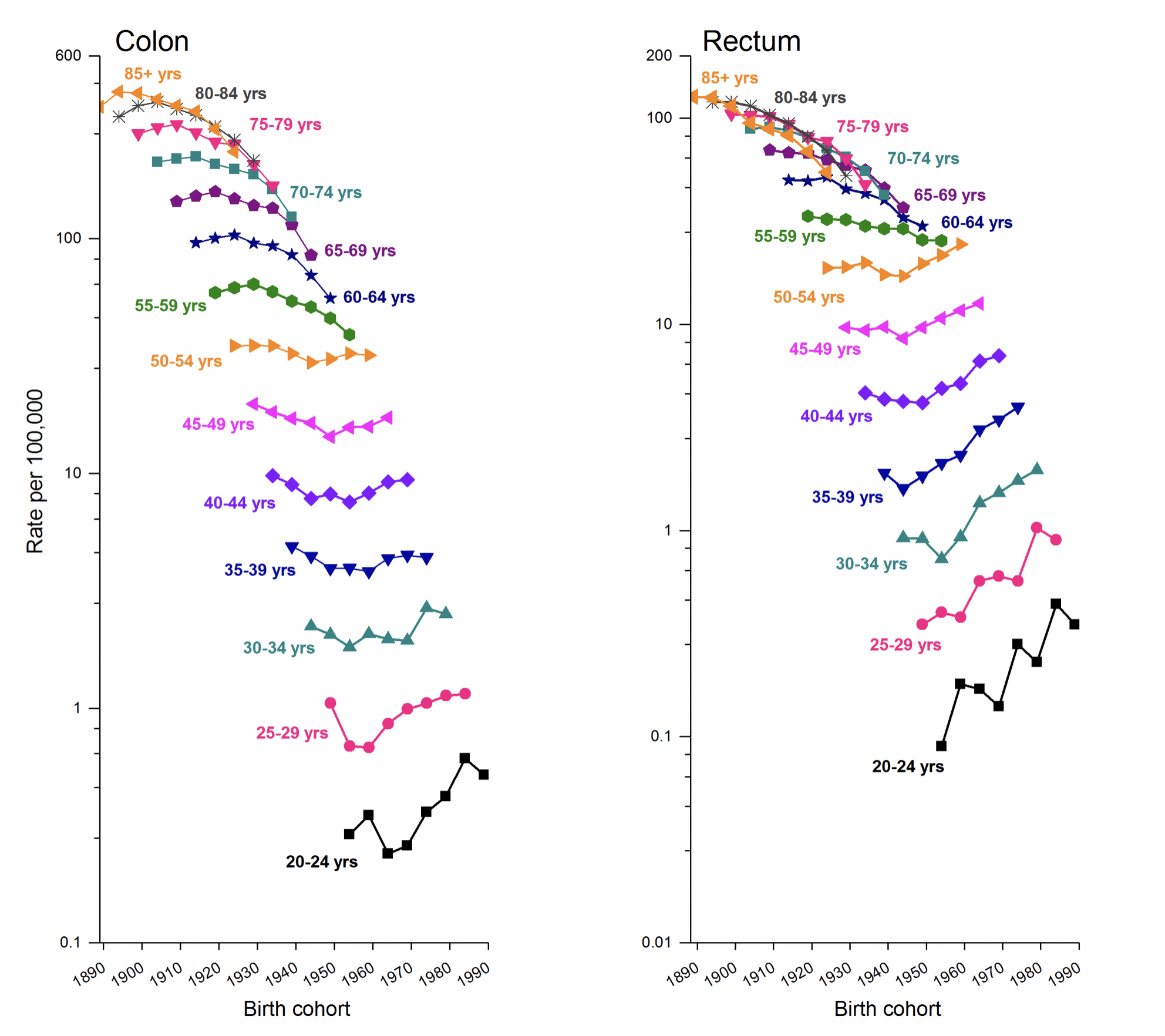
Efforts to reduce colon and rectal cancers have been a striking success story for those over 50 years old. Incidence among older Americans declined 32% between 2000 and 2013, due largely to better screening. But the story for young adults is very different. Those born around 1990 now face four times the risk of developing rectal cancer and twice the risk of colon cancer in their 20s, compared to those born around 1950, according to the American Cancer Society. (Rates among young adults are still relatively low; see graphs below.)
Trends in age-specific colon and rectal cancer incidence rates by year of birth, U.S., 1974-2013
U.S. Trends in Age-Specific Colon and Rectal Cancer Incidence Rates 
Source: R.L. Siegel, et al., JNCI, Vol.109, 2017 — Supplementary Figure 4
According to the National Cancer Institute’s most recent annual report, released last week, colorectal cancer is the most common cancer among men between the age of 20 and 49.
“No one can explain this apparent contradiction,” Li told Microwave News. Known risk factors for colorectal cancer include obesity, an unhealthy diet and lack of physical activity, but Li doesn’t think they can resolve the paradox. “If anything,” he said, “younger generations are more health conscious with better diets.”
Li offers an alternative hypothesis: Young people’s habit of carrying their cell phones in the front or back pockets of their jeans. “When placed in trouser pockets, the phones are in the vicinity of the rectum and the distal colon and these are the sites of the largest increases in cancer,” he says.
RF Exposures from Phones on Standby
Li’s hypothesis assumes that phones continue to emit RF radiation when placed in a pocket. They do, especially smartphones, but exposures are difficult to estimate.
When not in use, phones quickly go to standby mode, and RF transmissions are greatly reduced. Yet, the phone stays active because the system must always know its location in order for the network to direct calls or texts to the nearest cell tower for delivery.
A Swedish-Danish study, published in 2012, found that phones on standby were only in touch with the local base station once every two-to-five hours —and then for just a few seconds. “The exposure in standby mode can be considered negligible,” concluded Kjell Hansson Mild of Umeå University, the lead author of the study. Jørgen Bach Andersen of Aalborg University was a coathour.
Today, Mild sees things differently because smartphones —which were still relatively new when he was working on his study— contact the network much more frequently, if only to update their location. Mild wants research. “We need more measurements and dosimetry on how a phone radiates in a pocket,” Mild said in an interview, adding that, “I keep my phone in my briefcase and when I turn it on, I use a hands-free set.”
When a phone is in a pocket, the separation distance from the body is less than that recommended by Om Gandhi, Mild said. Gandhi, a professor emeritus at the University of Utah, has published a stream of papers on cell phone exposures, estimated by measurements and calculations (here’s one from 2002).
In an e-mail exchange, Gandhi noted that, in compliance tests, cell phones are placed about 10 mm away from the body. Without that spacing —for instance, when a phone is in a pocket next to the body— exposure (SAR) would be about twice that cited in safety specifications. The title of Gandhi’s most recent paper, posted in April by the IEEE, the electrical engineering society, spells out the problem: “Microwave Emissions from Cell Phones Exceed Safety Limits in Europe and the U.S. When Touching the Body.”
In his paper, Mild highlighted that exposures go up if a phone on standby is in motion:
“[W]hen a person carries the phone in a pocket and moves in a city the phone updates when entering a new base station area, and this can be as often as once every few minutes depending if one is in [a] city center or suburban area. For [those] periodic updates the GSM phones operate at full power.”
A later investigation by Damiano Urbinello and Martin Röösli of the University of Basel showed that exposures are even more significant when a phone is in a moving vehicle, whether a car, train or bus.¹ They predicted that smartphones would likely increase exposures because of their need for “regular location updates.”
There was much more to learn. Urbinello and Röösli wrote:
“There is an urgent need to evaluate more thoroughly how personal RF-EMF exposure is affected by one’s own phone in standby mode.”
That was six years ago. There’s been little, if any, follow-up since then. “I am not aware of much further research,” Röösli told Microwave News.
Exposures are “quite variable and the amount of uplink may depend on the type of mobile phone, the network, the provider and the apps installed,” Röösli said. “In particular, push functions are expected to increase the amount of uplink in standby mode.”
Phones in Pockets Below the Waist
Do young adults keep their phones in their pockets? Li points to a 2017 survey of Australian women, aged 15 to 40, by Mary Redmayne, who found that a majority routinely put their phones in a pocket below the waist. Importantly, the youngest women do this the most. She also reported that 96% of the women keep their phones on standby during the day; at night it’s 83%.
In an e-mail, Redmayne said that she has no information about where young men keep their phones, nor is she aware of anyone who had looked into it.
Colorectal Rates Among the Young Rising in Many Countries
Increases of colorectal cancer among the young are being reported around the world, not just in the U.S. — including many European countries, as well as Australia and New Zealand. Just a few weeks ago, IARC reported that, between 2008 and 2015, the incidence of colon cancer among 20-29-year-olds increased by about 18% per year in Denmark, 8% in Australia and 4% in Ireland. While the risk declined in Canada and Norway, the rate of rectal cancer in those countries rose by 3.5% and 10.6% per year, respectively.
 Writing in The Lancet – Gastroenterology & Hepatologythe IARC team advises:
“Although the incidence of colorectal cancer in adults younger than 50 years remains low compared with that in older age groups, our findings are of concern and highlight the need for action to counteract the rising burden of disease in younger cohorts.”
Also in May, a second research group reported similar trends across 20 European countries in Gut, a BMJ  journal. On average, colorectal cancer rose by 7.9% per year among 20-29-year-olds from 2004 to 2016. The effect gets smaller with age: The increase among 30-39-year-olds was 4.9%, and 1.6% for 40-49-year-olds.
In 1990, the rate was 0.8 cases per 100,000 Europeans in their 20s. By 2016, it was 2.3/100,000. The big jump came recently: For 1990-2004, incidence went up by 1.7% per year, but it grew to 7.9% per year from 2004 to 2016.
Li: A Plausible Explanation
“My hypothesis could be proven wrong,” Li concedes, “but this potential explanation is more plausible than any other current hypotheses out there.” People should be made aware of the possible risks, he said, so that young adults can decide whether to take precautions and colorectal cancer researchers can weigh the merits of the case.
Over the last 20 years, Li, who is with Kaiser Permanente in Oakland, CA, has completed a number of groundbreaking studies on the effects of power-frequency EMFs. In 2001, he reported that women faced up to a sixfold increased risk of miscarriages when exposed to magnetic fields above 16 mG (see MWN, M/J01 and J/F02). That early work has been supported by others and there are now at least seven studies that point to an EMF–miscarriage risk.
In other projects, Li has shown that magnetic fields can affect the quality of human spermand that prenatal EMF exposure can lead to childhood asthma and obesity.