Showing posts with label Childhood Cancer. Show all posts

Monday, June 03, 2019

Colorectal Cancer Is Soaring Among Young Adults Are Smartphones in the Mix?

Epidemiologist De-Kun Li Wants To Know


De-Kun Li wants to change the conversation on cell phones and cancer. Li, a senior epidemiologist and veteran EMF researcher, believes that brain tumors have been getting too much attention at the expense of other types of cancer, notably colorectal cancer.
Efforts to reduce colon and rectal cancers have been a striking success story for those over 50 years old. Incidence among older Americans declined 32% between 2000 and 2013, due largely to better screening. But the story for young adults is very different. Those born around 1990 now face four times the risk of developing rectal cancer and twice the risk of colon cancer in their 20s, compared to those born around 1950, according to the American Cancer Society. (Rates among young adults are still relatively low; see graphs below.)
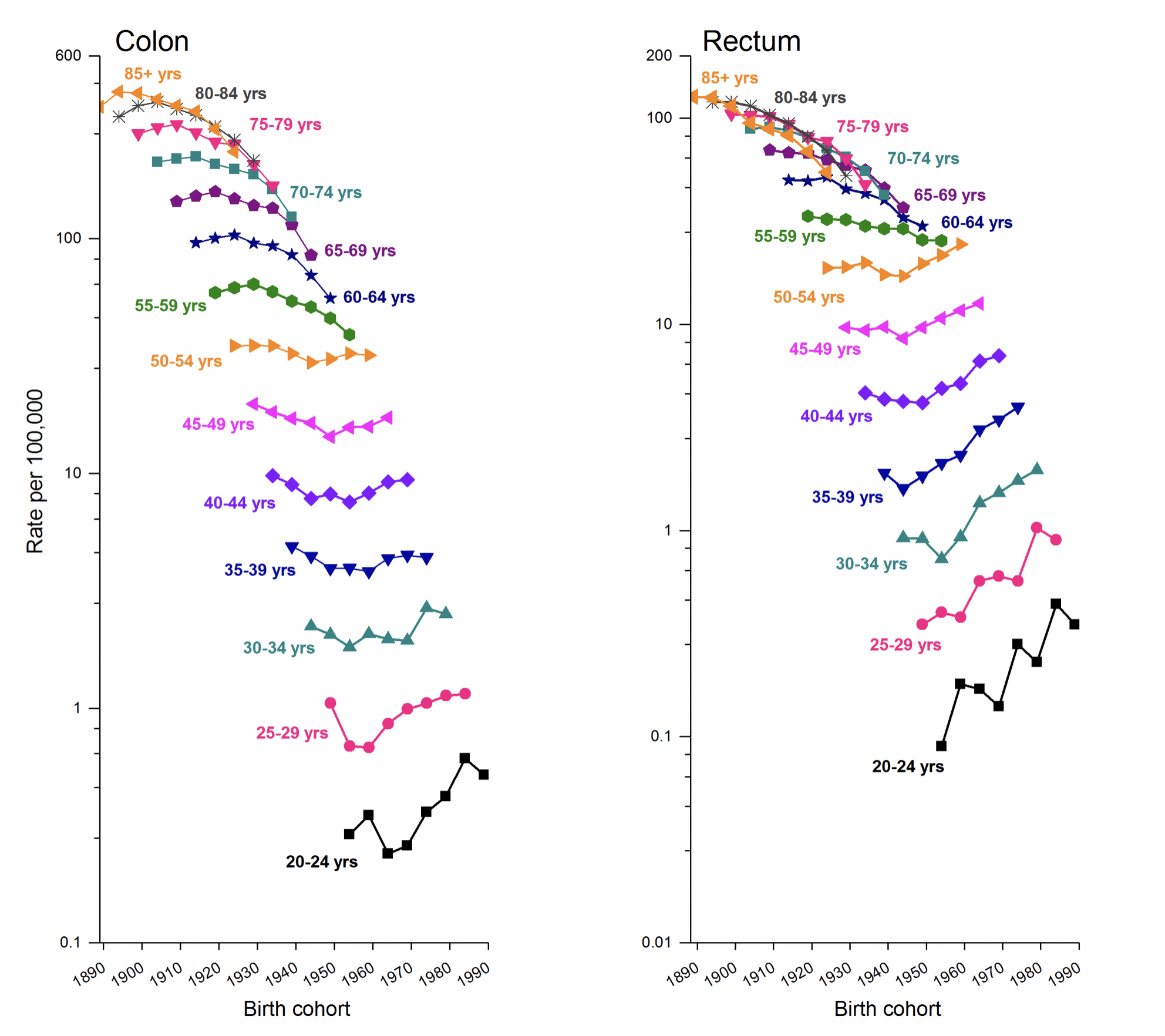
Trends in age-specific colon and rectal cancer incidence rates by year of birth, U.S., 1974-2013
U.S. Trends in Age-Specific Colon and Rectal Cancer Incidence Rates 
Source: R.L. Siegel, et al., JNCI, Vol.109, 2017 — Supplementary Figure 4
According to the National Cancer Institute’s most recent annual report, released last week, colorectal cancer is the most common cancer among men between the age of 20 and 49.
“No one can explain this apparent contradiction,” Li told Microwave News. Known risk factors for colorectal cancer include obesity, an unhealthy diet and lack of physical activity, but Li doesn’t think they can resolve the paradox. “If anything,” he said, “younger generations are more health conscious with better diets.”
Li offers an alternative hypothesis: Young people’s habit of carrying their cell phones in the front or back pockets of their jeans. “When placed in trouser pockets, the phones are in the vicinity of the rectum and the distal colon and these are the sites of the largest increases in cancer,” he says.
RF Exposures from Phones on Standby
Li’s hypothesis assumes that phones continue to emit RF radiation when placed in a pocket. They do, especially smartphones, but exposures are difficult to estimate.
When not in use, phones quickly go to standby mode, and RF transmissions are greatly reduced. Yet, the phone stays active because the system must always know its location in order for the network to direct calls or texts to the nearest cell tower for delivery.
A Swedish-Danish study, published in 2012, found that phones on standby were only in touch with the local base station once every two-to-five hours —and then for just a few seconds. “The exposure in standby mode can be considered negligible,” concluded Kjell Hansson Mild of Umeå University, the lead author of the study. Jørgen Bach Andersen of Aalborg University was a coathour.
Today, Mild sees things differently because smartphones —which were still relatively new when he was working on his study— contact the network much more frequently, if only to update their location. Mild wants research. “We need more measurements and dosimetry on how a phone radiates in a pocket,” Mild said in an interview, adding that, “I keep my phone in my briefcase and when I turn it on, I use a hands-free set.”
When a phone is in a pocket, the separation distance from the body is less than that recommended by Om Gandhi, Mild said. Gandhi, a professor emeritus at the University of Utah, has published a stream of papers on cell phone exposures, estimated by measurements and calculations (here’s one from 2002).
In an e-mail exchange, Gandhi noted that, in compliance tests, cell phones are placed about 10 mm away from the body. Without that spacing —for instance, when a phone is in a pocket next to the body— exposure (SAR) would be about twice that cited in safety specifications. The title of Gandhi’s most recent paper, posted in April by the IEEE, the electrical engineering society, spells out the problem: “Microwave Emissions from Cell Phones Exceed Safety Limits in Europe and the U.S. When Touching the Body.”
In his paper, Mild highlighted that exposures go up if a phone on standby is in motion:
“[W]hen a person carries the phone in a pocket and moves in a city the phone updates when entering a new base station area, and this can be as often as once every few minutes depending if one is in [a] city center or suburban area. For [those] periodic updates the GSM phones operate at full power.”
A later investigation by Damiano Urbinello and Martin Röösli of the University of Basel showed that exposures are even more significant when a phone is in a moving vehicle, whether a car, train or bus.¹ They predicted that smartphones would likely increase exposures because of their need for “regular location updates.”
There was much more to learn. Urbinello and Röösli wrote:
“There is an urgent need to evaluate more thoroughly how personal RF-EMF exposure is affected by one’s own phone in standby mode.”
That was six years ago. There’s been little, if any, follow-up since then. “I am not aware of much further research,” Röösli told Microwave News.
Exposures are “quite variable and the amount of uplink may depend on the type of mobile phone, the network, the provider and the apps installed,” Röösli said. “In particular, push functions are expected to increase the amount of uplink in standby mode.”
Phones in Pockets Below the Waist
Do young adults keep their phones in their pockets? Li points to a 2017 survey of Australian women, aged 15 to 40, by Mary Redmayne, who found that a majority routinely put their phones in a pocket below the waist. Importantly, the youngest women do this the most. She also reported that 96% of the women keep their phones on standby during the day; at night it’s 83%.
In an e-mail, Redmayne said that she has no information about where young men keep their phones, nor is she aware of anyone who had looked into it.
Colorectal Rates Among the Young Rising in Many Countries
Increases of colorectal cancer among the young are being reported around the world, not just in the U.S. — including many European countries, as well as Australia and New Zealand. Just a few weeks ago, IARC reported that, between 2008 and 2015, the incidence of colon cancer among 20-29-year-olds increased by about 18% per year in Denmark, 8% in Australia and 4% in Ireland. While the risk declined in Canada and Norway, the rate of rectal cancer in those countries rose by 3.5% and 10.6% per year, respectively.
 Writing in The Lancet – Gastroenterology & Hepatologythe IARC team advises:
“Although the incidence of colorectal cancer in adults younger than 50 years remains low compared with that in older age groups, our findings are of concern and highlight the need for action to counteract the rising burden of disease in younger cohorts.”
Also in May, a second research group reported similar trends across 20 European countries in Gut, a BMJ  journal. On average, colorectal cancer rose by 7.9% per year among 20-29-year-olds from 2004 to 2016. The effect gets smaller with age: The increase among 30-39-year-olds was 4.9%, and 1.6% for 40-49-year-olds.
In 1990, the rate was 0.8 cases per 100,000 Europeans in their 20s. By 2016, it was 2.3/100,000. The big jump came recently: For 1990-2004, incidence went up by 1.7% per year, but it grew to 7.9% per year from 2004 to 2016.
Li: A Plausible Explanation
“My hypothesis could be proven wrong,” Li concedes, “but this potential explanation is more plausible than any other current hypotheses out there.” People should be made aware of the possible risks, he said, so that young adults can decide whether to take precautions and colorectal cancer researchers can weigh the merits of the case.
Over the last 20 years, Li, who is with Kaiser Permanente in Oakland, CA, has completed a number of groundbreaking studies on the effects of power-frequency EMFs. In 2001, he reported that women faced up to a sixfold increased risk of miscarriages when exposed to magnetic fields above 16 mG (see MWN, M/J01 and J/F02). That early work has been supported by others and there are now at least seven studies that point to an EMF–miscarriage risk.
In other projects, Li has shown that magnetic fields can affect the quality of human spermand that prenatal EMF exposure can lead to childhood asthma and obesity.

Monday, May 20, 2019

Cancer-Suicide-Anxiety-Violence at School: Exploring Causation & Solutions


“The greatest crisis that America faces today, as big as any of our environmental crises is the chronic disease epidemic in America’s children. The generation of American children born after 1990 is arguably the sickest generation in the history of our country. With chronic ailments and pediatric rates of some chronic conditions that are the highest in the world.” -Robert F. Kennedy, Jr. – Chairman, Children’s Health Defense DISCLAIMER: Every effort is made to ensure accurate information is shared within these video messages. However, if you believe that anything is incorrect, I would appreciate your respectfully letting me know, via email, along with supporting reference link(s). If appropriate, I will issue a retraction or correction – thank you. To reserve your space in upcoming ROUNDTABLE, simply send email to: studio_luna@comcast.net with RESERVE in subject line – you will receive confirmation shortly. LIST of Some of the Topics to be Covered in this Roundtable Session: • Health Effects of Non-ionizing Radiation in Children • Peer-reviewed, published scientific studies showing biological effects from RFR/EMF • Symptoms of Exposure to Microwave Radiation • Proven links between EMFs (microwave radiation) emitting from wireless devices and: Cancer, Depression, Suicide, Violence, Anxiety, Addiction, Isolation, Behavioral Issues, Heart Episodes, Infertility, ADD/ADHD, Compromised Ability to Learn, Reduced Lifestyle and Social Skills, Headaches – Dizziness – Nose/Ear Bleeds – Brain Fog – Difficulty Concentrating, Cancer and Suicide Clusters, etc. • Teacher Retention Challenges • Compromised Healing (chronic illness cannot heal properly in toxic environment) • Alternative Treatment Options to Augment and/or Supplement Traditional Protocols • Digital Dementia • Solutions – How to Reduce Exposure – “Digital Detox” • How to Demand Schools Return to 100% WIRED classrooms & Cancel Cell Tower Leases • How and Why Industry & Government Places Profits Before People • Measures You Can Take TODAY to Reverse These Trends • How 5G will intensify the radiation on our planet and especially within our children. • What is the difference between 5G and 5G-Wi-Fi? LINKS TO STUDIES: There are more than 1,000 scientific studies conducted by independent researchers from around the world concerning the biological effects of RF radiation. Here we present some of the most recent. https://www.americansforresponsiblete... BioInitiative Report – 2012--A Rationale for Biologically based Exposure Standards for Low-Intensity Electromagnetic Radiation http://www.bioinitiative.org/ The core of the EMF-Portal is an extensive literature database with an inventory of 28,230 publications and 6,342 summaries of individual scientific studies on the effects of electromagnetic fields. https://www.emf-portal.org/en Link to over 5000 peer reviewed EMF studies: http://www.justproveit.net/content/st... EMF Publications – https://www.emfoff.com/publications/?... Screen Time in Schools – Camilla Rees – on Biological Effects of Electromagnetic Radiation https://www.youtube.com/watch?v=JS8Bn... Stopping the crisis: Oregon teachers, parents consider solutions to stop classroom outbursts https://www.youtube.com/watch?v=Hewg4... Millennials Besieged by Chronic Illness: From Age 27, It’s All “Downhill" https://childrenshealthdefense.org/ne... Does Your Child Have Symptoms of Wi-Fi Exposure at School? https://nebula.wsimg.com/a18e5b6de473... A Message to Schools about Wireless http://electromagnetichealth.org/elec... Children’s Health Defense: Exposing Causes, Seeking Justice, Protecting Children https://www.youtube.com/watch?v=4vkWe... “Turn if Off 4 Kids” Initiative Toolkit http://www.nacst.org/turn-it-off-4-ki... 10 Elements of an Electromagnetically Clean and Conscious School http://manhattanneighbors.org/wp-cont... LINK TO FLYER – “Does your child have symptoms of Wi-Fi exposure at school? http://nebula.wsimg.com/a18e5b6de4734... Message to Schools and Colleges about Wireless Devices and Health https://www.scribd.com/document/28977... Dr. Magda Havas: Wi-Fi in Schools is Safe. True or False? https://www.youtube.com/watch?v=6v75s... GREAT RESOURCES – PRINTABLES from EHT.org https://ehtrust.org/resources-to-shar...

Wednesday, April 24, 2019

New study links over 7,000 cancer deaths to cell phone tower radiation exposures

(NaturalNews) Could exposure to radiation from cell phone towers really responsible for over 7,000 cancer deaths? According to research findings from Brazil, the facts speak for themselves. The study established a direct link between cancer deaths in Belo Horizonte, Brazil's third largest city, with the cell phone network.

What does this direct link stem from? 

Over 80 percent of those who succumbed to certain types of cancer resided approximately a third of a mile away from one of the hundreds of cell phone antennae that populate the city.

These cancers, primarily found in the prostate, breasts, lungs, kidneys, liver, are the ones associated with exposure to electromagnetic fields (EMFs).

This is a real concern for cell phone users and even non- cell phone users. Those who shun mobile phone technology still suffer the consequences of cell phone tower radiation.

Is the Brazilian study an isolated study?

Cell phone tower studies which examined the relationship between radiation exposure and cancer rates were conducted in the city of San Francisco in addition to cities in Austria, Germany, and Israel, dating as far back as the 1970s. All the studies shared similar findings: living within a certain proximity to a cell phone tower increased the risk of cancer anywhere from two to 121 times depending on what type of cancer was detected.

Adilza Condessa Dode, PhD, one of the engineering researchers as well as the coordinator of the Brazilian study, addresses those who are concerned about cell phone tower radiation and explains the Brazil study does not stand alone. Dode elaborates, "these levels (EMFs), are already high and dangerous to human health. The closer you live to an antenna, the greater the contact with the electromagnetic field."

The Brazilian study covers just one city in Brazil. Residents of the United States are vulnerable too as America is home to hundreds of thousands of these radiation emitting towers. In the U.S., with the proliferation of cell phones and the growing needs of cell phone users in recent years, there has been an explosion in cell towers.

Overwhelming evidence

A growing number of organizations and many more studies support the conclusions of the Brazilian study. The International Association for Research on Cancer (IARC), based upon findings from research conducted by an international think tank, came to the conclusion that radio frequency radiation, including the radiation spewing from cell towers, is a possible carcinogen.

The BioInitiative 2012 Report written by a group of leading independent international scientists has put out an unequivocal health warning against exposure to EMFs. This includes exposures from cell phone towers.

Why are cell phone towers particularly dangerous? 

The threat comes from the constant nature of the activity of the towers; they emit pulsed radio frequency radiation. This radiation has been shown in thousands of studies to cause biological damage to the body and to be a precursor to disease.

What are some of the dangers (besides cancer), which result from this damage and are associated with EMFs and cell phone antennae?

• Genetic mutations
• Memory disruptions
• Hindered learning
• ADD
• Insomnia
• Brain disorders
• Hormonal imbalances
• Infertility
• Dementia
• Heart complications

These dangers clearly make it imperative to take action.

Cell towers are here to stay but their implantation needs effective regulation in terms of location and radiation levels. The 1996 Telecommunications Act (TCA), does not qualify the public's right to protest cell tower locations based on health hazards. Cell towers should be located away from residential areas and far away from schools and day care centers.

Sources:


http://www.getmefacts.info/
http://www.hellkom.co.za
http://www.cell-out.org/
http://whyfry.org
http://cdn.bizcommunity.com
http://www.magdahavas.com

About the author:
Lloyd Burrell is the founder of http://www.electricsense.com/. Since falling prey to a violent reaction to his cell phone in 2002 Lloyd has spent more than 10 years researching the effects of electromagnetic fields (EMFs) on health. He is the author of an eBook entitled "How To Beat Electrical Sensitivity" which offers a solution to the growing number of people whose health is being compromised by exposure to wireless and similar technologies.

You can download his free EMF Health Report and subscribe to his newsletter by visiting his website ElectricSense.com. You can also follow him on Facebook , TwitterYoutubeand .


Source

Tuesday, April 02, 2019

CDC, state officials investigating multiple cases of rare cancer in southwestern Pa.

Ewing sarcoma is a type of bone cancer.  No mention in the following article of the fact that bones absorb radiation heat.  

Residents of the area are asking if radiation may be the cause of all the childhood cancers in the area.

A quick google search of cell towers near Canonsburg, PA  brings up the following image...


Cell tower density for Greensburg, PA (also mentioned in the article) is even worse.


PA is also forcing smart meters onto people's homes.


Many in the Canon-McMillan School District first learned about Ewing sarcoma, a rare childhood bone cancer, when Luke Blanock of the village of Cecil was diagnosed on Dec. 5, 2014. 
The media did stories about the community rallying around the smart, handsome teenager and his family, then returned on Feb. 19, 2016, to cover Mr. Blanock — pale, thin and having just been told he had only two weeks to live — when he married his high school girlfriend, Natalie Britvich.
He rebounded a bit and even played a round of golf before succumbing nearly six months later on Aug. 7, from multiple tumors of the brain, spine, skull, jaw and pelvis. He was only 19.
But, as it turns out, the Ewing sarcoma scare within Canon-McMillan’s boundaries in eastern Washington County neither began nor ended with Luke Blanock.
In fact, six cases of Ewing sarcoma have been diagnosed within the school district since 2008, including two cases in the past nine months. 
And only now is it being disclosed that twice that number of Ewing cases have occurred in southeastern Westmoreland County since 2011.
Only 200 to 250 cases of Ewing sarcoma — a rare cancer of the bone or nearby soft tissue — occur each year in the United States. The National Cancer Institute said the incidence for all ages is one case per million but up to 10 cases per million among those in the 10-to-19 age group.
Based on a report by a concerned resident and St. Vincent College researchers about the Ewing cases in Westmoreland County, the Pennsylvania Department of Health and the U.S. Centers for Disease Control and Prevention launched a study to determine whether these cases constitute a cluster. The state now has expanded the investigation to include the Canon-McMillan School District and Washington County.
Nate Wardle, health department spokesman, said it received more than a dozen phone calls within the last month from residents of Washington and Westmoreland counties about the Ewing sarcoma cases, and several more called this week.
Cases mount up
The string of Ewing cases in Canon-McMillan began with the mid-2008 diagnosis of Curtis Valent, a Cecil Township resident who graduated from Bishop Canevin High School. He died on Jan. 2, 2011, at age 23, according to his obituary. His parents could not be reached for comment.
Late in 2008, Alyssa Chambers, then an 18-year-old Canon-McMillan senior living in northern Cecil Township, was diagnosed with Ewing sarcoma and survived. She later became an oncology nurse at UPMC Shadyside. 
Kyle Deliere, who lived about a mile from Mr. Blanock in the village of Cecil, was diagnosed with Ewing next, on Oct. 30, 2011. He lost weight, had night sweats and fevers, and developed large tumors on his hip, femur and lungs. The 11-letter high school athlete who wrestled for the University of Pittsburgh died on Nov. 15, 2013, at age 27. 
Then in June 2018, David Cobb, 37 at the time, and also living in Cecil Township, was diagnosed with Ewing sarcoma and now is undergoing rounds of chemotherapy.
Compounding this cancer conundrum and fueling concern, Mitchell Barton, a 21-year-old Canon-McMillan graduate now working as a technician in a local box factory, posted news on Facebook of his Dec. 27, 2018, Ewing diagnosis.  
He and Mr. Blanock played baseball together in high school. Mr. Barton, now undergoing chemotherapy, still lives at home in North Strabane, where fracked natural gas wells surround him. For that reason, environmental issues crossed his mind from the moment of diagnosis. 
“I worked at a golf course for four years and was exposed to a lot of chemicals, weed killers and things like that,” he said. “Our house also is in a valley surrounded by four gas wells. I heard about natural gas and my mom is concerned about methane [natural gas].”
In addition to the Ewing cases, a 14-year-old girl from Cecil Township died of astrocytoma, a brain and spinal cord cancer, in February, and as many as seven current students and two preschoolers in the Canon-McMillan School District have other types of cancer. 
Those nine consist of two cases of osteosarcoma (bone); one liposarcoma (joint); one rhabdomyosarcoma (also joint); a Wilms (kidney) tumor in a child whose family has moved from the district; one liver cancer; two cases of leukemia (blood); and a 2-year-old with cancer that the parent declined to identify.
In another case, a 21-year-old Canon-McMillan graduate of North Strabane was diagnosed in early January with leukemia.
Another concentration of cases
The worries about Ewing and other forms of childhood cancer go well beyond the Canon-McMillan School District. 
In Westmoreland County, 12 cases of Ewing sarcoma were found to be diagnosed from 2011 through early 2018. 
Maureen Grace, a Westmoreland County lawyer and teacher, began compiling a list upon hearing of one case after another in areas southeast of Greensburg. 
“All that I can say is that I saw beautiful children and families suffering. I asked myself, ‘What if this happened to a child in my family?’ Every child, every parent and anyone who cares about children has the right to clean, healthy, safe air, water and surroundings for their babies, little ones and teenagers to grow and become adults. I don't know if we have this environment right now,” Ms. Grace said.
“Our children are our most precious resource. If we don’t investigate this to the very best of our abilities, who are we as a culture or community?” she added. “We need to do better for our little ones who look to us for the answers. We need to protect them above all else.”
So determined, she sought help from two St. Vincent College researchers — Elaine Bennett, professor of anthropology and public health, and Cynthia Walter, a now-retired professor of ecology and toxicology — who recruited students to help verify cases, analyze results and write a report. Ms. Grace also received help through the Healthy Child/Healthy World Organization.
The research team, known as the Westmoreland County Pa. Ewing Sarcoma Project, submitted its report to the state health department and CDC in December 2017.
Working quietly, Ms. Grace finally responded to longstanding inquiries from the Pittsburgh Post-Gazette and stepped forward with Ms. Walter, who holds a doctorate in biology, to publicize their results.
Ms. Grace said she initially documented eight pediatric Ewing cases and the health department now has expanded that total to 12, when cases involving young adults were included. 
Confirming a cluster requires meeting a high statistical and analytical bar, including identifying a pollution or chemical exposure linked to that cancer, according to a Pitt biostatistician. 
That presents a problem because Ewing sarcoma has no known cause.
What could be the cause?
The Westmoreland project presented the state with a long list of possible pollution sources, including countywide shale gas drilling and fracking operations and a Penn Township landfill that has accepted thousands of tons of radioactive drill cuttings from gas well sites. The project’s report also makes a case for how pollution exposure could lead to Ewing.
But Ms. Grace said she and the team don’t yet know if fracking, water or air pollution, or pollution from old industry, among other sources of pollution and contamination, are responsible. “We don’t want our aim to stray from seeking a scientific cause and solution,” she said.
The health department said it is reviewing cancer statistics for Washington County and for the Canon-McMillan School District, where it is only aware of four cases but has yet to incorporate 2018 cancer data into its review. In the past decade, two additional Ewing sarcoma cases have occurred in Washington County — one in Charleroi and another in or near Bentleyville — with at least two cases each in Greene and Fayette counties.
The health department also said it has been working with researchers to separately evaluate and monitor Westmoreland County statistics. 
Even with 12 Ewing cases, the department does not see a statistically significant excessive number in Westmoreland County, Mr. Wardle said, adding that that finding has been shared with concerned residents of the county. “But we will continue to monitor the number of cases in the area.”
He said the department is doing the statistical evaluation of the Ewing cases in Washington County and now has included all childhood cancers in the study, including those identified by the Post-Gazette. 
The Ewing family of sarcoma is not one of the common cancers the department reports on annually, he said. Most cases occur in teens when they experience growth spurts, and science is limited as to what causes it.
The concerned citizens who recently called the health department wanted to know if the cancer cases are related to environmental factors, including radiation, Mr. Wardle said. Washington County has historic radiation issues related to a uranium mill tailings disposal site in North Strabane, near Canonsburg, where the U.S. Department of Energy continues to report background or below background levels of radiation. 
Another concern is the widespread drilling and fracking of more than 1,000 shale gas wells, which produce waste water with radioactive components, among other pollutants. The first experimental well in southwestern Pennsylvania was fracked in 2005 in Cecil Township. The township now sits downwind from a phalanx of compressor stations and a hilltop cryogenics plant, a major source of pollution.
Academic studies done in Pennsylvania and Colorado have found higher rates of childhood cancers in areas where fracking is occurring but with no links to Ewing sarcoma.  
The Marcellus Shale Coalition, the trade organization representing the shale gas industry in Pennsylvania, issued a statement citing a review of medical data by the American Cancer Society that found “no known lifestyle-related or environmental causes of Ewing tumors ....”
In a statement, David Spigelmyer, coalition president, said attempts to link the incidence of Ewing sarcoma and other childhood cancers to the shale gas drilling industry were without scientific or medical support.


Source