
Tuesday, June 25, 2019


Monday, June 24, 2019
Americans 60 and older are spending more time in front of their screens than a decade ago
The amount of time that Americans ages 60 and older spend on their TVs, computers, tablets or other electronic devices has risen almost half an hour per day over the past decade, according to a Pew Research Center analysis of Bureau of Labor Statistics data, even as screen time among younger people has more or less held steady.
Those 60 and older – a group increasingly populated by aging Baby Boomers – now spend more than half of their daily leisure time, four hours and 16 minutes, in front of screens, mostly watching TV or videos. Screen time has increased for those in their 60s, 70s, 80s and beyond, and the rise is apparent across genders and education levels. Meanwhile, the time that these older adults spend on other recreational activities, such as reading or socializing, has ticked down slightly.
This rise in screen time coincides with significant growth in the adoption of digital technology by older Americans. In 2000, 14% of those ages 65 and older were internet users; now 73% are. And while smartphone ownership was uncommon at all ages around the turn of the 21st century, now about half (53%) of people 65 and older are smartphone owners.
Overall, leisure time for Americans 60 and older has held steady at about seven hours a day, and the amount of time they spend on other activities has also been quite stable over the past decade. On average, they sleep more than eight and a half hours per day; spend three hours on chores and errands; and devote more than an hour to eating, as well as an additional hour for personal activities such as grooming or health care. By comparison, younger Americans work more, have less leisure and screen time, and spend less time doing housework.
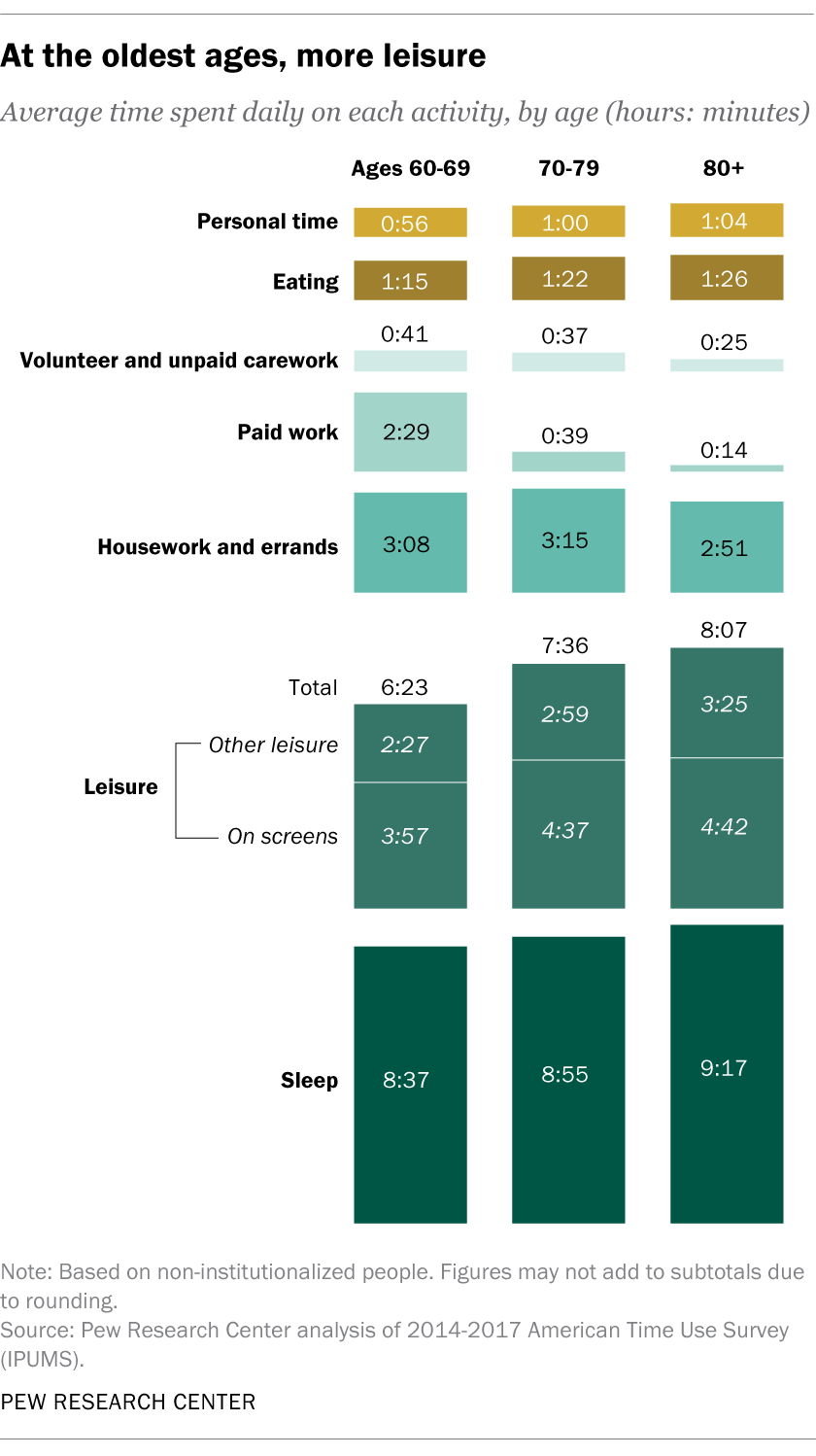 While overall time use patterns of older Americans haven’t changed much over the past decade, some differences do emerge by age, sex and education. More than four-in-ten Americans in their 60s are still working, while just 14% of people in their 70s and 4% of those 80 and older are employed. As a result, the average amount of time spent working per day among people in their 60s is far higher than it is for people ages 70 and older.
These age differences in paid work are also reflected in age differences in time spent on leisure. People in their 60s spend more than an hour less per day, on average, engaged in leisure activities when compared with their older counterparts. Those in their 60s also sleep less than their older counterparts and log a bit more time on unpaid caregiving and volunteering.
The differences in the day-to-day experiences of men and women ages 60 and older largely echo gender patterns that are seen at younger ages. Men 60 and older are more likely to be working than their female counterparts (33% vs. 24%) and, among those who work, they tend to work more hours.
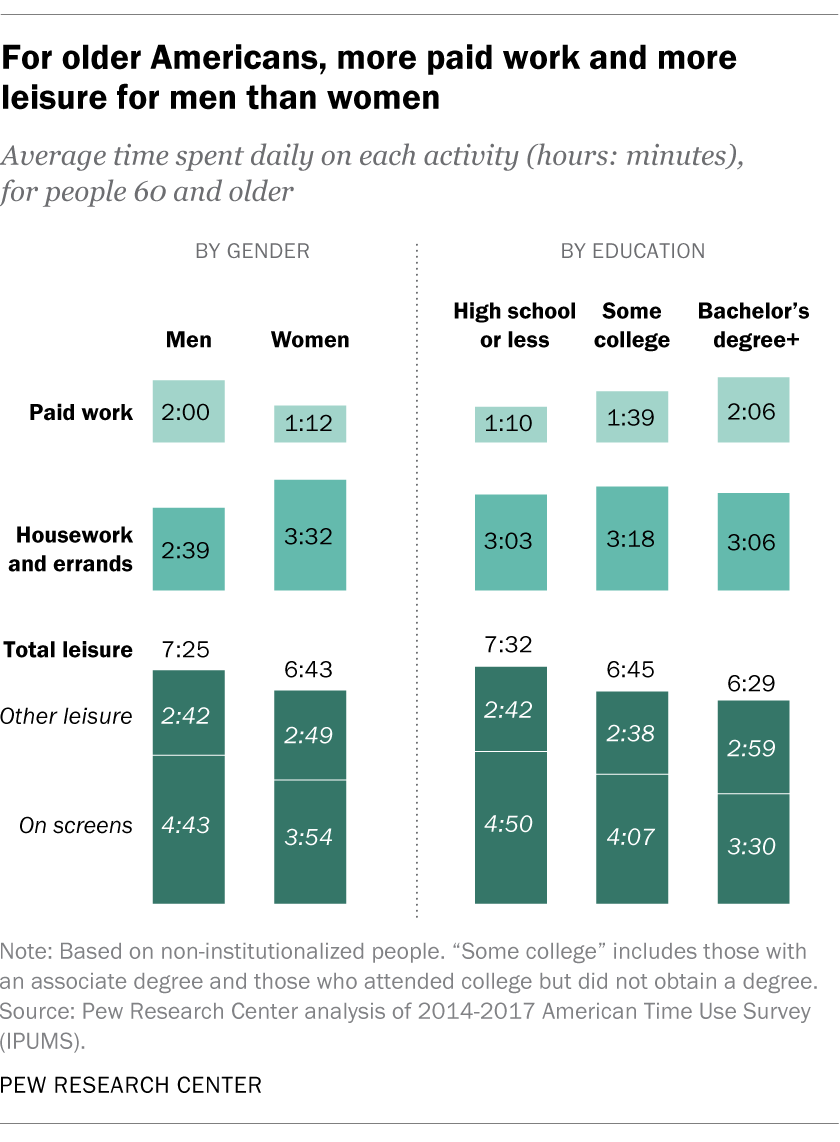 But while more paid work is sometimes linked with less leisure time, this is not the case when it comes to men and women ages 60 and older: Among adults in this age group, men spend 48 more minutes a day working than women, yet they also spend 42 more minutes on leisure time.
For their part, women 60 and older spend almost an hour more per day than men on housework and errands, especially cleaning and food preparation. Women spend an hour and 56 minutes cooking and cleaning daily, compared with 44 minutes for men. On the flip side, men spend more time on household maintenance – 55 minutes a day versus 22 minutes for women.
Time use among older adults also differs by educational attainment. As is the case across age groups, those with higher levels of education are more likely to be employed. Around four-in-ten adults who are 60 and older and have a bachelor’s degree or more (37%) are working, compared with 31% of their counterparts with some college experience and 21% of those with a high school diploma or less. This translates into a gap in the amount of time spent on paid work for all people 60 and older: Those with a bachelor’s degree or more work an average of just over two hours a day, while those with a high school diploma or less work an average of an hour and 10 minutes daily.
As is the case among younger Americans, the additional time spent on paid work by people who are 60 or older and have a bachelor’s degree or more is offset by additional leisure time for people with a high school diploma or less. And not only does the amount of leisure time vary by educational level, so does the way that this leisure time is spent. People with less education spend more of their leisure time on screens and less time reading compared with their more educated counterparts. Less educated adults also spend less time exercising: 12 minutes a day for those with a high school diploma or less, compared with 26 minutes for college graduates.
But the educational gaps in leisure time are not due entirely to differences in time spent working: Even among people 60 and older who are not employed, those with a high school diploma or less spend about half an hour more per day (8 hours and 17 minutes) on leisure than those with either some college (7 hours and 42 minutes) or a bachelor’s degree or more (7 hours and 38 minutes). These differences are driven more by the educational gap in how men spend their leisure time: Men with a high school diploma or less spend an hour more per day on leisure than those with a bachelor’s degree (9 hours and 10 minutes vs. 8 hours and 10 minutes). Among women who are not working, there is a 35-minute educational gap in leisure time (7 hours and 42 minutes vs. 7 hours and 7 minutes).
Source
Glioma incidence and survival variations by county‐level socioeconomic measures
Abstract
Background
Multiple studies have reported higher rates of glioma in areas with higher socioeconomic status (SES) but to the authors' knowledge have not stratified by other factors, including race/ethnicity or urban versus rural location.Methods
The authors identified the average annual age‐adjusted incidence rates and calculated hazard ratios for death for gliomas of various subtypes, stratified by a county‐level index for SES, race/ethnicity, US region, and rural versus urban status.Results
Rates of glioma were highest in counties with higher SES (rate ratio, 1.18; 95% CI, 1.15‐1.22 comparing the highest with the lowest quintiles [P < .001]). Stratified by race/ethnicity, higher rates in high SES counties persisted for white non‐Hispanic individuals. Stratified by rural versus urban status, differences in incidence by SES were more pronounced among urban counties. Survival was higher for residents of high SES counties after adjustment for age and extent of surgical resection (hazard ratio, 0.82; 95% CI, 0.76‐0.87 comparing the highest with the lowest quintile of SES [P < .001]). Survival was higher among white Hispanic, black, and Asian/Pacific Islander individuals compared with white non‐Hispanic individuals, after adjustment for age, SES, and extent of surgical resection, and when restricted to those individuals with glioblastoma who received radiation and chemotherapy.Conclusions
The incidence of glioma was higher in US counties of high compared with low SES. These differences were most pronounced among white non‐Hispanic individuals and white Hispanic individuals residing in urban areas. Better survival was observed in high SES counties, even when adjusting for extent of surgical resection, and when restricted to those who received radiation and chemotherapy for glioblastoma. Differences in incidence and survival were associated with SES and race, rather than rural versus urban status.5G: Eco-Energy or Energy Monster?
As part of the forthcoming “Connected Hobart; a Smart City forum” a central feature of the logo for the event is “Eco-Energy”. Now this term is defined on the ICI Global website as: “Natural and clean energy solutions for a green environment protecting ecology”. So, it would seem to be a no-brained that Hobart’s “Eco-Energy” should mean reduced greenhouse gas emissions with more efficient 5G technology, and overall reduced energy usage.This may be the case for Tasmania with its hydro and planned pumped hydro and wind farms, but certainly not for the rest of Australia. According to Origin Energy, Of Australia’s overall energy supply, 73% comes from coal, 13% from natural gas, 7% from hydro power, and 7% from renewables. So, 86% of Australia’s energy usage is from greenhouse gas emitters, coal and gas.
Will the planned nationwide rollout of 5G networks reduce Australia’s greenhouse emissions with “Eco-Energy” 5G smart city technology? Unfortunately it looks like being the opposite, according to a new 5G report by Vertiv, and the technology analyst firm 451 Research.
Titled: “5G: The Risks and Rewards for Operators”, the report gives the findings of a detailed survey of more than 100 telecommunications decision makers dealing with 5G. The research covers 5G deployment plans, services supported by early deployments, and the most important technical enablers for 5G success.
One of the key findings is that 5G technology will likely increase total network energy consumption by 150 to 170 per cent by 2026. To quote in part:
“As we mentioned above, 5G is going to be significantly more energy-intensive than previous generations of wireless connectivity – so much so that extra efficiency measures will need to be taken to ensure a worthwhile investment for infrastructure and telecommunications providers alike. A whopping 94% of our survey respondents indicated that they expected overall energy costs to increase along with 5G/MEC deployments.”
From the report:
Under Key findings: “5G is widely expected to raise overall energy costs. – Nearly all (94%) respondents indicated that 5G will raise overall energy costs. Given the prominence of energy as an overall percentage of opex, it’s clear that mitigation strategies will be critical to maintain 5G business case viability.”
” 5G connectivity requires a significant amount of energy to run, especially after technologies are put in place to manage and dictate the direction of the traffic. The technology inside datacenters will have to adjust to make 5G adoption cost-effective for telecom providers.”
“As we mentioned above, 5G is going to be significantly more energy-intensive than previous generations of wireless connectivity – so much so that extra efficiency measures will need to be taken to ensure a worthwhile investment for infrastructure and telecommunications providers alike. A whopping 94% of our survey respondents indicated that they expected overall energy costs to increase along with 5G/MEC deployments.”
“The impact of distributed 5G infrastructure on energy consumption will be vast and will require a collaborative effort that will cut across business units, new datacenter designs, technological innovations in battery and cooling, and AI-enabled remote management.”
Under recommendations: • “Order an energy audit ahead of 5G rollout to ensure site-level readiness. – Conduct an energy audit across existing IT facilities in anticipation of 5G net-energy increase.”
An internal analysis by Vertiv discovered that “the move to 5G is likely to increase total network energy consumption by 150 to 170 per cent by 2026. The largest cost increases will be in macro, node and network data centres”….SNIP
- Read the Report Telco Industry Hopes and Fears FROM ENERGY COSTS TO EDGE COMPUTING TRANSFORMATION 2019
- Read Press release Vertiv and 451 Research Release New Report on 5G Preparedness and Technical Enablers: With 5G Deployments Advancing Rapidly, Operators Share Plans for Dealing with Increasing Densification, Higher Energy Consumption
- Read 2/2019 “5G is likely to increase total network energy consumption by 150 to 170 per cent by 2026″
Read more reports that show increased energy consumption from the EHT webpage at Reports on the Increasing Energy Use of Wireless Systems and Digital Ecosystem
Also see:
Power Consumption: 5G Basestations Are Hungry, Hungry Hippos
News Analysis
Dan Jones 3/6/2019
The increased power consumption of next-generation basestations may be one of the dirty little secrets of 5G, which might not be a secret much longer as operators roll out initial networks.
The power consumption of a 5G basestation is three times that of its 4G LTE predecessor, according to Zhengmao Li, EVP at China Mobile, at a presentation at Mobile World Congress last week, as noted by my Heavy Reading Colleague, Gabriel Brown:
5G basestations bump up the power requirements over 4G LTE, in part because of the massive antenna arrays (MIMO) used for the next generation tech. Earl Lum, president of EJL Wireless Research, says that MIMO increases the “power amplifiers” and “analog-to-digital paths” required, as well as overall digital circuitry in the units. For instance, typical 4G basestations now use 4 transmitter and 4 receiver (4T4R) elements, while 5G is expected to use 64T64R MIMO arrays…SNIP
The Air Force has a new drone-killing microwave weapon named 'Thor'
U.S. military bases across the globe may soon have a New Mexico-made, high-powered microwave weapon at their disposal to instantaneously down swarms of enemy drones.
The Air Force Research Laboratory at Kirtland Air Force Base unveiled the weapon Thursday morning in a live demonstration with local reporters, who watched the system effortlessly knock a hovering drone out of the sky with an invisible and inaudible electromagnetic wave.
The $15 million system, called the Tactical High Power Microwave Operational Responder, or THOR, disabled the unmanned aerial vehicle in a flash, sending it spiraling to the ground the moment the electromagnetic ray hit it. Had more drones been flying within THOR's expansive scope, they also would have dropped in an instant, THOR program manager Amber Anderson said.
"It operates like a flashlight," Anderson said after the demonstration. "It spreads out when the operator hits the button, and anything within that cone will be taken down. It engages in the blink of an eye."
The AFRL built the machine on an expedited, 18-month timeline to get it into war fighters' hands as fast as possible, given the increasing military threat from drones, said Kelly Hammett, head of AFRL's Directed Energy Directorate in Albuquerque. The system is aimed at protecting military bases from multiple-drone attacks, which the Air Force has identified as its No. 1 priority for emerging "directed energy," or microwave and laser, defense systems.
That's because conventional defenses offer limited protection against swarms of incoming drones. Sharpshooters or military jets, for example, can't take out 50 drones at once, but THOR can.
"It's built to negate swarms of drones," Anderson said. "We want to drop many of them at one time without a single leaker getting through."
The Air Force Research Laboratory at Kirtland Air Force Base unveiled the Tactical High Power Microwave Operational Responder (THOR) on June 20, 2019(KRQE screenshot)
AFRL spent $15 million to develop THOR, which could cost about $10 million to produce if the U.S. Department of Defense chooses to deploy it, Hammett said. It was built in cooperation with three companies, including global engineering firms BAE Systems and Leidos and the Albuquerque firm Verus Research. The project created 20 full-time jobs in Albuquerque outside the AFRL, Hammett said.
If THOR is adopted by the Defense Department, it could mean a lot more local jobs, because the system is likely to be manufactured here, at least partly.
"If the Air Force or Army decide to procure it, that would be big for Albuquerque," Hammett said. "It would establish a manufacturing and production base right here, representing hundreds of millions of dollars, if not more."
The AFRL has been developing mircowave and laser defense technology for years, including collaboration with Raytheon, which built its own anti-drone microwave system in recent years that it successfully tested against swarms of UAVs at Fort Sill, Okla., in December 2017, and at White Sands Missile Range in southern New Mexico last fall.
Those tests, however, showed some limitations when integrating Raytheon's system with other military technologies and battlefield tactics and protocols, Hammett said. Raytheon has since invested more resources to further develop its system, which could still be deployed in the future by the military.
But AFRL chose to also build THOR to offer different operating capabilities and more options for the military to rapidly meet urgent defense needs, Hammett said.
It's designed for rapid deployment wherever needed, with the microwave antennae and foundation stored in a shipping container transported on a flatbed truck. The equipment is stored in parts for easy, snap-together assembly in just three hours.
"It takes two people to set it up and three to tear it down." Anderson said. "You can take it to the field, rapidly set it up and it's ready to fire. It's designed as a turnkey system."
A handheld remote control rotates the antennas in all directions as needed, providing 360-degree defense against drones. The firing mechanism and overall system control are operated from a laptop.
The $15 million system, called the Tactical High Power Microwave Operational Responder, or THOR, disabled the unmanned aerial vehicle in a flash, sending it spiraling to the ground the moment the electromagnetic ray hit it. Had more drones been flying within THOR's expansive scope, they also would have dropped in an instant, THOR program manager Amber Anderson said.
"It operates like a flashlight," Anderson said after the demonstration. "It spreads out when the operator hits the button, and anything within that cone will be taken down. It engages in the blink of an eye."
The AFRL built the machine on an expedited, 18-month timeline to get it into war fighters' hands as fast as possible, given the increasing military threat from drones, said Kelly Hammett, head of AFRL's Directed Energy Directorate in Albuquerque. The system is aimed at protecting military bases from multiple-drone attacks, which the Air Force has identified as its No. 1 priority for emerging "directed energy," or microwave and laser, defense systems.
That's because conventional defenses offer limited protection against swarms of incoming drones. Sharpshooters or military jets, for example, can't take out 50 drones at once, but THOR can.
The Air Force Research Laboratory at Kirtland Air Force Base unveiled the Tactical High Power Microwave Operational Responder (THOR) on June 20, 2019(KRQE screenshot)

AFRL spent $15 million to develop THOR, which could cost about $10 million to produce if the U.S. Department of Defense chooses to deploy it, Hammett said. It was built in cooperation with three companies, including global engineering firms BAE Systems and Leidos and the Albuquerque firm Verus Research. The project created 20 full-time jobs in Albuquerque outside the AFRL, Hammett said.
If THOR is adopted by the Defense Department, it could mean a lot more local jobs, because the system is likely to be manufactured here, at least partly.
"If the Air Force or Army decide to procure it, that would be big for Albuquerque," Hammett said. "It would establish a manufacturing and production base right here, representing hundreds of millions of dollars, if not more."
The AFRL has been developing mircowave and laser defense technology for years, including collaboration with Raytheon, which built its own anti-drone microwave system in recent years that it successfully tested against swarms of UAVs at Fort Sill, Okla., in December 2017, and at White Sands Missile Range in southern New Mexico last fall.
Those tests, however, showed some limitations when integrating Raytheon's system with other military technologies and battlefield tactics and protocols, Hammett said. Raytheon has since invested more resources to further develop its system, which could still be deployed in the future by the military.
But AFRL chose to also build THOR to offer different operating capabilities and more options for the military to rapidly meet urgent defense needs, Hammett said.
"It takes two people to set it up and three to tear it down." Anderson said. "You can take it to the field, rapidly set it up and it's ready to fire. It's designed as a turnkey system."
A handheld remote control rotates the antennas in all directions as needed, providing 360-degree defense against drones. The firing mechanism and overall system control are operated from a laptop.
Source
Young Adults Are Growing Horns As a Result of Cell Phone Use
People are evolving to possess horns in their backs due to frequent mobile phone usage. I wish I were kidding, but I’m not. Researchers at the University of the Sunshine Coast in Queensland, Australia made the discovery and claim that human physiology is being permanently altered.
If you’re reading this article on your phone, it doesn’t exactly mean you’re going to end up with two large prehistoric looking blades protruding from your backside. However, the news isn’t comforting even when taken at its authentic meaning.
Here’s what’s happening.
When you look at a mobile device, you tilt your head at a specific angle. This position redistributes weight that normally sits on the spine to back muscles. This is resulting in bones producing new ligaments and tendons to help deal with the new stressor. And all of this means horn-like features protruding from the base area of the skull.
“Our findings raise a concern about the future musculoskeletal health of the young adult population and reinforce the need for prevention intervention through posture improvement education,” the report states.
This “prominent exostosis,” as it is scientifically described, occurs more in the young than in the old. No surprises there. The sizing of the horns specified in the report is 10–31 mm.
But don’t take my word for it, have a look for yourself. Below are two radiographs from two 28-year-old men. Note the presence of “horns.”

radiographs display sizeable enthesophytes protruding from base of skull.

radiographs display sizeable enthesophytes protruding from base of skull.
When the researchers increased the age group by ten years, the instances of horns showed a 1.03 reduction. This further confirms the issue is mobile phone based as young people use portable technology more than their parents.
Here’s an excerpt from the study.
Repetitive and sustained mechanical load is required for robust adaptation to take place in tendon properties, as connective tissue adaptive response to load necessitates a slow process of matrix protein (collagen) production4,6,22. The development of EEOP may be attributed to, and explained by, the extensive use of screen-based activities by individuals of all ages, including children25,26,27, and the associated poor posture.
This report is yet another indication that our technology enslavement is quite literally changing human life, even at the physiological level. Humans are evolving more and more to become technological beings. But that may not be the worst of our tech crisis.
New 5G technology is being blamed for serious health risks all over the world, although government officials largely dispute these claims. Another technology concern involves citizen surveillance. Big box retailer Walmart announced that it would install spying technology throughout its stores.
There is little question that humans are going to need to find a way to contend with technology’s dark side. Clearly, technological advances are helpful to human life. It makes things more convenient, it also helps us discover information and news at a faster rate. Moreover, cryptocurrency assists citizens of nations with restrictive censorship laws spread information. Things certainly aren’t all bad with technology, however, our reliance on such conveniences enslaves us.
Source
Subscribe to:
Posts (Atom)