Showing posts with label smartphones. Show all posts

Tuesday, August 06, 2019

Children Drowning Because of Parents Preoccupied With Their Phones

Activist Post also reported about this last year.  Unfortunately, it’s still happening around the globe.   From The Jerusalem Post:
Last year, the German Lifeguarding Association published findings that drew a direct link between children dying in the water and parents cellphone usage at the time of death. For years, lifeguards have warned parents that using a phone while children are swimming causes the parent to lose focus on the child, and in many cases of children drowning this was one of the causes
Safety experts from around the globe have issued warnings time and again that drowning is most often silent. There are many examples of children who drowned in packed pools without anyone noticing. Sometimes, these incidents even happen at home in an inflatable pool with just a few centimeters of water, or even in a washing bucket.
Authorities around the world are now explicitly warning people against using their smartphones whenever a child is near water, whether that be the bathtub, an inflatable pool, while washing the floor, and of course, when the family is at the beach or poolside.
[…]
Once a person begins to drown, it is incredibly difficult to save them. Even if they are revived, there is often serious brain damage due to prolonged lack of oxygen. This is often more severe in children than in adults. It is incredibly difficult to turn back the clock once a child begins to drown.
Excessive tech use and addiction is on the rise and the consequences can be as devastating as other forms of addiction in adults as well as in kids.


Monday, July 29, 2019

California - Hollister school district bans cell phone use on campuses

HOLLISTER, Calif. - The Hollister Elementary School District Board this week decided to ban cell phone-use by students on campus for the upcoming school year. 
Students will be required to turn off their cell phones before setting foot at the district's elementary and middle schools. 
"I never even thought about elementary schools, but I understand there are second graders, second graders have cell phones and they're doing the same type of thing," said Stephen Kain, the board president of HESD.
Kain was a teacher before he retired. He remembers the exact time when cell phones and smart phones started becoming a problem in class, let alone in 2019 with constant access to social media like Snapchat and Instagram at the touch of a screen. 
"If you are worrying about what the last person said about you or posted a picture of you, it really raises the anxiety level of kids at school," said Kain. "When you have a high anxiety level, you can't learn. You're too worried about other things."
The school district board voted to ban cell-phone use for students unanimously. 
"The rule will be they're turned off as soon as you walk onto campus. You can turn them on again as soon as you leave campus," said Kain.
Cell phones must also be kept out of sight at all times. They will not be allowed during transition times or breaks either. 
If students are caught using a cell phone during school for the first time, their phone will be taken away and parents must retrieve the device from the office themselves. If they are caught a second time, parents will have to speak with administrators about the issue. If they are caught a third time, the student will not be allowed to take a cell phone to school anymore completely. 
"It distracts everything of the students, of the teachers. And if it was myself, and I was a teacher, I would say no cell phones in class, leave it home," said Geraldine Rodriguez, a Hollister resident. 
But some students say the rules are too harsh. 
"I feel like it's a good idea to keep it in your pocket or in your backpack, but I don't think they should take it away during break or lunch because I think that's too extreme," said Nataly Delgado, a Hollister high school student who attended middle school in the city. 
But problems with cyberbullying and the potential for academic cheating are other reasons why the district voted for the ban. 
"If you're going to learn, you need to have your full focus on learning. You can't be worrying about other things. And that's where we're coming from," said Kain. 
There are 5,600 students across the entire district. The new policy will take effect in August on the first day of school. This does not include the high school in Hollister or anywhere else in San Benito County. 

Friday, July 19, 2019

Smartphones, tablets causing mental health issues in kids as young as two

Children as young as two are developing mental health problems because of smartphones and tablets, scientists warn.
Just an hour a day staring at a screen can be enough to make children more likely to be anxious or depressed.
This could be making them less curious, less able to finish tasks, less emotionally stable and lowering their self-control, the DailyMail reports.
Although teenagers are most at risk from the damaging devices, children under the age of 10 and toddlers' still-developing brains are also being affected.
But research shows 'zombie' children spend nearly five hours every day gawping at electronic devices.
Researchers from San Diego State University and the University of Georgia say time spent on smartphones is a serious but avoidable cause of mental health issues.
"Half of mental health problems develop by adolescence," professors Jean Twenge and Keith Campbell said. "There is a need to identify factors linked to mental health issues that are [able to be changed] in this population, as most are difficult or impossible to influence. How children and adolescents spend their leisure time is [easier] to change."
Parents and teachers must cut the amount of time children spend online or watching television while they're studying, socialising, eating or even playing sport.
Professor Twenge said her study, one of the biggest of its kind, backs the American Academy of Pediatrics' established screen time limit – one hour per day for children aged two to five.
It also suggests a similar limit – perhaps two hours – should be applied to school-aged children and adolescents, she added.
The researchers analysed data provided by the parents of more than 40,000 US children aged two to 17 for a nationwide health survey in 2016. The questionnaire asked about the youngsters' medical care, any emotional, developmental or behavioural issues and their daily screen time.
Adolescents spending more than seven hours a day on screens are twice as likely to have been diagnosed with anxiety or depression as those who spent an hour. Links between screen time and wellbeing are stronger among adolescents than young children, the study found.
Professor Twenge said: "At first, I was surprised the associations were larger for adolescents. However, teens spend more time on their phones and on social media, and we know from other research that these activities are more strongly linked to low wellbeing than watching television and videos, which is most of younger children's screen time."
Even moderate use of four hours is also associated with lower psychological well-being than one hour a day.
Pre-schoolers, or under fives, who are high users are twice as likely to often lose their temper – and are 46 per cent more prone to not be able to calm down when excited.
Among 14 to 17 year olds, more than four in ten (42.2 per cent) of those in the study who spent more than seven hours a day on screens did not finish tasks.
About one in eleven (9 per cent) of 11 to 13-year-olds who spent an hour with screens daily were not curious or interested in learning new things.
Writing in the journal Preventative Medicine Reports, the professors said they were particularly interested in links between screen time and diagnoses of anxiety and depression in youngsters, which have not yet been studied in great detail.
They said: "Previous research on associations between screen time and psychological well being among children and adolescents has been conflicting, leading some researchers to question the limits on screen time suggested by physician organisations."
The US National Institute of Health estimates children and adolescents commonly spend an average of five to seven hours on screens during leisure time. Evidence is growing of the adverse effects this has on health.
This year the World Health Organisation decided to include gaming disorder in the 11th revision of the International Classification of Diseases.
And in December 2017 a team of Oxford University researchers found UK 'zombie' children's average daily screen time has leapt in a generation from just under three hours to four hours and 45 minutes.
Experts warn 'addicted' children risk sleeplessness, obesity and falling victim to cyber-bullying, while losing valuable social skills through a lack of face-to-face contact.

Thursday, July 11, 2019

Med students' smartphones may expose patients to staph infections


Smartphones have become an essential part of modern medicine, but they might be exposing patients to potentially deadly staph infections, a new study suggests.
Tests of cellphones at a Brazilian medical school revealed that 40 percent carried Staphylococcus aureus, a common cause of hospital infections.
Worse, 85 percent of the bacteria isolated were resistant to antibiotics, and half had the ability to adhere to surfaces.
The majority of the contaminated phones -- 7 out of 10 -- belonged to nursing students, researchers said.
"The possibility of disseminating pathogenic bacteria through cellphones is frightening," said lead researcher Lizziane Kretli Winkelstroter, a professor at the Western University of Sao Paulo, Brazil. "If we are talking about a super bacteria, it would be difficult to cure the infection, and unfortunately, it could lead to the death of patient."
The senior director of infection prevention for the Johns Hopkins Health System, Dr. Lisa Maragakis, said she has "no doubt" that cellphones in the United States are also contaminated.
"Staphylococcus aureus is a bacteria that lives on all of our skins, so just by the sheer amount we handle our cellphones, we know through routine use they're going to become contaminated with a variety of bacteria from the environment and from our hands," she said.
Doctors these days rely heavily on cellphones for communication, collaboration and information-sharing, the researchers said.
But since these phones are handled frequently, it's difficult to say how contaminated they might be from a variety of infectious bacteria and viruses.
"Germs can be present in the equipment and utensils we use on a daily basis. The fact that they are not perceptible to the naked eye do not mean that we should not give its due importance," Winkelstroter said.
To gain a sense of the problem, Winkelstroter's team took cultures from 100 cellphones of health-care students at Western University.
Health students regularly attend practical classes and clinical stages where they have direct contact with samples, objects and surfaces that contain infectious germs, researchers said.
Dr. Waleed Javaid, director of infection prevention and control at Mount Sinai Downtown in New York City, noted that "hand hygiene and cleaning of devices are one of the major factors that decrease chances of spread of these organisms."
But it's not clear whether doctors, nurses and other medical staff are being as scrupulous in keeping smartphones clean.
"I can say that personal devices like cellphones are probably less frequently cleaned and disinfected," Maragakis said. "I imagine if we went around and cultured a bunch of different cellphones we would find a variety of different bacteria and viruses on them."
Antibiotic-resistant staph can cause serious or fatal illnesses in health-care settings, where patients often have compromised immune systems, according to the U.S. Centers for Disease Control and Prevention.
These include sepsis, pneumonia, infection of the heart valves and bone infections.
"I do think we can do a better job of wiping off our devices, both in the health-care setting and in general," Maragakis said. "Even an alcohol wipe goes a long way to reducing the bacterial load on something like a cellphone."
However, smartphones probably couldn't -- and shouldn't -- be banned from hospital premises, Winkelstroter said.
"Banning cellphones does not seem to be the most appropriate measure since they are currently very useful in obtaining information in a quick way and are very helpful to health professionals," she said. "However, more attention should be given the sanitation and disinfection of these phones. My suggestion is to develop a protocol for disinfecting the cellphones of these professionals at least once a day."
The findings were presented this weekend at the annual meeting of the American Society for Microbiology in San Francisco.
Research presented at meetings is typically considered preliminary until published in a peer-reviewed journal.
More information
The U.S. National Institutes of Health have more about staph infections.
Copyright 2019 HealthDay. All rights reserved. 

Friday, June 21, 2019

A Morphological Adaptation?: Smartphones Now Transforming The Human Skeleton

Modern life is transforming the human skeleton. Humans are now developing a bone spike at the back of the head caused by regularly looking down at their smartphones, according to a recent study.
The phenomenon is called an external occipital protuberance: a lump on the back of the head believed to be caused by the body reacting to smartphone use by growing new bone layers on the back of the skull.


David Shahar, a health scientist at the University of The Sunshine Coast, Australia, told BBC that in the last twenty years, he has noticed a spike in patients who have the extra bone layers was once considered rare.
The study was published in the Journal of Anatomy in 2016, Shahar and his co-author wrote how they discovered the phenomenon in x-rays of millennials at his clinic. He examined 218 radiographs of the lateral cervical spine, where external occipital protuberance appeared in 18 to 30-year-olds.


Of the group, 41% had the lump, with 10% having a spike at least 20mm long. The study noted it was more common in men than women, at 67% versus 20%. The longest was 35.7mm in a man and 25.5mm in a woman.
The extra bone is a type of enthesophytes, which is abnormal bony projections located on a tendon or ligament. Enthesophytes are common in baby boomers but not so much with millennials until the last decade.
Shahar said the proliferation of hand‐held technologies from early childhood, could explain his findings.
He said the phenomenon dubbed "text neck," is when the neck must work extra hard to stabilize the head in place while the head is pointed down to view devices like smartphones and tablets. Extended screen time will force the body to create more bond on the back of the skull to support the head.
According to another study in the journal Scientific Reports in 2018 involving 1200 participants aged between 18 to 86, Shahar discovered millennials were more likely to develop external occipital protuberance than baby boomers.
Shahar said, humans, participating in modern society will likely keep developing the lump and will become more substantial over time -- "Imagine if you have stalactites and stalagmites, if no one is bothering them, they will just keep growing."
Source

Friday, June 14, 2019

Novus Makes New Smartphone for Kids Despite Warnings from American Academy of Pediatrics and Other Experts about Multiple Health Threats


Discouraging kids to have and use smartphones is really ramping up.  PBS and other media sources have been increasing their coverage – and warnings – about screen addictionblue light, LED light and Electromagnetic Radiation exposure.  The long list of health consequences associated with tech use and exposure keeps growing – macular degeneration, blindness, brain health issues (see 12) cancer, insomnia, and so much more.  Warnings from credible medical sources keep piling on.
Of course, Silicon Valley parents (aka tech inventors) have always limited their own kids’ use and exposure to screens – even sending them to “low tech schools.  More recently they’ve been taking more desperate measures to protect them – like making their nannies sign “no screens” contracts and spying on them to make sure they don’t break rank.
So it’s pretty tacky that Novus decided to create a new smartphone for kids and Backhub is helping them raise money for it.  Even tackier – the smartphone can be converted into a watch even though wearable devices have been associated with a variety of issues (including rashes) which led to many being recalled.  This device can also be converted into a night light and alarm clock/to be placed at kids’ bedsides.  OMG!
It’s understandable that parents want to know their kids are safe 24/7.  But wouldn’t’ it be better to instead create something for them that doesn’t have such serious health and privacy risks?  According to their website –
Abardeen is a professional team that has more than 10 years of experience in designing and manufacturing of kids’ smartwatches. We’re on a mission to create the best smart devices for children at affordable prices.
So this is not a team of newbies.  They’ve even admitted:
However we also know that hidden obstacles and challenges often occur. Because of that, we’ve made sure to account for some amount of craziness or unforeseen problems that may occur in our schedule. If something does go wrong, we promise to keep our backers updated and informed about any issues and about the way in which we are solving them.
Nice disclaimer, Abardeen team.  Of course, if parents weren’t willing to buy these products for their kids, tech inventors wouldn’t keep making them.  They’d find another way to feed themselves and their families.


Monday, June 03, 2019

Colorectal Cancer Is Soaring Among Young Adults Are Smartphones in the Mix?

Epidemiologist De-Kun Li Wants To Know


De-Kun Li wants to change the conversation on cell phones and cancer. Li, a senior epidemiologist and veteran EMF researcher, believes that brain tumors have been getting too much attention at the expense of other types of cancer, notably colorectal cancer.
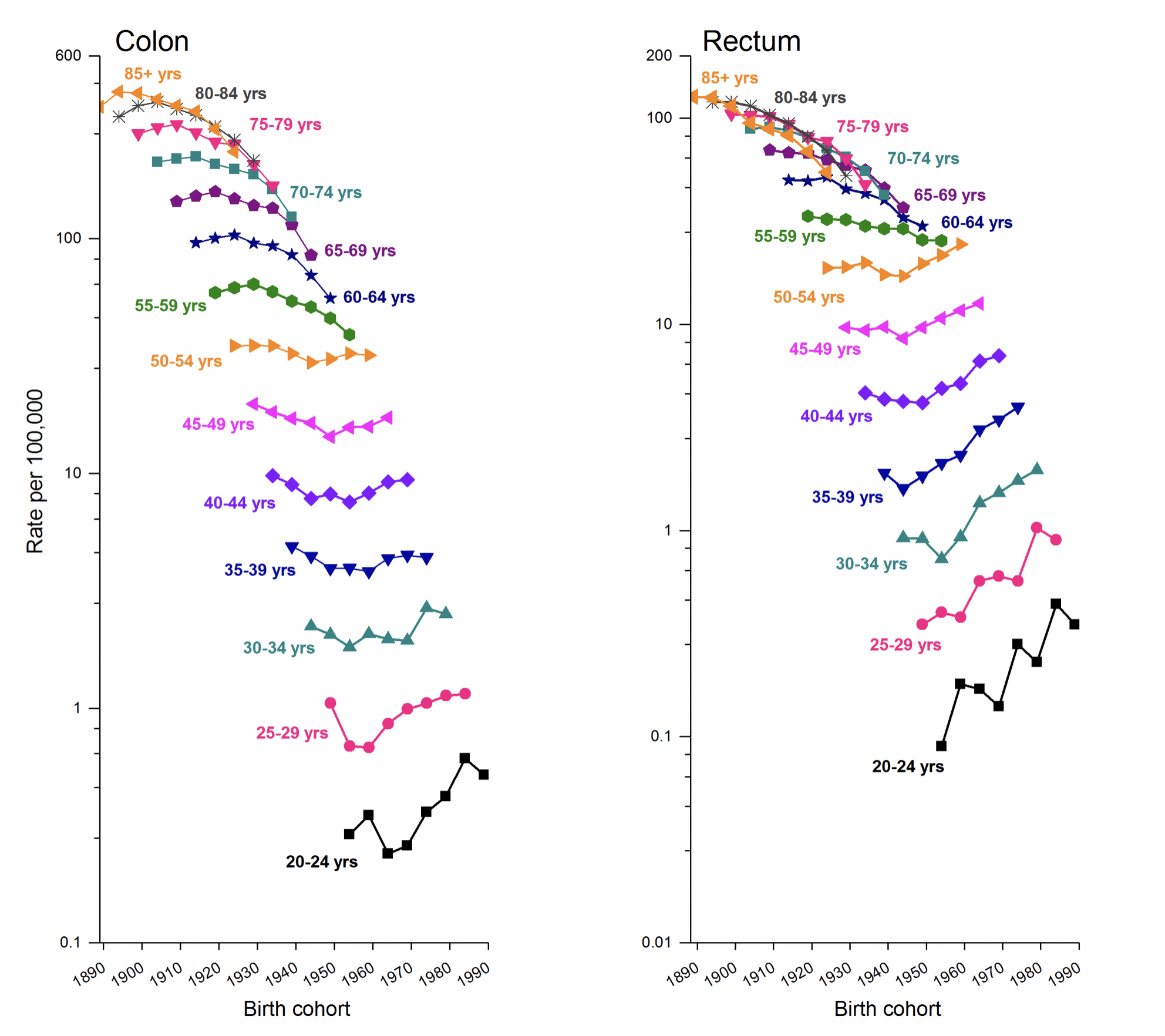
Efforts to reduce colon and rectal cancers have been a striking success story for those over 50 years old. Incidence among older Americans declined 32% between 2000 and 2013, due largely to better screening. But the story for young adults is very different. Those born around 1990 now face four times the risk of developing rectal cancer and twice the risk of colon cancer in their 20s, compared to those born around 1950, according to the American Cancer Society. (Rates among young adults are still relatively low; see graphs below.)
Trends in age-specific colon and rectal cancer incidence rates by year of birth, U.S., 1974-2013
U.S. Trends in Age-Specific Colon and Rectal Cancer Incidence Rates 
Source: R.L. Siegel, et al., JNCI, Vol.109, 2017 — Supplementary Figure 4
According to the National Cancer Institute’s most recent annual report, released last week, colorectal cancer is the most common cancer among men between the age of 20 and 49.
“No one can explain this apparent contradiction,” Li told Microwave News. Known risk factors for colorectal cancer include obesity, an unhealthy diet and lack of physical activity, but Li doesn’t think they can resolve the paradox. “If anything,” he said, “younger generations are more health conscious with better diets.”
Li offers an alternative hypothesis: Young people’s habit of carrying their cell phones in the front or back pockets of their jeans. “When placed in trouser pockets, the phones are in the vicinity of the rectum and the distal colon and these are the sites of the largest increases in cancer,” he says.
RF Exposures from Phones on Standby
Li’s hypothesis assumes that phones continue to emit RF radiation when placed in a pocket. They do, especially smartphones, but exposures are difficult to estimate.
When not in use, phones quickly go to standby mode, and RF transmissions are greatly reduced. Yet, the phone stays active because the system must always know its location in order for the network to direct calls or texts to the nearest cell tower for delivery.
A Swedish-Danish study, published in 2012, found that phones on standby were only in touch with the local base station once every two-to-five hours —and then for just a few seconds. “The exposure in standby mode can be considered negligible,” concluded Kjell Hansson Mild of Umeå University, the lead author of the study. Jørgen Bach Andersen of Aalborg University was a coathour.
Today, Mild sees things differently because smartphones —which were still relatively new when he was working on his study— contact the network much more frequently, if only to update their location. Mild wants research. “We need more measurements and dosimetry on how a phone radiates in a pocket,” Mild said in an interview, adding that, “I keep my phone in my briefcase and when I turn it on, I use a hands-free set.”
When a phone is in a pocket, the separation distance from the body is less than that recommended by Om Gandhi, Mild said. Gandhi, a professor emeritus at the University of Utah, has published a stream of papers on cell phone exposures, estimated by measurements and calculations (here’s one from 2002).
In an e-mail exchange, Gandhi noted that, in compliance tests, cell phones are placed about 10 mm away from the body. Without that spacing —for instance, when a phone is in a pocket next to the body— exposure (SAR) would be about twice that cited in safety specifications. The title of Gandhi’s most recent paper, posted in April by the IEEE, the electrical engineering society, spells out the problem: “Microwave Emissions from Cell Phones Exceed Safety Limits in Europe and the U.S. When Touching the Body.”
In his paper, Mild highlighted that exposures go up if a phone on standby is in motion:
“[W]hen a person carries the phone in a pocket and moves in a city the phone updates when entering a new base station area, and this can be as often as once every few minutes depending if one is in [a] city center or suburban area. For [those] periodic updates the GSM phones operate at full power.”
A later investigation by Damiano Urbinello and Martin Röösli of the University of Basel showed that exposures are even more significant when a phone is in a moving vehicle, whether a car, train or bus.¹ They predicted that smartphones would likely increase exposures because of their need for “regular location updates.”
There was much more to learn. Urbinello and Röösli wrote:
“There is an urgent need to evaluate more thoroughly how personal RF-EMF exposure is affected by one’s own phone in standby mode.”
That was six years ago. There’s been little, if any, follow-up since then. “I am not aware of much further research,” Röösli told Microwave News.
Exposures are “quite variable and the amount of uplink may depend on the type of mobile phone, the network, the provider and the apps installed,” Röösli said. “In particular, push functions are expected to increase the amount of uplink in standby mode.”
Phones in Pockets Below the Waist
Do young adults keep their phones in their pockets? Li points to a 2017 survey of Australian women, aged 15 to 40, by Mary Redmayne, who found that a majority routinely put their phones in a pocket below the waist. Importantly, the youngest women do this the most. She also reported that 96% of the women keep their phones on standby during the day; at night it’s 83%.
In an e-mail, Redmayne said that she has no information about where young men keep their phones, nor is she aware of anyone who had looked into it.
Colorectal Rates Among the Young Rising in Many Countries
Increases of colorectal cancer among the young are being reported around the world, not just in the U.S. — including many European countries, as well as Australia and New Zealand. Just a few weeks ago, IARC reported that, between 2008 and 2015, the incidence of colon cancer among 20-29-year-olds increased by about 18% per year in Denmark, 8% in Australia and 4% in Ireland. While the risk declined in Canada and Norway, the rate of rectal cancer in those countries rose by 3.5% and 10.6% per year, respectively.
 Writing in The Lancet – Gastroenterology & Hepatologythe IARC team advises:
“Although the incidence of colorectal cancer in adults younger than 50 years remains low compared with that in older age groups, our findings are of concern and highlight the need for action to counteract the rising burden of disease in younger cohorts.”
Also in May, a second research group reported similar trends across 20 European countries in Gut, a BMJ  journal. On average, colorectal cancer rose by 7.9% per year among 20-29-year-olds from 2004 to 2016. The effect gets smaller with age: The increase among 30-39-year-olds was 4.9%, and 1.6% for 40-49-year-olds.
In 1990, the rate was 0.8 cases per 100,000 Europeans in their 20s. By 2016, it was 2.3/100,000. The big jump came recently: For 1990-2004, incidence went up by 1.7% per year, but it grew to 7.9% per year from 2004 to 2016.
Li: A Plausible Explanation
“My hypothesis could be proven wrong,” Li concedes, “but this potential explanation is more plausible than any other current hypotheses out there.” People should be made aware of the possible risks, he said, so that young adults can decide whether to take precautions and colorectal cancer researchers can weigh the merits of the case.
Over the last 20 years, Li, who is with Kaiser Permanente in Oakland, CA, has completed a number of groundbreaking studies on the effects of power-frequency EMFs. In 2001, he reported that women faced up to a sixfold increased risk of miscarriages when exposed to magnetic fields above 16 mG (see MWN, M/J01 and J/F02). That early work has been supported by others and there are now at least seven studies that point to an EMF–miscarriage risk.
In other projects, Li has shown that magnetic fields can affect the quality of human spermand that prenatal EMF exposure can lead to childhood asthma and obesity.