Showing posts with label Screen Time. Show all posts

Thursday, August 08, 2019

AMA and American Academy of Pediatrics Both Have Warned Screens Can Cause Obesity, Insomnia, Anxiety, Depression in Teens

For anyone who still thinks kids “glued” to screens is cute or normal, on November 17, 2017, The American Medical Association (AMA) posted a press release warning about teens being harmed by screen use:
This increased use of devices such as tablets and phones is being associated with an uptick in harmful effects, including obesity, sleep problems, depression and anxiety.
Recently, medical experts even started warning this was causing some to grow “horns” on the back of their heads.  That’s not cute or normal at all. 
Unfortunately, parents as well as public schools are still starting kids younger than teens on screens despite past and present warnings.  
Since 2012, the American Academy of Pediatrics has been warning about kids’ use of technology AND their exposure to its Electromagnetic Fields aka “Electrosmog” (Bluetooth, cell phone radiation and WiFi).  Research has proven that kids are more vulnerable to exposure.  In fact, there is still no “safe” level that has been scientifically determined for children or pregnant women.  Many experts also warn that blue light from screens causes all kinds of issues including insomnia and blindness.
Exposure is cumulative and everyone is affected differently.  Of course, if your kid is perfectly fine right now, you may not be concerned.  But if you are concerned, Environmental Health Trust is one of many organizations that provide a plethora of information about this on their websites.  Here are some highlights about the American Academy of Pediatrics warnings about cell phones, cell towers, and WiFi:
The American Academy of Pediatrics (AAP), the largest US medical association of pediatricians and pediatric specialists, recommends that the US government tighten wireless exposure limits and that the public reduce children’s exposure to cell phones and other devices that emit wireless radiation. The AAP also cautions that cell tower radiation is linked to headaches, sleep problems and depression in scientific research studies.  
The AAP issued the following cell phone safety tips on their webpage Healthy Children Webpage on Cell Phones. They  specifically recommend to reduce exposure to wireless radiation:

Council on Environmental Health Executive Committee in the AAPs press release on the NTP Study Results.
The official position of the AAP is documented in three letters they sent to government officials. The letters describe children’s unique vulnerability to wireless radiation and call on the federal government to review and tighten radiation standards for wireless devices in order to protect pregnant women and children’s health. In 2012, the AAP sent a letter in support of the newly proposed federal legislation referred to as the Cell Phone Right to Know Act. In 2012, the AAP wrote a letter to the Federal Communications Commission calling for it to open up a review of radiofrequency limits. In 2013, after the FCC opened up “Reassessment of Exposure to Radiofrequency Electromagnetic Fields Limits and Policies” the AAP submitted a letter with their official comment.
In 2012, the AAP published Pediatric Environmental Health, the AAP Textbook of Children’s Environmental Health and Chapter 41 is about Electromagnetic Fields. The AAP website HealthyChild.org informs the public about cell phone and wireless radiation and cell tower radiation. In 2016, the AAP issued a press release about the carcinogenic findings from the NIH National Toxicology Program Studies and issued new recommendations with 10 ways to reduce children’s exposure to wireless radiation.


Friday, July 19, 2019

Smartphones, tablets causing mental health issues in kids as young as two

Children as young as two are developing mental health problems because of smartphones and tablets, scientists warn.
Just an hour a day staring at a screen can be enough to make children more likely to be anxious or depressed.
This could be making them less curious, less able to finish tasks, less emotionally stable and lowering their self-control, the DailyMail reports.
Although teenagers are most at risk from the damaging devices, children under the age of 10 and toddlers' still-developing brains are also being affected.
But research shows 'zombie' children spend nearly five hours every day gawping at electronic devices.
Researchers from San Diego State University and the University of Georgia say time spent on smartphones is a serious but avoidable cause of mental health issues.
"Half of mental health problems develop by adolescence," professors Jean Twenge and Keith Campbell said. "There is a need to identify factors linked to mental health issues that are [able to be changed] in this population, as most are difficult or impossible to influence. How children and adolescents spend their leisure time is [easier] to change."
Parents and teachers must cut the amount of time children spend online or watching television while they're studying, socialising, eating or even playing sport.
Professor Twenge said her study, one of the biggest of its kind, backs the American Academy of Pediatrics' established screen time limit – one hour per day for children aged two to five.
It also suggests a similar limit – perhaps two hours – should be applied to school-aged children and adolescents, she added.
The researchers analysed data provided by the parents of more than 40,000 US children aged two to 17 for a nationwide health survey in 2016. The questionnaire asked about the youngsters' medical care, any emotional, developmental or behavioural issues and their daily screen time.
Adolescents spending more than seven hours a day on screens are twice as likely to have been diagnosed with anxiety or depression as those who spent an hour. Links between screen time and wellbeing are stronger among adolescents than young children, the study found.
Professor Twenge said: "At first, I was surprised the associations were larger for adolescents. However, teens spend more time on their phones and on social media, and we know from other research that these activities are more strongly linked to low wellbeing than watching television and videos, which is most of younger children's screen time."
Even moderate use of four hours is also associated with lower psychological well-being than one hour a day.
Pre-schoolers, or under fives, who are high users are twice as likely to often lose their temper – and are 46 per cent more prone to not be able to calm down when excited.
Among 14 to 17 year olds, more than four in ten (42.2 per cent) of those in the study who spent more than seven hours a day on screens did not finish tasks.
About one in eleven (9 per cent) of 11 to 13-year-olds who spent an hour with screens daily were not curious or interested in learning new things.
Writing in the journal Preventative Medicine Reports, the professors said they were particularly interested in links between screen time and diagnoses of anxiety and depression in youngsters, which have not yet been studied in great detail.
They said: "Previous research on associations between screen time and psychological well being among children and adolescents has been conflicting, leading some researchers to question the limits on screen time suggested by physician organisations."
The US National Institute of Health estimates children and adolescents commonly spend an average of five to seven hours on screens during leisure time. Evidence is growing of the adverse effects this has on health.
This year the World Health Organisation decided to include gaming disorder in the 11th revision of the International Classification of Diseases.
And in December 2017 a team of Oxford University researchers found UK 'zombie' children's average daily screen time has leapt in a generation from just under three hours to four hours and 45 minutes.
Experts warn 'addicted' children risk sleeplessness, obesity and falling victim to cyber-bullying, while losing valuable social skills through a lack of face-to-face contact.

Monday, June 24, 2019

Americans 60 and older are spending more time in front of their screens than a decade ago

The amount of time that Americans ages 60 and older spend on their TVs, computers, tablets or other electronic devices has risen almost half an hour per day over the past decade, according to a Pew Research Center analysis of Bureau of Labor Statistics data, even as screen time among younger people has more or less held steady.
Those 60 and older – a group increasingly populated by aging Baby Boomers – now spend more than half of their daily leisure time, four hours and 16 minutes, in front of screens, mostly watching TV or videos. Screen time has increased for those in their 60s, 70s, 80s and beyond, and the rise is apparent across genders and education levels. Meanwhile, the time that these older adults spend on other recreational activities, such as reading or socializing, has ticked down slightly.
This rise in screen time coincides with significant growth in the adoption of digital technology by older Americans. In 2000, 14% of those ages 65 and older were internet users; now 73% are. And while smartphone ownership was uncommon at all ages around the turn of the 21st century, now about half (53%) of people 65 and older are smartphone owners.
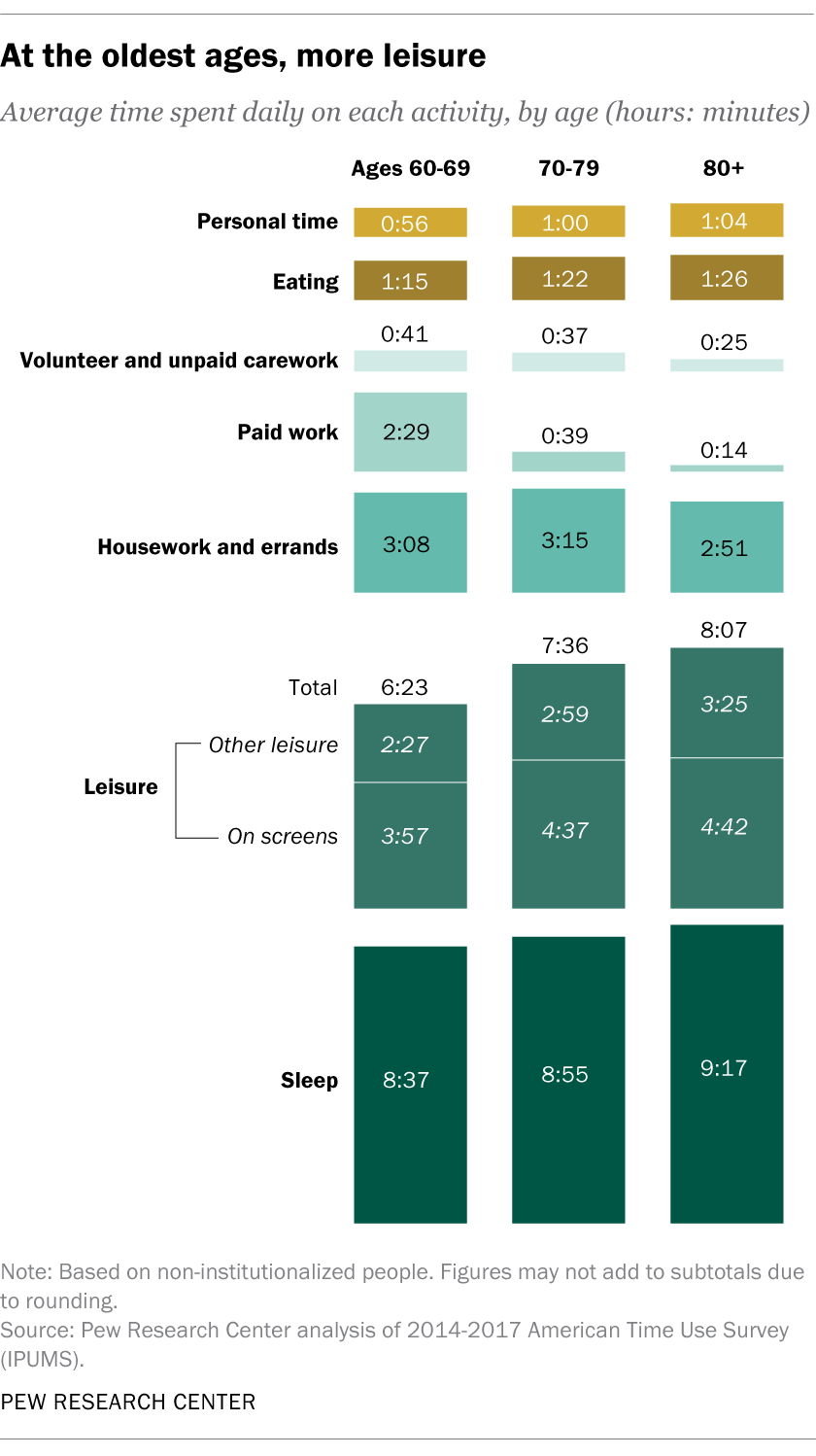
Overall, leisure time for Americans 60 and older has held steady at about seven hours a day, and the amount of time they spend on other activities has also been quite stable over the past decade. On average, they sleep more than eight and a half hours per day; spend three hours on chores and errands; and devote more than an hour to eating, as well as an additional hour for personal activities such as grooming or health care. By comparison, younger Americans work more, have less leisure and screen time, and spend less time doing housework.
At the oldest ages, more leisureWhile overall time use patterns of older Americans haven’t changed much over the past decade, some differences do emerge by age, sex and education. More than four-in-ten Americans in their 60s are still working, while just 14% of people in their 70s and 4% of those 80 and older are employed. As a result, the average amount of time spent working per day among people in their 60s is far higher than it is for people ages 70 and older.
These age differences in paid work are also reflected in age differences in time spent on leisure. People in their 60s spend more than an hour less per day, on average, engaged in leisure activities when compared with their older counterparts. Those in their 60s also sleep less than their older counterparts and log a bit more time on unpaid caregiving and volunteering.
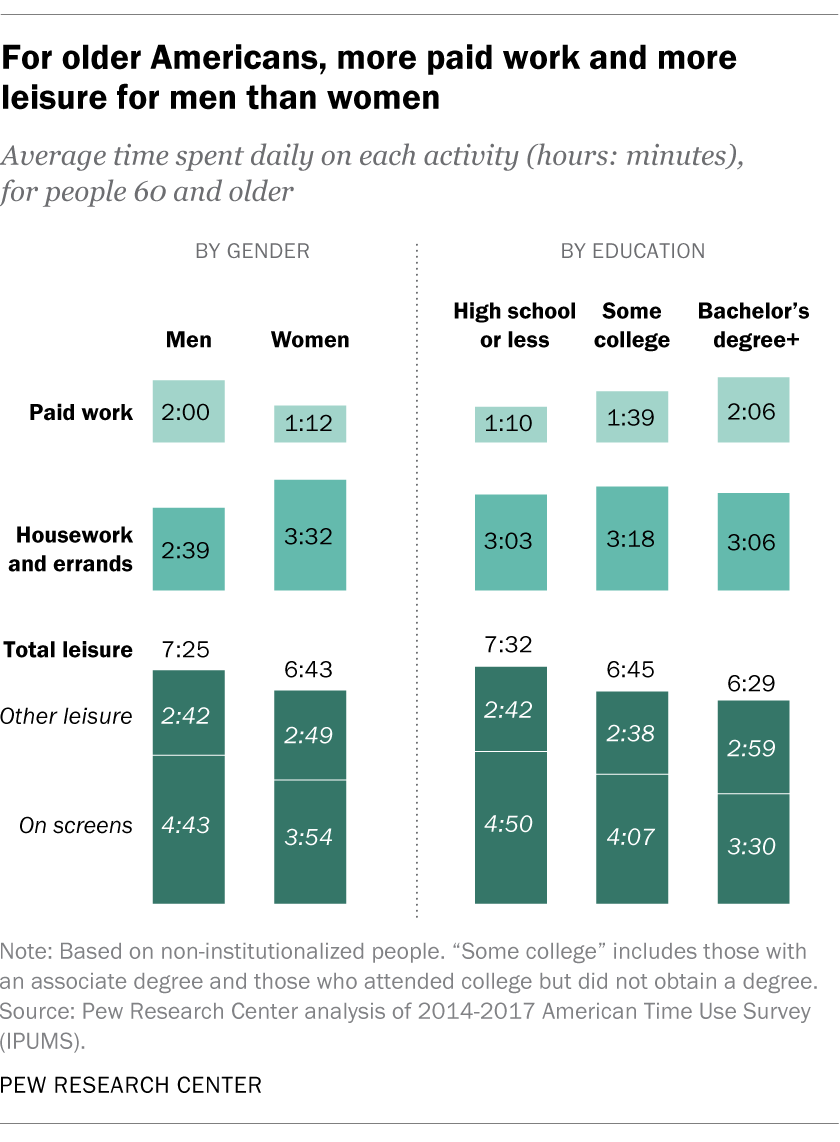
The differences in the day-to-day experiences of men and women ages 60 and older largely echo gender patterns that are seen at younger ages. Men 60 and older are more likely to be working than their female counterparts (33% vs. 24%) and, among those who work, they tend to work more hours.
For older Americans, more paid work and more leisure for men than womenBut while more paid work is sometimes linked with less leisure time, this is not the case when it comes to men and women ages 60 and older: Among adults in this age group, men spend 48 more minutes a day working than women, yet they also spend 42 more minutes on leisure time.
For their part, women 60 and older spend almost an hour more per day than men on housework and errands, especially cleaning and food preparation. Women spend an hour and 56 minutes cooking and cleaning daily, compared with 44 minutes for men. On the flip side, men spend more time on household maintenance – 55 minutes a day versus 22 minutes for women.
Time use among older adults also differs by educational attainment. As is the case across age groups, those with higher levels of education are more likely to be employed. Around four-in-ten adults who are 60 and older and have a bachelor’s degree or more (37%) are working, compared with 31% of their counterparts with some college experience and 21% of those with a high school diploma or less. This translates into a gap in the amount of time spent on paid work for all people 60 and older: Those with a bachelor’s degree or more work an average of just over two hours a day, while those with a high school diploma or less work an average of an hour and 10 minutes daily.
As is the case among younger Americans, the additional time spent on paid work by people who are 60 or older and have a bachelor’s degree or more is offset by additional leisure time for people with a high school diploma or less. And not only does the amount of leisure time vary by educational level, so does the way that this leisure time is spent. People with less education spend more of their leisure time on screens and less time reading compared with their more educated counterparts. Less educated adults also spend less time exercising: 12 minutes a day for those with a high school diploma or less, compared with 26 minutes for college graduates.
But the educational gaps in leisure time are not due entirely to differences in time spent working: Even among people 60 and older who are not employed, those with a high school diploma or less spend about half an hour more per day (8 hours and 17 minutes) on leisure than those with either some college (7 hours and 42 minutes) or a bachelor’s degree or more (7 hours and 38 minutes). These differences are driven more by the educational gap in how men spend their leisure time: Men with a high school diploma or less spend an hour more per day on leisure than those with a bachelor’s degree (9 hours and 10 minutes vs. 8 hours and 10 minutes). Among women who are not working, there is a 35-minute educational gap in leisure time (7 hours and 42 minutes vs. 7 hours and 7 minutes).

Source

Friday, May 31, 2019

Letting screen time get between you and your child

Screen time's effect on young children is still largely not understood - but researchers are concerned about the impact of distracted parents on their devices on their children. 


Friday, April 26, 2019

WHO Says No Screen Exposure for Babies Under 1 Year Old. Kids Under 5 Should Have No More Than 1 Daily Hour of “Sedentary Screen Time."


By B.N. Frank

From The Washington Post:
The answer, according to WHO, is never for children in their first year of life and rarely in their second. Those aged 2 to 4, the international health agency said, should spend no more than an hour a day in front of a screen.  American Academy of Pediatrics (AAP) has also made similar recommendations regarding kids’ use and exposure to screens.

[…]

Research on older children has associated screen time with behavioral and development issues, but research on babies and toddlers is more inconclusive. One study published in JAMA Pediatrics in January found that screen time could delay toddlers’ language and sociability skills. Another study published this month in Pediatrics found that parents interacted with, and spoke to, their toddlers more when reading print books than when they read electronic books to their children.
In the U.S., a $300M federal research study has already determined that screen use harms kids’ brains in a multitude of ways.

American Academy of Pediatrics (AAP) has also made recommendations regarding kids’ exposureto cell phonescell towers, and other sources of wireless radiation.  In 2012, they endorsed Ohio state rep Dennis Kucinich’s “Cell Phone Right to Know” Act.

WHO has also weighed in on cell phone and wireless radiation exposure.  (See 12)

In 2014, the American Cancer Society noted that the WHO promised to conduct a formal assessment of risks from radiation exposure from utility “Smart” Meters.  In 2017, it was reported that “Smart meters cause a “cornucopia of health issues” for occupants of the 57 million American homes equipped with the new technology, according to the World Health Organization and Cancer.org.”

Despite this, utility “Smart” Meters are still being promoted as beneficial to customers and eco-friendly by utility companies and even some environmentalists and health care professionals.  It’s ridiculous.  People everywhere are still fighting to get these meters removed from their homes and communities.  (See 12,3)

Reducing screen time is important.  Also important – recognizing that no “safe” level of wireless radiation has been scientifically determined for children or pregnant women.  None of this will apparently stop tech companies from marketing screens and everything else even though they’ve admitted they may eventually be held financially liable for causing harm to the public.

See videos here.