Showing posts with label children. Show all posts

Thursday, August 08, 2019

AMA and American Academy of Pediatrics Both Have Warned Screens Can Cause Obesity, Insomnia, Anxiety, Depression in Teens

For anyone who still thinks kids “glued” to screens is cute or normal, on November 17, 2017, The American Medical Association (AMA) posted a press release warning about teens being harmed by screen use:
This increased use of devices such as tablets and phones is being associated with an uptick in harmful effects, including obesity, sleep problems, depression and anxiety.
Recently, medical experts even started warning this was causing some to grow “horns” on the back of their heads.  That’s not cute or normal at all. 
Unfortunately, parents as well as public schools are still starting kids younger than teens on screens despite past and present warnings.  
Since 2012, the American Academy of Pediatrics has been warning about kids’ use of technology AND their exposure to its Electromagnetic Fields aka “Electrosmog” (Bluetooth, cell phone radiation and WiFi).  Research has proven that kids are more vulnerable to exposure.  In fact, there is still no “safe” level that has been scientifically determined for children or pregnant women.  Many experts also warn that blue light from screens causes all kinds of issues including insomnia and blindness.
Exposure is cumulative and everyone is affected differently.  Of course, if your kid is perfectly fine right now, you may not be concerned.  But if you are concerned, Environmental Health Trust is one of many organizations that provide a plethora of information about this on their websites.  Here are some highlights about the American Academy of Pediatrics warnings about cell phones, cell towers, and WiFi:
The American Academy of Pediatrics (AAP), the largest US medical association of pediatricians and pediatric specialists, recommends that the US government tighten wireless exposure limits and that the public reduce children’s exposure to cell phones and other devices that emit wireless radiation. The AAP also cautions that cell tower radiation is linked to headaches, sleep problems and depression in scientific research studies.  
The AAP issued the following cell phone safety tips on their webpage Healthy Children Webpage on Cell Phones. They  specifically recommend to reduce exposure to wireless radiation:

Council on Environmental Health Executive Committee in the AAPs press release on the NTP Study Results.
The official position of the AAP is documented in three letters they sent to government officials. The letters describe children’s unique vulnerability to wireless radiation and call on the federal government to review and tighten radiation standards for wireless devices in order to protect pregnant women and children’s health. In 2012, the AAP sent a letter in support of the newly proposed federal legislation referred to as the Cell Phone Right to Know Act. In 2012, the AAP wrote a letter to the Federal Communications Commission calling for it to open up a review of radiofrequency limits. In 2013, after the FCC opened up “Reassessment of Exposure to Radiofrequency Electromagnetic Fields Limits and Policies” the AAP submitted a letter with their official comment.
In 2012, the AAP published Pediatric Environmental Health, the AAP Textbook of Children’s Environmental Health and Chapter 41 is about Electromagnetic Fields. The AAP website HealthyChild.org informs the public about cell phone and wireless radiation and cell tower radiation. In 2016, the AAP issued a press release about the carcinogenic findings from the NIH National Toxicology Program Studies and issued new recommendations with 10 ways to reduce children’s exposure to wireless radiation.


Friday, August 02, 2019

Video - Electrosmog Radiation In Anne Arundel County Public Schools

Excellent video.  8 minutes.

...to put pressure on the schools in Maryland regarding the electrosmog concerns.

8+ minutes.  We're pretty certain nothing like this has been produced before.

Turn your speakers up.   

Have a nice day.


Monday, July 29, 2019

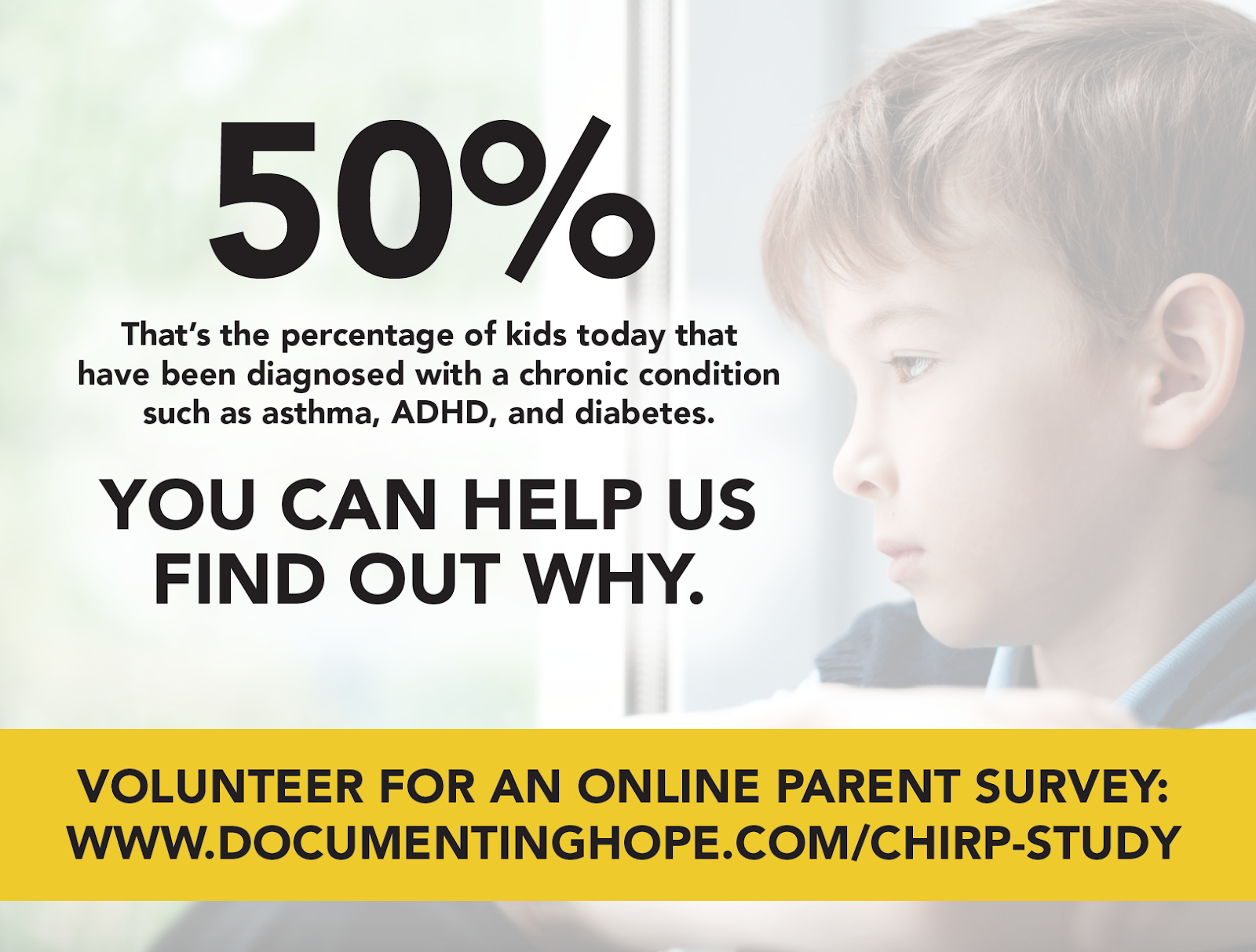
The CHIRP Study (finding answers to chronic illness in children)


Via Nick Pineault

Today I wanted to give you a heads up about something called the "CHIRP" study.
I met a LOT of extremely inspiring people at the 2019 Nourish Vermont conference (you can watch my entire keynote here):
- Jason Prall who's raising awareness on ancestral practices that lead to amazing longevity and healthspan + the power of psychedelics
- Dr. Zach Bush who's applying his research on lignans (used in his Restore product, among other things) to help heal and fix conventional agriculture
- Dr. Ted Achacoso who's a real pioneer in a brand new type of preventative medicine
But as a new dad, it's Beth Lambert's keynote that touched me the most (you can watch it here).
As Beth shared in her talk, the reality is that a whopping 50% of all children in the US (similar trends seen in other Western countries) suffer from chronic disease. What the heck?
The vast majority of these conditions simply cannot be blamed on genetics. The truth is that most of them are caused by "environmental factors".
Here's where science is kind of stuck right now -- most studies are trying to find out if ONE factor is THE culprit behind the dramatic increase we're seeing in autism, allergies, autoimmunity and the slew of other conditions ailing our children.
The problem is that kids are not exposed to ONE new environmental factor that could potentially make them sick... but to hundreds of them: GMOs, glyphosate, other pesticides and new unmonitored chemicals, nuclear radiation, vaccination (oh my god I used the V word!), screentime, and you've guessed it already -- EMFs!
Here's where Beth's work comes in, and where YOU can make a huge difference in the world...
Beth is spreading the word about a study she's involved with called CHIRP™, (Child Health Inventory for Resilience and Prevention), which is a private, online survey for parents. The study and research project is under the direction of Principal Investigator and Pediatric Neurologist and Neuroscientist, Dr. Martha Herbert -- who's well aware of EMFs.
As a result, the CHIRP questionnaire includes critical questions about the use of cell phones in children, where their wifi routers is, etc.
In plain English, if enough children fill out this free online survey, a research study led by a Harvard scientist might be able to identify correlations between different chronic diseases and EMF exposure.
Can we, for example, identify that children who use tablets, phones or who have a baby monitor near their head are more likely to be sick? This is critical data that we need to gather.
Here’s how you can help:
A) If you are the parent of a child between the ages of 1 and 15, take the survey! It takes a number of hours to complete, but you don’t have to take it all at once. It’s online, secure and your information is totally private and will be de-identified (personal identifying information is removed). Get started by filling out this form to see if you qualify to take the CHIRP survey!
B) If you do not have a child between the ages of 1 and 15, we need you to help spread the word! Please share with your friends, followers, colleagues and more!
If you are based in the US and have kids between the ages 1 and 15, I hope you'll consider participating in the study!
image
Together we can all make a difference.

Monday, July 22, 2019

Pampers Joins Huggies in Selling “Smart” Diapers Despite Health Warnings, Privacy and Security Issues


Activist Post reported about Huggies’ “Smart Diapers” in May.  Now Proctor & Gamble has announced they will start selling their own “Smart” diapers in the fall.  Unlike the Huggies line, their diapers will only track pee (not poo) but they will also track babies’ sleep patterns.
The Lumi by Pampers line, which Pampers says has a waitlist ahead of its US launch this fall, includes an activity sensor that secures to a “landing” on the front of a baby’s diaper. It comes with a baby monitor and a 10-day supply of diapers. The sensor works with a corresponding app to log the kid’s pee and identify patterns. Additional packs of Lumi by Pamper diapers will be sold separately. Pricing has not been finalized.
Parents using the Lumi diapers will in theory not have to worry about checking any of that because they’ll get smartphone alerts. The app will display one of three diaper statuses: dry, wet, very wet.
Like anything “Smart”, there are concerns about privacy and security.  Some experts are also saying these diapers could cause more harm than good.  No sh*t, Sherlock:
  1. The American Academy of Pediatrics (AAP) and other health experts have been issuing warnings about kids’ exposure to cell phone and wireless radiation for many years.
  2. Earlier this year 250 scientists signed a petition that warns against numerous devices that emit Radio Frequency (RF) Radiation (used in WiFi and Bluetooth)
  3. No safe level of wireless radiation exposure that has been determined for children or pregnant women.
“Smart” Diapers are also a great source of “Surveillance Capitalism” for any company who decides to sell customer data to 3rd parties.
Anyone thinking that “Smart” Diapers smell like legal trouble is right on the money.  Unfortunately, babies with foolish tech-crazed parents are defenseless in the meantime.


Source 

Friday, July 19, 2019

Smartphones, tablets causing mental health issues in kids as young as two

Children as young as two are developing mental health problems because of smartphones and tablets, scientists warn.
Just an hour a day staring at a screen can be enough to make children more likely to be anxious or depressed.
This could be making them less curious, less able to finish tasks, less emotionally stable and lowering their self-control, the DailyMail reports.
Although teenagers are most at risk from the damaging devices, children under the age of 10 and toddlers' still-developing brains are also being affected.
But research shows 'zombie' children spend nearly five hours every day gawping at electronic devices.
Researchers from San Diego State University and the University of Georgia say time spent on smartphones is a serious but avoidable cause of mental health issues.
"Half of mental health problems develop by adolescence," professors Jean Twenge and Keith Campbell said. "There is a need to identify factors linked to mental health issues that are [able to be changed] in this population, as most are difficult or impossible to influence. How children and adolescents spend their leisure time is [easier] to change."
Parents and teachers must cut the amount of time children spend online or watching television while they're studying, socialising, eating or even playing sport.
Professor Twenge said her study, one of the biggest of its kind, backs the American Academy of Pediatrics' established screen time limit – one hour per day for children aged two to five.
It also suggests a similar limit – perhaps two hours – should be applied to school-aged children and adolescents, she added.
The researchers analysed data provided by the parents of more than 40,000 US children aged two to 17 for a nationwide health survey in 2016. The questionnaire asked about the youngsters' medical care, any emotional, developmental or behavioural issues and their daily screen time.
Adolescents spending more than seven hours a day on screens are twice as likely to have been diagnosed with anxiety or depression as those who spent an hour. Links between screen time and wellbeing are stronger among adolescents than young children, the study found.
Professor Twenge said: "At first, I was surprised the associations were larger for adolescents. However, teens spend more time on their phones and on social media, and we know from other research that these activities are more strongly linked to low wellbeing than watching television and videos, which is most of younger children's screen time."
Even moderate use of four hours is also associated with lower psychological well-being than one hour a day.
Pre-schoolers, or under fives, who are high users are twice as likely to often lose their temper – and are 46 per cent more prone to not be able to calm down when excited.
Among 14 to 17 year olds, more than four in ten (42.2 per cent) of those in the study who spent more than seven hours a day on screens did not finish tasks.
About one in eleven (9 per cent) of 11 to 13-year-olds who spent an hour with screens daily were not curious or interested in learning new things.
Writing in the journal Preventative Medicine Reports, the professors said they were particularly interested in links between screen time and diagnoses of anxiety and depression in youngsters, which have not yet been studied in great detail.
They said: "Previous research on associations between screen time and psychological well being among children and adolescents has been conflicting, leading some researchers to question the limits on screen time suggested by physician organisations."
The US National Institute of Health estimates children and adolescents commonly spend an average of five to seven hours on screens during leisure time. Evidence is growing of the adverse effects this has on health.
This year the World Health Organisation decided to include gaming disorder in the 11th revision of the International Classification of Diseases.
And in December 2017 a team of Oxford University researchers found UK 'zombie' children's average daily screen time has leapt in a generation from just under three hours to four hours and 45 minutes.
Experts warn 'addicted' children risk sleeplessness, obesity and falling victim to cyber-bullying, while losing valuable social skills through a lack of face-to-face contact.

Thursday, June 27, 2019

Please Get the Digital Baby Monitor OUT of the Nursery!

The digital baby monitor is problematic. Is this news to you? If so, read on. (and at the bottom of the post I found a SAFER one!) Updated Sept., 2016.

As a parent, this information may be very hard for you to hear at first…


As I said on my post 9 Facts About Wireless & Your Child’s Brain, please view this information as a gift. I hope this gives you a starting point to take actionin your home.

When you first learn you are pregnant, you make a list of “must haves.” Probably the list includes a digital baby monitor. But, would you be surprised if I said this is one thing you may not want? 

As one article said, “It’s hard to talk about the dangers of wireless technology without sounding like a conspiracy theorist. This is especially true in the United States, where non-industry-funded studies are rare, where legislation protecting the wireless industry from legal challenges has long been in place, and where our lives have been so thoroughly integrated with wireless technology that to suggest it might be a problem—maybe, eventually, a very big public-health problem—is like saying our shoes might be killing us.

Except our shoes don’t send electromagnetic frequencies directly into our brains.” 

If this was even partially true, I’m sure you would want to know. You need to be able to make your own analysis instead of being told what is ‘good for you’, so do your own research and don’t just believe everything out there written (including me)! 
 

The Nitty Gritty of the Digital Baby Monitor

Most baby monitors are now advertised as using DECT phone technology (1.8 to 1.9 GHz) or operate at 2.4 GHz, the same electromagnetic microwave frequency used for microwave ovens, cordless phones, and Wi-Fi routers.These are identifiable by the large number of claimed channels (usually at least 30 and often up to 120), which DECT automatically switches (roams) between. These emit sharply pulsing bursts of microwave frequencies 100 times every second all the time they are turned on. (PowerWatch –source)

Digital baby monitors, bought by parents to keep their children safe, may instead be harming them, some scientists fear.  They warn that the devices are bathing the infants in electromagnetic frequencies at an age when they are most vulnerable to it.


According to PowerWatch, a wireless digital baby monitor a 1 meter (~3 feet) away from the baby’s crib was roughly equivalent to the microwaves experienced from a cell phone tower only 150 meters (~450 feet) away. 

Most parents would agree that installing a cell phone tower next to a schoolwould definitely not be a good idea. The battle is being fought around the U.S. and largely has been won in Europe apparently due to more independent studies and less suppression of truth.
 

‘Talk Back’, Camera-Based, and Mat Digital Baby Monitors

Get the Digital Baby Monitor OUT of the Nursery!, a baby in his crib with a bay monitor right by his head

With the ‘talk back’digital baby monitor, where parents can talk back to the baby, both units continuously emit pulsing microwave frequencies (on 2 different frequency channels – one for each way), not just when the baby is making a noise or the parent is talking to them. There are also some camera-basedmonitors which run at 2.4 GHz. Since these have to transmit video and sound, it is likely that they would have a higher power output. (source)
 

The digital baby monitor mats that check temperature, heartbeat, breathing, etc, should only be used if you have medical reasons to believe that your baby might be in danger of sudden infant death. When used with a wireless baby alarm they carry high levels of microwaves (up to 6 volts per metre) right into the cot, and we believe that will not do your baby any good at all.(source)


Health Studies on the Digital Baby Monitor and Infants:

SIDS Largely Eradicated In Sweden & Japan by Doing This 1 Thing

One scientific paper proposed: A possible association between fetal/neonatal exposure to radio frequency electromagnetic radiation and the increased incidence of autism spectrum disorders (ASD). (source)
 

The study above links the introduction of wireless RF (Radio Frequency) communication technologies such as digital baby monitors to the rise autism in the public. It found:

  • For several decades prior to 1980, autism incidence remained essentially stable; reportedly at about one diagnosed case per 2000 children
  • RF radiation sources have become commonplace in the personal human environment from approximately 1980 to the present
  • Operation of an RF radiation source such as a two-way radio, portable telephone, or a cell phone exposes the operator to levels of RF radiation shown to be biologically active
  • Passive operation, such as from an RF emitting baby monitor, is a widespread postnatal exposure
Some of the known effects of exposure to RF radiation include:
  • cognitive impairment
  • memory deficit
  • EEG modifications
  • DNA damage
  • chromosome aberrations
  • micronucleus formation
  • fetal malformation
  • increased permeability of the blood-brain barrier
  • altered cellular calcium efflux
  • and altered cell proliferation
 

Dr. Magda Havas, PhD (and others) ask:

Is there a link to cancers such as childhood leukemia or nervous system tumors? Do infants sleep poorly with these monitors as indicated by PowerWatch (UK) and is the link between an infant’s erratic heart rate and exposure to these baby monitors real? We just published a paper on erratic heart rate for adults exposed to a 2.4 digital cordless phone!

At any rate, exposing infants to microwave radiation, even at very low levels is unwise. Since technology is available to provide voice-activated baby monitors–the ones that emit microwave radiation only when activated–the baby monitors that emit microwave radiation continuously should be banned – especially DECT baby monitors. 

We can’t help our children being exposed to radiation from phone towers and masts, other people’s mobile and cordless phones, but we can reconsider using a digital baby monitor. 

PowerWatch strongly recommends that only low-band (35 to 50 MHz) analog baby monitors be used. These use analog frequency modulation (FM, like VHF radio stations) that does not pulse at all. The analog monitors are often identifiable by their low number of channels – typically 2-4. (source)

Understanding this information may make immense difference to you and your families health. Knowledge leads to action and should not lead to guilt (which I’ll address in a moment).
 

Help Baby (and you) Get More Sleep

 A Sleeping Baby

Though it is beyond the scope of this post, this tip may help you and your baby get more sleep:

Nearing four months, babies are beginning to cycle between light and deep sleep and may start sleeping through the night…hoorah! Each night, a four-month old will go through two or three complete sleep cycles. Every 90 minutes, babies cycle to a state of light sleep called REM. Every three to four hours, they cycle to a more active, almost awake state. Each time they move into that light sleep, they will usually make noise, move about, cry out, and may even wake themselves. We adults do it, too, minus the crying, of course.

At these intervals when we hear these sounds (often around 11PM, 2AM, and 5AM), we often want to go to our babies, pick them up to comfort them, feed them, or hold them so they don’t wake the household. But by going in to check our babies when we hear movement or cries during the night, we risk two things:
  1. Really waking your baby by going to him when she’s just in a light sleep cycle and isn’t really awake
  2. Conditioning your baby to need you to settle her down between sleep cycles. It prevents her from practicing techniques to fall back asleep againearly on when she does awaken


The goal for any parent is to learn what is a real cry needing attention and to ignore all the other sounds your baby makes at night. You want to get a good night sleep when you can! With a bit of practice and the natural instinct God gave to Mothers, you will gain that understanding quickly. 

Guilt

Because many of us hold ourselves to higher standards when it comes to parenting than perhaps any other endeavor, I need to address the area of guilt.

The moment our new babies comes into our arms, a whole new set of emotions rushes in – joy, wonderment, pride, fear, and, yes, guilt. I’ve totally been there and still feel terrible about so many things I’ve done or failed to do!

But we live in an extremely confusing world today, and we cannot know everything, so my thinking is this: Just having accurate information is empowering (that is why I write) and it need not make us feel guilty or fearful. Mamas, please know I am on your side, and silly as it sounds since I don’t know you all individually and personally, I care very much for you and your family…I guess it’s just the way I’m wired. Please stop the guilt.
 

Considering the fact that I could be wrong on radiation, my go-to place is prayer…for wisdom, insight, strength, understanding, good instincts as a Mom, courage, and so much more, and I pray these things for you, too. We have a loving Lord who will give us these things when we ask:


“Consider it pure joy, my brothers and sisters, whenever you face trials of many kinds, because you know that the testing of your faith produces perseverance. Let perseverance finish its work so that you may be mature and complete, not lacking anything. If any of you lacks wisdom, you should ask God, who gives generously to all without finding fault, and it will be given to you.”~James 1: 2-5
 

Read the product information on monitors carefully, as they can be confusing.

Low Emissions Monitors

Safety 1st Sure Glow Audio Monitor (2 RX) – it operates on 49 MHz) that offers a range of over 600 feet.

The First Years Crisp and Clear Audio Monitor (Amazon) – gauge your baby’s activity level through the sound level lights on the monitor (which is helpful when you are in a noisy area yourself)

Crystal Clear Audio Monitor

Angelcare Baby Sound Monitor, White– operating on 927 MHz and 2.4 GHz frequencies, the Angelcare Baby Sound Monitor is sound-activated, so it only turns on when your baby makes noise. This brings you the best of both worlds – less static and interference and lower emissions.

Phillips Avent SCD630/37 Video Baby Monitor This digital video baby monitor uses FHSS technology butis sound-activated, which cuts down on electromagnetic emissions simply because the device doesn’t always need to be powered on. It also gives you the option to use an audio-only mode. So, you get a secure, encrypted connection and high-resolution video screen when you need it, and an audio-only or voice-activated feature when you don’t need a constant video stream. (This is the most popular baby monitor on this list among my readers.) (source)

Even analog monitors, however, should be kept at least 3 feet from the child’s bed and if possible, used sparingly.

Ask/borrow from friends whose children have outgrown them (older models are more likely to be analog). Also shop Amazonor look for them at garage sales.

Source