Showing posts with label Verizon. Show all posts

Monday, August 05, 2019

T-Mobile CEO says Verizon’s 5G plan is ‘fake,’ ‘clueless,’ and ‘dead in the water’


AT&T is “lying, confusing people”

T-Mobile CEO John Legere took something of a victory lap this afternoon, using a call with investors to trash talk his rivals’ 5G plans now that T-Mobile’s merger with Sprint has federal approval. Legere called Verizon “dead in the water without a strategy” and said AT&T has been “lying” and “confusing” customers about its deployment.
Legere laid out a coherent and entertaining (and if you’re his competitors, insulting) vision of the current state of 5G strategies while on the call. Of course, it’s all premised on the idea that T-Mobile, once combined with Sprint, has the one true vision for 5G, which is more than debatable. But his explanation isn’t necessarily wrong, either.
The TL;DR is that Legere believes 5G requires low-band, mid-band, and high-band spectrum in order to work, and the combined T-Mobile is the only carrier that has access to all that.
AT&T and Verizon both have high-band (millimeter wave, or mmWave) spectrum, which delivers extremely fast speeds, but it’s only useful at very short ranges. They also both have low-band spectrum, which is what’s already used for LTE. Mid-band spectrum, which Sprint has, can deliver somewhat faster speeds at somewhat longer distances, offering T-Mobile more flexibility.
Verizon has focused its 5G talk on the deployment of mmWave, and Legere says that a “mmWave-only strategy ... will not work” because it’ll cost too much. AT&T has emphasized that it’s working on upgrading its LTE network to transform it into 5G service (albeit, while misleading customers in the process through confusing branding). Legere says those upgrades are the right approach, but that AT&T has “a big hole” in its plan because of the lack of mid-band.
Whether mid-band is truly necessary for 5G is very much up for debate — Sprint, which owns mid-band spectrum, has described itself as mostly doomed when it comes to 5G because that’s all it has to rely on. T-Mobile’s ability to combine that spectrum with other offerings is why Legere is leaning back and ripping apart his rivals.
AT&T isn’t taking his criticism particularly seriously. “Oh look, Legere is back. They were last to 5G, but he’s already the expert,” an AT&T spokesperson told The Verge. We’ve reached out to Verizon for comment as well.
Verizon, AT&T, and T-Mobile have all started rolling out their 5G networks this year, though so far availability is extremely limited, to the point where it’d be a waste of money to buy a 5G device, potentially even if you lived in one of the few areas where there is availability. Deployment is expected to increase significantly over the next year, particularly as carriers begin to step up their 5G rollouts outside of the very limited mmWave deployments we’ve see now.
It’ll be at least a couple months before T-Mobile can start to do anything with Sprint’s assets, though. The deal needs time to close, and several states still have lawsuits open against the deal. The settlement proposed today with the DOJ could help to resolve some of those issues, but states like California may wish to see even more concessions.
T-Mobile and Sprint reached a deal to have their merger approved by the Department of Justice earlier today. The deal requires the combined company to sell off a number of assets to Dish, including wireless spectrum and prepaid wireless brands like Boost Mobile, and for the company to let Dish piggyback on its network for up to seven years.

The merger had been pending for more than a year while it underwent review. The Federal Communications Commission approved the merger in May, but the Justice Department maintained concerns that allowing the two companies to combine would harm competition in the wireless market, as it would remove the two underdogs and create a third giant that’s relatively equally matched to competitors AT&T and Verizon.

The IRREGULATORS won their first round against the FCC for ripping off the American taxpayers and putting us all at risk


Free Book Explains How Americans Have Become Powerless Against Telecom Companies
In June, Bruce Kushnick and The IRREGULATORS won their first round against the Federal Communications Commission (FCC) for ripping off the American taxpayers and putting us all at risk.
Thanks to Ecological Options Network for reminding everyone about the IRREGULATORS’ free e-Book offer as well as an update on this legal case in their blog:

The Irregulators, a team of senior telecom experts, are exposing in court the illegal accounting scheme to replace wired networks with wireless and make us pay for it!
The Background
  1. Verizon, AT&T and other companies have illegally been using the construction budgets of the copper wireline-based (landlines) state telecommunications utilities to build out their wireless networks.
  • Local phone customers have been charged inflated rates that have paid to help telecom companies build their networks – so that rate payers have been unknowingly subsidizing wireless services at the detriment of wired networks.  Landlines offer better sound quality and more reliability in emergencies such as fires and storms and are essential service for elders.  Landlines do not have the health and cyber risks of wireless communications.
  • If these “cross subsidies” were removed – or repaid – then 5G would not be profitable.
  • This shell game has given wireless companies enormous profits and has shown artificial losses for wired services. This has allowed telecoms to classify wired networks as unprofitable, to justify eliminating the superior copper-wired service and to force us into entirely wireless service!
  • The telecoms have already charged rate payers (at thousands of dollars/line over two decades), to develop a fiber optic service, but didn’t deliver it to us as promised. Now they are attempting to charge us again for it but only giving us wireless service.
  • Almost all these inaccurate and misleading financial practices were enabled by the FCC accounting rules.
  • Exposing these “cross subsidies” and requiring the FCC to demand that telecom carriers fix them to accurately reflect the actual costs associated with each respective technology, could be a game changer.
  • To add insult to injury, the companies have dumped billions per state of their ‘corporate operations expenses’ that should never have been charged. This is the executive pay, lobbyists, lawyers, golf tournaments and the corporate jets — and worse, these are the lawyers, lobbyists that are working to force 5G on us– we’re paying them extra to harm us!
Warnings about widespread 5G deployment have come from:
  1. Security experts
  2. Meteorologists, NASA, NOAA and the U.S. Navy
  3. Doctors and scientists (see 12, 3)
  4. Utility companies
The Telecom Industry doesn’t even have evidence that 5G is safe! 

Source

Thursday, August 01, 2019

Verizon Turns On 5G in Atlanta, Detroit, Indianapolis, and D.C. Still No Scientific Evidence That This Is Safe.

The telecom industry has provided NO scientific evidence that 5G is safe.  Research has confirmed that it isn’t (see 12) and that exposure can cause sweating and other undesirable symptoms and conditions.  U.S. opposition to 5G continues to increase and few people have signed up for it where it’s already been installed.  It’s even been reported as making phones overheat (see 12).
Regardless, it’s now live in 4 more U.S. cities.  From The Verge:
Verizon has hooked four more cities up to its 5G network. Starting today, customers in Atlanta, Detroit, Indianapolis, and Washington, DC will be able to connect to the company’s next-gen wireless network. The additions mean that Verizon’s 5G network is now available in nine US cities, after previously rolling out in Denver, ProvidenceSt. PaulMinneapolis, and Chicago. Verizon says its 5G network will be live in more than 30 cities by the end of the year.''
…]
In Washington DC, consumers, businesses and government agencies can initially access Verizon’s 5G Ultra Wideband service in areas of Foggy Bottom, Dupont Circle, Cardozo / U Street, Adams Morgan, Columbia Heights, Le Droit Park, Georgetown Waterfront, Judiciary Square, Shaw, Eckington, NOMA, National Mall and the Smithsonian, Gallery Place / Chinatown, Mt. Vernon Square, Downtown, Penn Quarter, Brentwood, Southwest Waterfront, Navy Yard, and nearby Crystal City, VA, as well as around landmarks such as the Ronald Reagan National Airport, United States Botanical Gardens, Hart Senate Building, National Gallery of Art, Lafayette Square, The White House, Freedom Plaza, Farragut Square, George Washington University, Capital One Arena, Union Station, Howard University Hospital, George Washington University Hospital, and Georgetown Waterfront Park.
Descriptions for Atlanta, Detroit, and Indianapolis are equally specific.
Doctors, elected officials, environmentalists, meteorologists, security experts, the U.S. Navyutility companies have also warned against widespread 5G installation for reasons other than biological and environmental risks.  Regardless, telecom companies continue to promoteand install it wherever they can unless a community fights to stop it.

Source

Wednesday, July 24, 2019

Verizon Charges $650 Upfront and $85 Monthly for a 5G Hotspot Despite Anticipating Lawsuits, Few Subscribers, Bad Reviews, Widespread Opposition


Verizon continues to promote and install 5G throughout the U.S. despite the fact that the telecom industry has provided NO scientific evidence that it’s safe.  In fact, research has already proven 5G is harmful (see 12) and many credible individuals and organizations have issued warningsabout it for reasons other than biological and environmental harm.
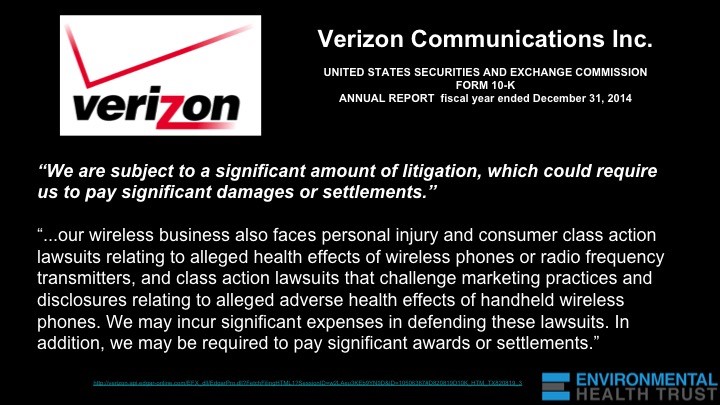
Since there is research that has already determined that exposure to all sources of wireless radiation is harmful, telecoms have been warning investors they may eventually be held liable for harm.  That’s probably why insurance companies won’t cover them anymore (see 12).
Few are signing up for 5G where it’s been installed and reviews have been bad.  Regardless, Verizon will not be deterred.  From Ars Technica:
Verizon yesterday announced its first 5G hotspot, namely the Inseego MiFi M1000 that Verizon is selling for $650. On top of the device cost, the monthly fees for 5G service will be higher than 4G even though Verizon’s 5G network barely exists.
Verizon said hotspot-only plans “start at $85 a month (plus taxes and fees).” Verizon describes the $85-per-month hotspot plan as “unlimited” when you go through the online checkout process. But the fine print states that customers get 50GB of high-speed 5G data, and 5G speeds are reduced to 3Mbps after that. The plan treats 5G and 4G data separately; it provides 15GB of high-speed 4G data and slows users down to 600kbps after that. Verizon allows 4K video streaming on 5G, while limiting video on the 4G network to 720p.
The carrier noted that the $85 monthly price is “only a $10 increase over 4G LTE service.” But the 5G device’s $650 price is three to four times higher than Verizon’s Jetpack hotspots, and the extra $10 a month provides access to a 5G network that exists only in five cities: Chicago; Denver; Minneapolis; Providence, Rhode Island; and St. Paul, Minnesota. Verizon says it will have 5G service in 30 cities by the end of this year.
Early reviews of Verizon’s 5G service found spotty coverage, so even in those five cities your 5G hotspot might frequently drop down to 4G. Verizon has said its 5G users “should expect typical download speeds of 450Mbps, with peak speeds of above 1.5Gbps and latency less than 30 milliseconds.”
Source

Wednesday, July 10, 2019

Amazon, Facebook internet outage: Verizon blamed for 'cascading catastrophic failure'

Cloudflare loses 15 percent of traffic due to an error at Verizon.

A Verizon error resulted in a "cascading catastrophic failure" that triggered widespread internet outages on Monday, affecting Cloudflare, Amazon, Facebook, and others. 
Website accelerator firm Cloudflare described the event as a "small heart attack" that left websites that rely on it, such as voice and text chat app Discord, unreachable from many parts of the internet for about two hours. And, according to Cloudflare, it was completely avoidable.  
The outage was due to a so-called route leak from a Verizon customer. In Cloudflare's case, this meant traffic that normally goes through Verizon and Level 3 Communications to reach Cloudflare instead went through a metal maker called Allegheny Technologies, Pennsylvania-based ISP DQE, and Cogent Communications onwards to Cloudflare. 
Allgheny and DQE's networks weren't up to the task of such a massive spike in traffic.
At the heart of yesterday's outage was the Border Gateway Protocol, which networks use to share information about what routes to take. Cloudflare says DQE incorrectly announced routes from its network to its customer, Allegheny. 
That routing information was passed on to Verizon, which "proceeded to tell the entire internet about these 'better' routes," explained Cloudflare engineer Tom Strickx.
"The leak should have stopped at Verizon. However, against numerous best practices outlined below, Verizon's lack of filtering turned this into a major incident that affected many internet services such as Amazon, Linode, and Cloudflare."  
The incident caused Cloudflare to lose about 15 percent of its traffic, according to Strickx. 
Andree Toonk, founder of Cisco-owned BGPmon, estimated that around 2,400 networks and 20,000 IP addresses were affected by the incident. 
Networking firm ThousandEyes said users in the US, Canada and UK experienced "severe packet loss" when trying to reach apps that depended on Cloudflare. It notes the route leak introduced more specific routes to the legitimate, less-specific ones that Cloudflare normally uses. 
The firm believes DQE was the original source of this outage due to its of BGP route-optimization software, which some engineers think should never be used due to the potential for them to cause yesterday's incident.  
"When a more-specific prefix is advertised to the internet, its route is preferred to the less specific prefix. Advertising a more-specific route for a third party's network is generally a no-no. In fact, intentional advertising of a more-specific prefix is a BGP hijacking method – how criminals attempt to siphon traffic away from legitimate service hosts for cyber-security exploits," explained Alex Henthorn-Iwane of ThousandEyes
Job Snijders, an engineer at NTT Communications, is a harsh critic of BGP optimizers, arguing the products need to be destroyed. 
"It is extremely irresponsible behavior to use software that generates fake BGP more-specifics for the purpose of traffic engineering. You simply cannot expect that those more-specifics will never escape into the global DFZ," he wrote in 2017.    
Snijders said yesterday's incident was a "cascading catastrophic failure both in process and technologies" and again called on networks to "turn off your 'BGP optimizers". 

ZDNet has contacted Verizon for a comment and will add its response if it receives one.

MORE ON THE CLOUD AND INTERNET OUTAGES


Source