Showing posts with label Privacy. Show all posts

Friday, August 09, 2019

Police Used Streetlamps To Spy On The Public More Than 140 Times

Gone are the days when cities used streetlamps to simply illuminate sidewalks and streets. Today’s streetlamps are being used to form an inter-connected web of surveillance devices.
A recent San Diego Union-Tribune article revealed how San Diego police officers have used streetlamp video surveillance in at least 140 cases and sometimes as frequently as 20 times a month.
Let that sink in for a moment; spying streetlamps are real and police have already requested video footage from more than 140 streetlamps.
Lt. Jeffery Jordon called spying streetlamps “game changing” and that is exactly how they should be viewed. Streetlamps that are designed to spy on the public, really is a game changer.
San Diego’s streetlamps are also equipped with ShotSpotter microphones that police claim are not being used to listen to public conversations.
Should we believe them?
Could police use ShotSpotter to listen to public conversations? Nearly a decade ago, the East Bay Times revealed how the Oakland Police used ShotSpotter to record public conversations.
It was only three years ago when the NJ Transit secretly used DriveCam’s LTYX camerasequipped with microphones to listen to public conversations.
So just what is law enforcement using these streetlamps for?
No one knows for sure; but a spokesperson for San Diego Mayor Kevin Faulconer said that a citywide policy to regulate the use of the microphones and cameras in streetlamps is “under development.”
The San Diego Union-Tribune claims that 100 police officers have direct access to streetlamp surveillance and said that nearly every one of the department’s 1,800 police officers can request access.
Just how concerned is the City Council that law enforcement is using streetlamps as surveillance devices?
Apparently not very much, as City Councilwoman Monica Montgomery admitted, by saying that she’s “open to exploring” oversight of the program.
In what dystopian nightmare are we living in, where listening and watching everything we do in public is “under development” or “open to oversight”?
Over the past few years, I have written numerous stories about smart streetlamp/streetlight surveillance.
Police are also using streetlamps equipped with things like Smart Nodes and secret facial recognition cameras to identify Bluetooth devices and people. More recently, I warned everyone that law enforcement is using GE’s CityIQ street lights and Intellistreets to identify people. (Click here to learn more about SKYEYE streetlamps.)
But this story is far more disturbing than those because as the San Diego Union-Tribune points out, politicians and police think nothing of using streetlamps to track people in real-time.
Streetlamp cameras allowed Detective Carlos Muñoz to track the attacker to a 7-11, where in-store cameras and a credit card purchase helped identify him.
How could police track an alleged attacker to a 7-11 unless they have real-time access to streetlamp videos?
Instead of sending off warning bells in City Hall, the city council plans on adding more spying streetlamps. And that should disturb everyone.
The city currently has rolled out about 3,200 streetlamp cameras and expects to have about 4,200 by next summer. General Electric and government officials have promoted the system as the “world’s largest smart city platform.”

Turning San Diego into the “world’s largest smart city platform” takes on a whole new meaning when you realize that the city has at least 40,000 streetlamps.
Can you imagine an entire city covered with 40,000 spying streetlamps? Can you imagine America being blanketed with more than 26 million spying streetlamps?
The prospect of having that many surveillance devices in one city is unnerving to say the least. But the prospect of having 26 million spying streetlamps operating across the country is terrifying.

Thursday, August 08, 2019

Pentagon launching ‘solar spy balloons’ over midwest, documents reveal

The United States military intends to test a number of surveillance balloons over six states. The future deployment of these high-altitude surveillance balloons was revealed in a Federal Communications Commission (FCC) document filing.
The balloons will not be piloted and will run on solar power. South Dakota will serve as the official launch spots for the balloons, with navigational radiuses of 250 miles. If you live in Wisconsin, Iowa, or even Missouri, you could be under experimental surveillance in the near future. The balloons will reach altitudes of over 60,000 feet, far beyond any human eye detectable ranges. The balloons will be used to “provide a persistent surveillance system to locate and deter narcotics trafficking and homeland security threats.”
The balloons will be equipped with cutting edge technologies, such as powerful radars that can track cars and trucks. Weather won’t discourage the success of the spy balloons missions, either, as they are equipped to endure most types of weather activities.
Of course, it is difficult to ignore the full potential of such high-altitude spy devices. In an article found in The Guardian, Arthur Holland Michel, the co-director of the Center for the Study of the Drone at Bard College in New York, said, “What this new technology proposes is to watch everything at once. Sometimes it’s referred to as ‘combat TiVo’ because when an event happens somewhere in the surveilled area, you can potentially rewind the tape to see exactly what occurred, and rewind even further to see who was involved and where they came from.”
The “everything at once” line should feel a bit unsettling, at least if you are concerned with big government spying. Such technology means common Americans have little place to hide from surveillance. It’s one thing to turn off Alexa or your iPhone, it is far another to hide in a bunker for the rest of your life. Of course, nothing in the description of these surveillance balloons implies that the technology will be used to spy on us. But that’s never disclosed in any technology. The spying events are usually “accidents” or the work of “rogue employees.” Both Google and Amazon claimed they never intended to spy on us using high-tech personal assistants such as Alexa, but they did.
The US Southern Command (Southcom) commissioned the release of these spy balloons. Southcom is responsible for defense agendas in Central and South America. Mainly, they aim to cut off large shipments of drugs.
The ACLU is firing back, however, saying that American citizens have a right to privacy.
“We do not think that American cities should be subject to wide-area surveillance in which every vehicle could be tracked wherever they go,” said Jay Stanley, a senior policy analyst at the American Civil Liberties Union.
“Even in tests, they’re still collecting a lot of data on Americans: who’s driving to the union house, the church, the mosque, the Alzheimer’s clinic,” he said. “We should not go down the road of allowing this to be used in the United States and it’s disturbing to hear that these tests are being carried out, by the military no less.”
Sierra Nevada, the technology company tasked with supplying Southcom with spy technology, previously distributed planes for use in Central and South American operations. But planes are expensive in terms of fuel usage and flight crews. Solar spy balloons save tremendous money and ultimately, would be less detectable making them more effective.
In other words, US government surveillance just got super cheap and easy. The balloons can stay in the air for months at a time. Some believe these balloons may be able to provide improved cell phone and Internet services. Could the 5G health risk activists have yet another concern?
surveillance balloons midwest
Google earth picture of South Dakota surveillance balloon launch station.

The bitter truth remains, we can’t trust our government with spying technology. Yes, it’s always been among us, but new technology is bolstering its potential to unfathomable heights (pun intended). Our devices consistently track us, now the government can literally follow us as we drive to the store from 60,000 feet away. It will all be accomplished under the guise of more “safety and security.”
As a group, we are trading our civil liberties for perceived improved security. If history tells us anything, we aren’t likely to win that battle.

Source

Monday, August 05, 2019

Arizona State University Embeds Sensors Deep into Student Life


The university wants to deploy IoT inside Sun Devil Stadium and on campus to monitor everything from crowd noise to classroom attendance.

OK, Sun Devils, let's see how loud you can scream. Because a number of sensors installed in Sun Devil Stadium are listening.
“We can identify now the loudest cheering section in the stadium,” said Gordon Wishon, chief information officer with Arizona State University, home to the Sun Devils football team. “The next step in that is — once we’re able to deploy our proximity-based sensing technology — we hope to be able to identify the individuals who are seated in those sections, and then ultimately push out some sort of a reward or discount off of a hotdog, or some sort of a reward.”
The project to measure stadium noise is but one small — and you might say whimsical — pilot project the Tempe, Ariz.-based campus is undertaking as it explores how systems built on a network of interconnected devices can improve not only the game day experience, but everyday life for students on campus.
Cameras installed around Sun Devil Stadium offer not only a safety component, say officials, but they can also offer data indicating how long a restroom or concession line has grown to, and how quickly it's moving.
Wishon also mentions the hundreds of sinks and toilets in the stadium. After a game it often takes several days for custodial staff to check and clean each restroom.
“And so it would sometimes be days before they discovered that sink had been left running,” he said. “So we demonstrated that we could actually instrument the faucet, and could now detect not only when water was left running, but if it had been left running for more than say two or three minutes, we could automatically shut it off.”
These projects are still in the “pilot-demonstration mode,” and have not been fully deployed.
“Our plans are now to begin scaling these groups of concepts and demonstrations more broadly, not just in the stadium facility, but ultimately, our objective here isn’t necessarily focused just on athletics,” said Wishon.
School officials are devising projects that use IoT devices to help the school intervene more directly with students who may be struggling.
One of the first projects will use location-based sensors combined with “virtual Bluetooth” technology to identify when students are attending certain classes.
“From the data that we collect on students and their activities, we know that students who fail to attend ASU 101 — an introductory course for freshman that sort of exposes them to university life and how to study and all those sorts of things — on a regular basis, have a higher probability of failing to persist to their sophomore year,” said Wishon. “So we have a strong interest in knowing which students are attending that class and which are not.”
Class sizes for the 101 course are large, making attendance taking prohibitively difficult.
“And so we needed to find some automated way of taking attendance in those courses,” said Wishon, explaining a pilot program where a cohort of students have agreed to have their connected devices — like a smartphone, laptop or tablet — detected when it enters the classroom, an indication that the student is present.
The university’s IT department is also devising projects to make monitoring the operation of the school’s roughly 2,200 buildings easier and more efficient.
“Some of the newer buildings have building information management systems. Most have nothing,” said Wishon. “Those that do have systems are from a variety of different vendors using a variety of different technologies to deliver building control systems.”
The challenge for the university is how to give officials a single view into each of these different systems in order to better understand energy conservation or water conservation opportunities as well as predicting maintenance needs.
“I think there are enormous cost-savings to be found in the operation of the institution,” Wishon added. “But ultimately, our principal objective is to enhance and improve the student experience and to help deliver greater chances of their success while they’re here at the university.” 

Wednesday, July 31, 2019

Satellites Have Already Started Watching Your Every Movement

There are “real-time” spies in the skies.  Satellites have already begun watching your every move as mass surveillance becomes a horror story reality, especially for liberty-loving humans.
While commercial satellite imagery is powerful enough, for instance, to see a car, it’s not detailed enough to identify the make and model, according to a report from the MIT Technology Review. But privacy and freedom advocates say that doesn’t matter in the least.  The problem, is we’re already being watched by them.
According to CNET, the dramatic advances in satellite imaging technology in the last 10 years have privacy advocates worried about the 24-hour surveillance. Satellite companies claim that they keep a person’s data separate from any identifying characteristics, but Peter Martinez of the Secure World Foundation is one of those still concerned about the constant monitoring of people.
“The risks arise not only from the satellite images themselves but the fusion of Earth observation data with other sources of data,” Martinez said in an email. The problem is the sheer volume of satellites overhead. Imaging company Planet Labs confirmed that it has 140 imaging satellites currently in orbit. The report says this is enough to pass over every place on Earth once a day. And those who own the satellites say not to worry.
“Even with Planet’s highest resolution imagery (1m resolution), it remains impossible to distinguish individual people, car number plates, or otherwise identifying information. Our imagery is ideal for monitoring large-scale change on a daily basis. This includes seeing daily change across buildings and roads, forests, in agriculture, bodies of water and more,” a spokesperson for Planet Labs said in an email.
Technology is growing at a rapid pace, and with it grows governments’ surveillance capabilities. Although many are aware that they are being monitored and tracked by those who claim to own us, some don’t know just how bad it has become. Everyone wants some form of privacy; however, the world we live in doesn’t offer much.
Many countries have surveillance systems, but the countries in the Five Eyes, Nine Eyes and 14 Eyes alliances work together to share data on a massive scale, according to a report by Cloud WardsInnocent people are spied on every day. The Five Eyes, Nine Eyes, and 14 Eyes groups are big players in the global surveillance game. Each country involved can carry out surveillance in particular regions and share it with others in the alliance.
The Five Eyes are the U.S., UK, Canada, Australia, and New Zealand. 
The Five Eyes alliance, also known as FVEY, was founded on Aug. 14, 1941, and can be traced back to the WWII period. During the second world war, the exchange of intelligence information between the UK and the U.S. was important, and the partnership continued afterward. 
The Nine Eyes alliance consists of the Five Eyes countries, plus Denmark, France, the Netherlands and Norway. Though there’s evidence that the Nine Eyes and 14 Eyes exist, little is known about what they can and can’t do. 
The 14 Eyes alliance is made up of the Nine Eyes countries, plus Germany, Belgium, Italy, Spain and Sweden. It’s an extension of the Five Eyes and Nine Eyes alliances, but its actual name is SIGINT Seniors Europe. –Cloud Wards
As technology continues to advance, we will lose all privacy and all freedom.  We are already well on our way to complete totalitarianism.

Also Read from Activist PostNext-Generation Global Satellites Could Completely Erase Privacy: MIT


This article was sourced from SHTFplan.com

Source

Tuesday, July 23, 2019

California Is Launching a Creepy “Cradle to Career” Data System to Track EVERYTHING About Children

Just in case we haven’t provided you with enough creepy dystopian news lately, the nation’s leader in Creepy Dystopia, California, has a brand new program. The “Cradle to Career Data System” will study and document everything about a child born in the state.
But don’t worry, it’s for your children’s own good.

What the heck is the “Cradle to Career Data System”?

Beginning at birth and stalking the child until he or she joins the workforce, California wants to keep on eye on all sorts of demographics and variables. They’ll do this by collecting information from “partner entities.” They’ll use this information, according to the Pasadena Star, to “provide appropriate interventions and supports to address disparities in opportunities and improve outcomes for all students.”
Who are these partner entities, you ask?
The “partner entities” include (but are not limited to) “state entities responsible for elementary and secondary education data, entities responsible for early learning data, segments of public higher education, private colleges and universities, state entities responsible for student financial aid, childcare providers, state labor and workforce development agencies, and state departments administering health and human services programs.” (source)
So, your kid’s teachers, principles, professors, babysitters, and the purveyors of any state services you happen to use will all cough up every detail of your child’s life.

Of course, California just wants to help.

This to me has hints of communist countries who pluck the brightest students from their home and educate them to work for the state. However, the admitted goal is data collection for the folks who make the rules.
Easily the creepiest thing to come out of California since “The Silence of the Lambs” was released into theaters, the “Cradle to Career Data System” aims to collect the ethnic, economic and educational records of every child in the state, track their grades and their progress into early adulthood, and make some form of the data available to policy makers, analysts and activists. (source)
This isn’t a maybe. It’s already passed as a trailer bill (so it didn’t go through the usual legislative process) and has been funded with a budget of $10 million.
The governor’s Office of Planning and Research is now authorized to enter into contracts with “planning facilitators” who will convene advisory groups “comprised of representatives of students, parents, labor, business and industry, equity and social justice organizations, researchers, privacy experts, early education experts, school districts, charter schools, and county offices of education.” (source)

Californians, your children’s privacy is at stake here. They are going to become part of a pile of data that will be used to enact future laws to assure “equity.” But at any time, these records will be there, the life of your child, every time they got sent to the principal’s office, who stands up to authority, who has special skills or talents, what the child’s parents are like. That person’s entire life in one handy file. And pardon me if I don’t believe the data collection will stop once they get a job. Data is king right now, so why give up on a good thing?
We’re already tracked everywhere we go once we’re old enough to have a cellphone or use the internet. But this starts right, as the title of the program points out, at the cradle.

Why are they doing this?

It’s all about “social justice.” Think quotas on steroids.
“Advocates have been demanding data for the people in the Golden State for years,” the Equity Alert explains, to “answer key questions about whether and how our state schools, colleges, universities, and workforce systems are closing racial equity gaps and serving Californians.”
It sounds as if the goal is to go beyond laws that ban discrimination and beyond affirmative action into a brave new world, one in which government bureaucrats tally the economic success of each racial and ethnic group and sub-group and award government funding in an effort to reach “equity.” (source)
Of course, we all know that things like this are actually not equitable, at least not to kids from groups who are not considered to be “at risk.”
There’s no word yet on whether or not parents will be able to opt out on behalf of their offspring.

This certainly normalizes being surveilled.

We’ve written a great deal on this site about the social credit system and the surveillance state in which we live. To me, a program like this seems like just another nail in the coffin of privacy. Don’t think that this will stop at the border of California.
These kids will, from their first moment of awareness, be concerned about their permanent record. That’s an awfully big burden to put on someone who still eats with his fingers and wears pull-ups to bed. These children will spend their entire lives under a microscope, for better or for worse, while some data entry person types their every action of note into their record.
If you want to have a social credit system like the one in China, I guess you’ve got to start early.

Friday, July 19, 2019

1,300 Popular Android Apps Access Data Without Proper Permissions

Study finds Android apps circumvented privacy opt-in rules and collected sensitive user information against user permission.
Over 1,300 popular Android apps defy user permissions and gather sensitive data with no consent, according to a study by a coalition of academics from the International Computer Science Institute.
The report examined popular mobile apps available through the U.S. version of the Google Play store, including apps published by Disney, Samsung and niche app-makers such as the popular photo app  Shutterfly. What researchers found was that many of the apps extracted sensitive user information – including current geolocation data, historical geolocation data and MAC addresses – without consent.
In one example of how the circumvention takes place, researchers cited Shutterfly. Despite a user not giving the app permission to access private user information, Shutterfly collects GPS data using exchangeable image file format (EXIF) metadata from user images, researchers said.
“We observed that the Shutterfy app sends precise geolocation data to its own server without holding a location permission,” researchers wrote. Shutterfly gleans precise phone location data from the EXIF data generated by each image, which embeds the GPS coordinates in each image taken. “The app actually processed the image file: it parsed the EXIF metadata—including location—into a JSON object with labeled latitude and longitude fields and transmitted it their servers.”
What Shutterstock has in common with the other apps singled out by researchers is that they all use the same software developer kit (SDK) made by the China-based Baidu, with help from an analytics firm called Salmonads.
Researchers explain the SDK is used by all 1,300 apps it analyzed, so each share the same underlying framework. Where things become problematic is when, for example, the framework is shared between two apps. One app restricts access to location data and the other is allowed to share it. Researchers say the SDK sometimes sidesteps restrictive permissions of one app and adopts the rules of the other app that shares user data.
In this way, an app doesn’t have to get Android device-level permission to access geolocation data. The app can take advantage of the shared SDK framework and collect geolocation data from another app that does have location permissions, instead.
“Our work shows a number of side and covert channels that are being used by apps to circumvent the Android permissions system,” the researchers wrote. “The number of potential users impacted by these findings is in the hundreds of millions.”
Researchers said this practice defies users’ reasonable expectations of privacy and that the behaviors may constitute violations of various laws.
That said, researchers do not believe Shutterfly had any malicious intent; an assertion shared by the company in a statement.
“Like many photo services, Shutterfly uses this data to enhance the user experience with features such as categorization and personalized product suggestions, all in accordance with Shutterfly’s privacy policy as well as the Android developer agreement,” the company stated. A Shutterfly spokesperson added in a statement that its app only collects personal information with a user’s explicit permission.
However, researchers note the side effect of this type of inadvertent data collection might not always be innocent.
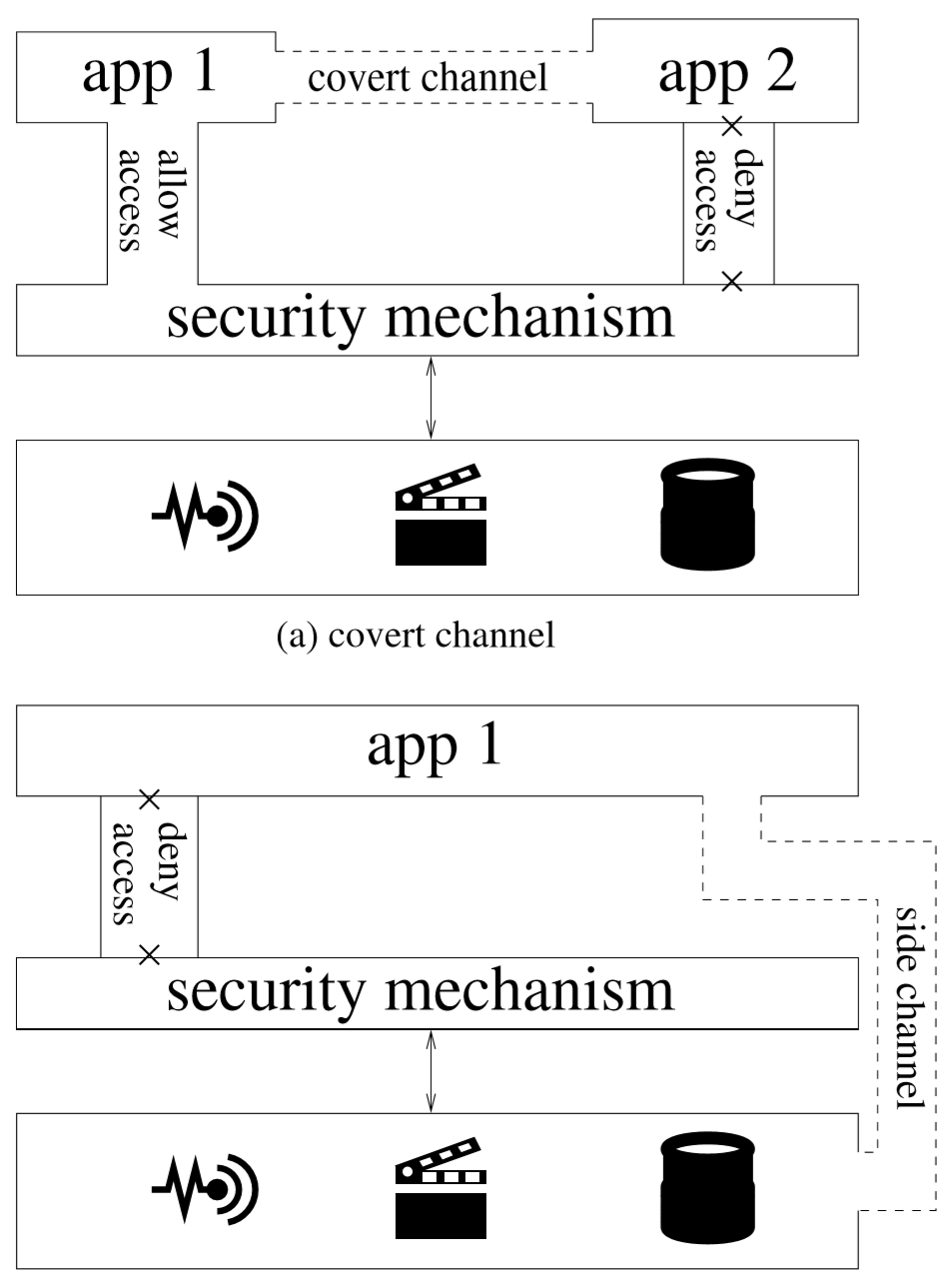
Researchers describe two ways data can be share without consent. One is via a “side channel” where data is inadvertently do to a flaw in design that accidentally leaks data. The second is “covert channels”.
“A covert channel is a more deliberate and intentional effort between two cooperating entities so that one with access to some data provides it to the other entity without access to the data in violation of the security mechanism,” researchers wrote.
The study was released Monday (PDF) by the Federal Trade Commission as a follow-on to its PrivacyCon 2019 confab last month. The study examined 88,113 popular apps from the U.S. Google Play store, and found that 1,300 of the apps and third-party libraries that employ side channels or “covert channels” to circumvent Android’s security measures. In all cases, apps could access the location data and MAC address of users’ devices.
Researchers contacted Google and the FTC in September after its’ final analysis. Google said its Android Q, expected to released later this year, will address this type of permission abuse.

Source