Thursday, July 25, 2013

Israeli government looks into how WiFi affects children


Israeli government looks into how WiFi affects children


JULY 25, 2013 · UPDATED 1:23 PM 


By Julienne Battalia

Special to the Weekly

In August 2012 a petition to the Israeli Supreme Court to ban WiFi in schools prompted a court order for the Israeli Government to find out how many children in the country were suffering from EHS.

Electro-hypersensitivity in children is a growing concern within Israel, and many other  countries,  including Sweden, the  UK , Canada and  Australia. The brief supporting  the petition revealed how the  Israeli government has been "reckless in dealing with wireless technology," so much so that it "did not  even know how to measure radiation from WiFi,  considering the special modulation of WiFi."  The brief also submitted  proof that EHS is caused by radio-frequency radiation, (EHS is  recognized by the Israeli Government and by the WHO as an illness caused by exposure to EMF/RF). The brief went on to explain  how  the  existing standard of measuring health effects based on the "thermal" safety standard only,  is not strong enough  given the evidence of thousands of papers that now show adverse health effects from “non-thermal" exposures.

The brief goes on to claim that “even the corrupt WHO declared RF a 2B carcinogen “ , and accuses the Telecom Industry of “intentionally:” misleading the public.

At the July 18, 2013 Supreme Court hearing,  the government was asked what it intends to do if a child with EHS was attending school with WiFi, the attorney for the government answered " remove the WiFi from the school."

http://www.islandsweekly.com/news/216983451.html

Wednesday, July 24, 2013

Fukushima: Radioactive cesium levels jump 9,000 percent in just three days, nobody knows why

cesium

Fukushima: Radioactive cesium levels jump 9,000 percent in just three days, nobody knows why

Wednesday, July 24, 2013 by: Jonathan Benson, staff writer
Tags: Fukushimaradioactive cesiumradiation leak


(NaturalNews) Some of the highest levels of ionizing radiation yet detected since the disaster first occurred were recently recorded at the Fukushima Daiichi nuclear power facility in Japan, according to shocking new reports. The Tokyo Electric Power Company (TEPCO), which runs the crippled nuclear plant, says levels of radioactive cesium in a water well were 9,000 percent higher on July 8, 2013, than they were three days earlier, and nobody knows why this is the case.

The Asahi Shimbun reports that TEPCO observed the spike after testing water in a well on the seaward side of Fukushima's No. 2 reactor. According to readings taken, radioactive cesium levels registered at an astounding 27,000 becquerels per liter (Bq/l), which is the highest ever since March 11, 2011, when the tsunami and earthquake first struck the plant. At this point, the cause of the spike is still unknown.

"It is unclear whether the radioactive water is leaking into the sea," said a TEPCO official, following the discovery. "After gathering needed data, we will conduct analyses."

As you may recall, radioactive water from the No. 2 well was found to have been leaking about a month after the disaster struck in April 2011. At that time, about 9,000 Bq/l of cesium-134 and 18,000 Bq/l of cesium-137 were detected in water samples. These amounts are 150 and 200 times higher, respectively, than the maximum level legally permitted.

At the same time, levels of other harmful forms of radiation, including strontium, have remained oddly consistent, which has many officials scratching their heads. According to the most recent data, radioactive strontium levels remained mostly steady around 890,000 Bq/l both before and after the cesium spike.

"We do not know why only cesium levels have risen," added the TEPCO official.


Radioactive tritium levels are also spiking dramatically, say officials

Besides cesium, radioactive tritium has also been detected in significantly higher amounts near the No. 2 well. According to The Wall Street Journal (WSJ), tritium levels in groundwater near the reactor have jumped 17-fold since December, and are continuing to rise with each passing day. Since May, tritium levels have increased a staggering 20 percent.

"[T]he tritium level that TEPCO measured on July 5 in one of its coastal monitoring wells near reactor No. 2 is ten times above Japan's safety standard of 60,000 becquerels per liter, and rising," writes Phred Dvorak for the WSJ. "That's the highest such level the company has recorded since the incident."

What this all suggests, of course, is that the Fukushima disaster is far from over, and may only be in the early stages of unleashing massive environmental destruction. Despite the fact that more than two years have passed since the disaster's onset, the situation appears to be intensifying with no end in sight, which could lead to much more serious problems in the future.

Meanwhile, as much as 93 billion becquerels of radioactive substances are believed to still be pouring into the Pacific Ocean every single day as a result of the Fukushima disaster. Reports from back in March indicate that, since the disaster, a total of 16.1 trillion becquerels of just cesium-137 are believed to have leaked into seawater.

"Once again, TEPCO release the bad news in a drip, drip, drip mode," wrote one commenter on an ENENews.com report on the issue. "These destroyed nuclear reactors are going to pop and sputter for thousands of years to come. Changes in the configuration of residual melted fuel remaining in and around the plants will create ongoing criticalities, with changing cooling water and groundwater flows."

Sources for this article include:

http://enenews.com

http://ajw.asahi.com/article/0311disaster/fukushima/AJ201307090059

http://blogs.wsj.com

http://www.foxnews.com

http://science.naturalnews.com

Learn more: http://www.naturalnews.com/041327_Fukushima_radioactive_cesium_radiation_leak.html#ixzz2a28BTpJd

UK gov’s smart meter dream unplugged: A ‘colossal waste of cash’

UK gov’s smart meter dream unplugged: A ‘colossal waste of cash’ 

Excerpt of analysis by TheRegister.co.uk On 23 June, the village of Alfriston in the South Downs hosted Get Wired, an event celebrating old-fashioned wired analogue power meters – or, more accurately, opposing their replacement by new wireless “smart” meters. Organiser Stop Smart Meters UK is worried about radiation, privacy, safety, higher bills and people losing control over their homes. The group’s fears are not shared by most politicians, and certainly not by the power industry. It plans to put 53 million smart meters into homes in England, Wales and Scotland by 2020 (Northern Ireland has its own policy). The rollout will go far beyond a European directive that asks conditionally for 80 per cent coverage by this date. But some experts are raising doubts about the plans – and not just the health risks. The UK’s smart meter scheme was introduced by Labour leader Ed Miliband, when he was energy and climate change secretary. The last government had a habit of chucking big technology schemes at problems; the difference is that this one made it off the drawing board – unlike a 2006 brainwave from Ed’s brother David for carbon rationing credit cards – and survived the current government’s cull of such schemes, which took out the likes of identity cards. Your home, their network The Coalition government has delayed and tweaked Miliband’s scheme, but still wants energy suppliers to replace each ‘dumb’ gas and electricity meter with a ‘smart’ one. One smart meter in each home will send power usage information to a new Data Communications Company, which will go live in autumn 2015. That usage data will be transmitted from homes largely using Blighty’s mobile networks – although wired communications will be used in particular locations including blocks of flats. The wide-area networking technology and the meters themselves are still being procured, with each energy supplier buying its own meters, so many technical details have not yet been decided. One detail that has been confirmed is for a “home area network” (HAN) in each house, using ZigBee networks at 2.4GHz and 868MHz. The HAN will allow the main meter both to act as a relay for a second meter’s usage monitoring, and to serve information to an in-home display (IHD) so Britons can monitor their power consumption from their sofas. The suppliers are enthusiastic about the scheme’s potential to save both the public, and them, money. Estimated bills and visits from meter readers will be a thing of the past, says Lawrence Slade, chief operating officer of trade body Energy UK, and the visibility of consumption will stop people wasting power: “One of the reasons we’re doing this is to help consumers understand their bills better,” he says. While he confirms that a smart meter would be used in the process of cutting people off from their supply, Slade adds that their introduction should lead to fewer disconnections, as the improved data will make it possible to spot and manage payment problems earlier. But what if someone other than power companies, such as foreign governments, worked out how to hack into the meters and cut people off? Slade says this “should not be able to happen”, while conceding “I don’t think you can say, hand on heart, that nothing will ever happen”. Read the full story at  UK gov’s smart meter dream unplugged: A ‘colossal waste of cash’ • The Register. - 

See more at: http://stopsmartmeters.org.uk/uk-govs-smart-meter-dream-unplugged-a-colossal-waste-of-cash/#comment-59986

Here's What Wi-Fi Would Look Like If We Could See It


Here's What Wi-Fi Would Look Like If We Could See It


Images via Nickolay Lamm. Captions by M. Browning Vogel, Ph.D.
Wi-fi. It's all around us, quietly and invisibly powering our access to the world's information. But few of us have a sense of what wi-fi actually is, let alone what it would look like if we could see it.
Artist Nickolay Lamm, a blogger for MyDeals.com, decided to shed some light on the subject. He created visualizations that imagine the size, shape, and color of wi-fi signals were they visible to the human eye. 
"I feel that by showing what wi-fi would look like if we could see it, we'd appreciate the technology that we use everyday," Lamm told me in an email. "A lot of us use technology without appreciating the complexity behind making it work."  
To estimate what this would look like, Lamm worked with M. Browning Vogel, Ph.D., an astrobiologist and former employee at NASA Ames. Dr. Vogel described the science behind wireless technology, and Lamm used the information to create the visualizations.
Dr. Vogel provided captions for each illustration explaining the science of wi-fi. The caption for the illustration at the top of the article describes the size of a wi-fi energy field, and how a signal is transmitted. It says:
Wifi is an energy field that is transmitted as waves. The waves have a certain height, distance between them and travel at a certain speed. The distance between wifi waves is shorter than that of radio waves and longer than that of microwaves, giving wifi a unique transmission band that can't be interrupted by other signals. Wifi waves are about 3 to 5 inches from crest to crest. The crests of waves is translated to a 1 by a computer, and the the troughs equal a 0. Chains of 1s and 0s that can be translated into the letters, numbers and codes that make up websites, email and other internet content. Typical wifi waves decrease in amplitude as they travel further from the source which is why the waves are larger to the right and smaller to the left, assuming the source is somewhere near the right of the image. This image shows an idealized wifi data transmitted over a band that is divided into different sub-channels, which are shown in red, yellow, green and other colors. 
The wi-fi visualizations are set in Washington, DC. Lamm used data from a map on DC.gov to approximate the size and shapes of wi-fi networks over the National Mall.
Below are Lamm's images, with Dr. Vogel's captions underneath.
Wifi waves travel through space as rapid, data encoded pulses or waves. A freeze frame of these pulses would show that the pulses are about 6 inches apart (as shown by the lightly colored bands traveling through space in this image). Wifi routers are basically antenna that can send data over multiple frequencies all at the same time. These multiple frequencies are shown as blue, green, yellow, and red colors that pervade the space around the mall. The data from these multiple frequencies swirls around in space as shown here, but can be translated using a common tag system understood by wireless devices.
Wifi occupies the radio frequency band of the electromagnetic spectrum between actual radio waves and microwaves (used to listen to the game, and cook your dinner, respectively). This frequency band means that wifi boxes and computers can send and receive data as electromagnetic wave that have a 3 to 5 inch distance distance between each pulse of the wave. The wifi pulses are shown here as multicolored spheres radiating out from the source, near the right of the image. Wifi transmitters are basically an antenna equipped with a transmission protocol that splits the frequency band into several segments, referred to as channels. Data can be transmitted over each channel or in order to send and receive greater quantities of data at faster rates. Although color represents its own unique, visible segment of the electromagnetic spectrum, we use red, orange, yellow and other colors to show the invisible wifi channels that make up the overall wifi signal. Wifi fields are usually spherical (like the one here) or ellipsoidal and extend about 20-30 meters, assuming a typical off the shelf wifi box.
Wifi routers or antenna can be attached to trees, buildings, lamp posts and other structures. A typical outdoor router can project its signal 300 feet or more from its location. Objects such as trees can obstruct the signal such that it has to be augmented by multiple wifi routers placed in different positions. Multiple routers can create a field that extends all the way across Washington DC's National Mall as shown here.
Wifi routers affixed to buildings, lamp posts and other object create a circular data field around them. These antenna have an omnidirectional signal that extends equally in all directions, shown as the circular bands. Wifi broadcasts at a frequency between radio and microwaves, meaning that the waves or pulses are about six inches apart, as shown by the colored, circular bands. 
Lamm, a 24-year-old student from Pittsburgh, is focused on using illustrations to bring attention to topics that are otherwise overlooked, he writes on his website. His projects combine art and research, and he often collaborates with other artists, including his mother.
In the last couple months, his projects have visualized what Barbie would look like as a normally proportioned woman, what the average human might look like in 100,000 years, and what New York City would look like on other planets.
As far as wi-fi goes, he's not the first artist whose curiosity was piqued by the invisible force.
Early this year, Austrian artist and architect Peter Jellitsch measured radio waves to record the wifi activity in a New York apartment over 45 days. (You know, the maddening pattern of how it cuts out and then comes back and is really strong and then is barely working again.) He used the data to sculpt an object that's a physical depiction of a wifi signal.
A couple years before that, a team from the from the Oslo School of Architecture and Design visualized wifi signals in a Norwegian town by "light painting" them. They created a long rod with 80 lights that lit up according to the signal strength of the wifi network, and filmed the result.
Lamm's depiction might be the most comprehensive, though. It's the first to incorporate shape, size, and color into the image, he told me. "I was surprised, wi-fi isn't as simple as I thought it would be."
 

A Rising Addiction Among Youths: Smartphones


A Rising Addiction Among Youths: Smartphones

From Joel Moskowitz:
A Rising Addiction Among Youths: Smartphones
IN-SOO NAM, Wall Street Journal, Jul 23, 2013
SEOUL—Lee Yun-soo has some regrets that she replaced her faded old clamshell phone with a smartphone six months ago.
The smartphone-penetration rate among children and teenagers in South Korea tripled last year, and the government says roughly one in five students is addicted to the devices. The WSJ’s Alastair Gale talks with Jake Lee about the problem.
The South Korean high-school student enjoys tweeting funny photos, messaging friends and playing online games. But she said her smartphone is increasingly disrupting her life at school and home.
“I hate doing it but I can’t help it,” she said as she fiddled with the palm-size gadget.
Ms. Lee is among the roughly 1 in 5 students in South Korea who the government said is addicted to smartphone use. This addiction is defined as spending more than seven hours a day using the phone and experiencing symptoms such as anxiety, insomnia and depression when cut off from the device.
Mobile Mania
South Koreans are among the world’s biggest tech users. That can pose problems:
South Korea has reached a mobile-phone penetration rate of more than 100%—meaning some people carry more than one handset—and smartphones represent nearly two-thirds of those devices, according to data from the government.
For comparison, the smartphone-penetration rate in the U.S. was 50.4% as of June, according to the International Telecommunication Union.
The smartphone-penetration rate in South Korean children ages 6 to 19 tripled to 65% last year from a year earlier, according to the Korea Communications Commission. The smartphone addiction rate among teenagers was 18%, double the addiction rate of 9.1% for adults, according to another government survey.
According to the Pew Research Center, 37% of teens in the U.S. had smartphones in 2012.
Earlier this month, the South Korean government said it plans to provide nationwide counseling programs for youngsters by the end of the year and train teachers on how to deal with students with addiction. Taxpayer-funded counseling treatment here already exists for adult addicts.
South Korea, home to the world’s biggest smartphone maker, Samsung Electronics prides itself on being the global leader in high-speed Internet and advanced mobile technology. Koreans are some of the first adopters of new digital devices.
With a mobile-phone penetration rate of more than 100%—meaning some individuals carry more than one handset—and smartphones nearly two-thirds of those devices, the government is setting measures to deal with the problems such heavy exposure has spawned. For comparison, the smartphone penetration rate in the U.S. was 50% as of June, according to the International Telecommunication Union.
Korea has had problems with online-game addiction among teenagers for years thanks to widespread availability of high-speed Internet services. Now that smartphone penetration among teens and children is rising at a faster pace than other groups, the age at which people find it hard to wean themselves from a smartphone is getting lower.
In many South Korean schools, teachers routinely collect mobile devices from their students during school hours. The government said it plans to train teachers how to deal with students who suffer smartphone addiction.
The smartphone penetration rate in children ages 6 to 19 tripled to 65% last year from a year earlier, according to the Korea Communications Commission. Meanwhile, the smartphone addiction rate among teens was 18%, double the addiction rate of 9.1% for adults, according to another government survey. According to the Pew Research Center, 37% of teens in the U.S. had smartphones in 2012.
“The situation is already serious,” said Hwang Tae-hee, an official at South Korea’s Ministry of Gender Equality & Family.
The problem is surfacing in other tech-savvy places such as Japan and Taiwan. A survey in Japan found that smartphone use among high school girls tripled last year.
As well as distracting students from their studies, experts say it is damaging interpersonal skills.
“Students today are very bad at reading facial expressions,” said Setsuko Tamura, a professor of applied psychology at Tokyo Seitoku University. “When you spend more time texting people instead of talking to them, you don’t learn how to read nonverbal language.”
In Taiwan, the phenomenon of constantly checking email or social media has led to the label “heads-down tribes.” A survey by the Taiwan Network Information Center showed that the number of people accessing the Internet via laptops, tablets or smartphones in the past six months has doubled to a record 5.35 million from a year earlier.
It is standard practice in Korean schools for teachers to collect mobile devices from their students during school hours—with patchy success. “Some of them hide their phones and use them during the break or even in class,” said Lee Kyoung-shin, a high-school teacher in Incheon, west of Seoul.
Smartphones are often the most important possession for a young person, said Ms. Tamura of Tokyo Seitoku University. “It represents their connection to their friends. Not participating could mean exclusion from a circle of friends, so we always find that children are terribly anxious to respond to messages,” she said.
Smartphone one-upmanship has led to incidents of bullying in Korean schools, where a 12-stage smartphone ranking sets the latest models as “kings” and earlier models as “slaves.” Theft is common, said Kim Hoi-kyung, a school supervisor at the Seoul Metropolitan Office of Education. The office in June decided to provide up to 20 million won ($17,830) per school this year to help teachers pay for losses of smartphones in their possession.
Lee Yun-soo, the 18-year-old high-school student, has found a way to avoid the distraction of her smartphone during exam periods: She removes the SIM card, which stores phone numbers, from her Android phone and inserts it into an older, Internet-disabled phone.
“I keep asking myself: ‘Why did I buy a smartphone?’ Sometimes I stay up all night using Facebook and tweeting. After switching to a smartphone, I quickly became addicted.” she said.
—Mayumi Negishi in Tokyo and Eva Dou in Taipei contributed to this article.
Write to In-Soo Nam at In-Soo.Nam@wsj.com
A version of this article appeared July 23, 2013, on page D2 in the U.S. edition of The Wall Street Journal, with the headline: Rising Addiction Among Teens: Smartphones.
http://www.emfacts.com/2013/07/a-rising-addiction-among-youths-smartphones/

Santa Cruz 4G Verizon “Monopine” Dies Well Deserved Death


Santa Cruz 4G Verizon “Monopine” Dies Well Deserved Death

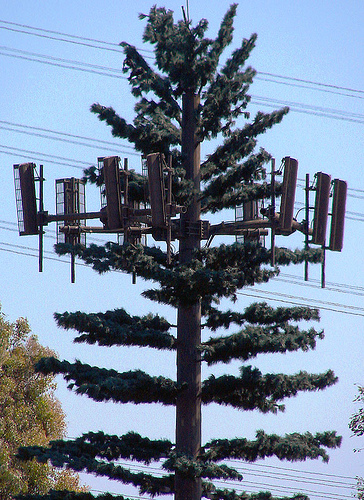
849389388_a802a2b7aaA plan by Verizon Corp. to install a 4G cell tower less than 700 feet from an elementary school in downtown Boulder Creek has been withdrawn, thanks to the dozens of people who showed up at the county building in Santa Cruz, CA on Friday morning and dozens more who passed out fliers and spoke to the landowner to express their opposition.
Moral of the story? When a community unites, we can stop inappropriate wireless installations that devastate neighborhoods, forced by corporate thugs.
The Sentinel reports that:
“Federal law restricts local governments from making decisions about cell towers on the basis of health risks, since there is no scientific consensus on radio frequency emissions posing a threat.”
This is not accurate reporting.  What would be more accurate would be the following:
“Federal law restricts local governments from making decisions about cell towers on private land* on the basis of health risks, since the federal government is owned by the corporations who write federal legislation, and who realized that if locals were allowed to make decisions on wireless equipment based on the increasing body of peer-reviewed evidence of health threats posed by cell towers, this would interfere with their profiteering from a national wireless network.”
And since when is Facebook the route through which community democratic decisions are made?
“Several Boulder Creek residents have said they want better service in the valley. The Sentinel asked people on Facebook about the possible tower, and the majority of those who commented said they were in favor of the project.”
One thing is for sure.  In some areas at least (jn this case the backyard of Silicon Valley), the cat is out of the bag about wireless health harm and there is no going back.
* Local governments can choose to reject cell towers for whatever reason they want including health and the environment if the land in question is owned by that local government.
http://stopsmartmeters.org/2013/07/23/santa-cruz-4g-verizon-monopine-dies-well-deserved-death/

Customers says OG&E Smart Meters making them sick


Customers says OG&E Smart Meters making them sick

Posted on: 9:24 pm, July 23, 2013, by  and updated on: 09:33pm, July 23, 2013

OKLAHOMA CITY — NewsChannel 4 is learning more about nationwide fears involving smart meters and allegations that they can negatively affect your health. According to a group that tracks complaints against smart meters, so far, three states instituted moratoriums on them.
In other states, class action lawsuits were filed and at one time, in California, 47 municipal jurisdictions had demanded a halt to installations of the meters.
The following states have either banned smart meters, have pending legislation against them, or have offered customers the opportunity to opt out. Some for health concerns, others over privacy issues: California, Connecticut, Florida, Georgia, Hawaii, Louisiana, Maine, Maryland, Michigan, Nevada, Oregon, Pennsylvania, Texas and Vermont.
Washing dishes at home is rare for Monique Smith since she doesn’t actually live here anymore.
“Immediately I started getting a headache; a really bad headache,” Smith says.
She claims the recently installed smart meter forced her out of her home. Within hours of it being installed she says she felt the effects.
“That night I got a really bad headache and as the next day went on I got really dizzy and by the third day I started having nose bleeds,” Monique Smith explains.
Not long after, her doctors diagnosed her with Electromagnetic Hypersensitivity Disorder also known as EHS.
Headaches, nose bleeds, muscle cramps, cognitive dysfunction, fatigue, skin irritation and irregular sleep patterns are just some of the symptoms sufferers describe when they are exposed to electromagnetic fields.
Where did this information come from? These are symptoms described by people who believe they are suffering from EHS. They describe a wide variety of symptoms, but these seem to be the ones that are mentioned consistently from state to state.
Also the doctor we interviewed in Dallas, who has been studying this disorder for decades, says these are the symptoms his patients describe most frequently. Some of these symptoms are also listed in both letters that were written by Monique Smith`s doctors here in Oklahoma.
Smith started living in a camper a quarter mile down the road to escape what she calls torture.
Smith says, “Prior to the smart meters we had a normal life.”
Her husband, Billy, begged OG&E to remove the smart meter but the company refuses to do so.
“OG&E won’t even listen to me and I’ve called them two or three dozen times. They won’t even call me back now. They think that we’re crazy when in fact the truth is right here; it’s evident. I see it every day in my wife,” Billy Smith says.
Joe Esposito knows exactly what they’re talking about. He also says his smart meter is making him sick.
Esposito founded the website stop smart meters in Oklahoma after his experience.
Esposito says, “I was having pain down my leg for six months, my front teeth, bottom teeth and the roof of my mouth felt like somebody poured Alka-Seltzer at night.”
He was able to find a temporary fix to minimize the amount of electromagnetic frequency from the outside meter.
“I put out a sheet of lead around that meter and nailed it to my house,” Esposito says.
He says his pain was gone the next day. Meanwhile, Monique’s pain is getting worse. One of her doctors of fifteen years even wrote a letter to OG&E.
Saying it’s “medically necessary that the smart meter be removed from the home.”
Another doctor states, “It may be beneficial to have the smart meter removed”
They said no, they would never do that. It would affect the system or cost individuals too much money to do that.
Billy Smith had a cage constructed for when they have to sleep in the house; like in cases of severe weather.
The cage was named after scientist Micheal Faraday who made advances in the study of electromagnetic fields. Billy Smith says it’s their safe haven.

NewsChannel 4 wanted to talk to the doctors who are treating Monique Smith, both of whom had written letters verifying their treatment for her illness, and saying that her smart meter should be removed from her home.
At first both agreed to an interview, but within weeks both cancelled.
All of the doctors working with Monique declined our invitation for an interview so we traveled here to Dallas to meet with Dr. William Rea one of the foremost experts in the country for electromagnetic hypersensitivity disorder.”
“I think it’s becoming the disaster of the 21st century,” Dr. Rea says.
Dr. Rea is an OU graduate and a cardiovascular surgeon who holds other specialties as well; he’s treated patients with electromagnetic hypersensitivity disorder for forty years.
“If you have problem with things like the smart meter, you may be getting the wrong impulses, the wrong electrical impulses that come into the body and cause disruption of that synchronized movement that you are supposed to have from electrical impulse,” Dr. Rea explains.
He says our cells are protected by membranes which are electromagnetic. They allow crucial materials like calcium, sodium and potassium to pass through.
He believes the frequency from various devices, like smart meters, interrupts this process and causes health problems.
Dr. William Rae says, “My problem is that they should take into account that people are electrical phenomena and that they do run on it and that you can screw up the physiology if you access it improperly if the patient is sensitive.”
Dr. Rea has gone to great lengths to keep harmful frequencies out of his practice. The aluminum blinds, porcelain floors, glass shields over walls, keep his patients protected.
“And what does this do in this room?” our reporter asked.
“This screens the electromagnetic so we don’t want anything coming from down below,” Dr. Rae explains.
“And that way you can properly assess if they are really hypersensitive or not?” we asked.
“That’s right,” Dr. Rae says.
After our trip to Dallas we sat down with a spokesman for OG&E.
Our reporter asked him, “What is your response to the concern over smart meters potentially affecting people’s health?”
“There are a number of measures in place to ensure that these devices are meeting all federal standards,” the OG&E spokesman, Alford, says.
“Why is it not possible for the Smith family in particular or any family, who says, ‘you know what I don’t want this?’” we asked.
“It’s much like TV. I can’t watch TV anymore with rabbit ears. I have to have digital equipment or I have to be subscriber to cable. There’s cost associated in operating in two different worlds,” Alford says.
Alford says everyone on the grid living in one area has to use the same technology and out of 800,000 customers, OG&E has only received two complaints.
“It’s possible, but it’s very; very, improbable,” Alford says.
John Fagan, Professor of Engineering at the University of Oklahoma examined six smart meters to weigh in on the topic. He’s not sure how the meters could make a person sick.
Professor Fagan says, “I have not been able to find the cause. I have found much greater radiation from cordless phones, cell phones, cell phone towers, TV stations.”
It’s not much consolation for Monique Smith, who is now, not only worried for her health, but also for her grandchildren who share the same symptoms when they come to visit.
“It’s sad when you see little kids. It’s just sad when you see them hurting because; what can you do? You can’t do anything you have to have the smart meter on your house,” Smith says.
We spoke with officials from the CDC about “smart meter sickness.” The agency has not released any official stance on the controversy, but they tell us they expect more studies in the future.
http://kfor.com/2013/07/23/customers-says-oge-smart-meters-making-them-sick/